This is the fourth installment in our 'Reading the Four Pillars' series. After learning the overall process of interpreting the Four Pillars and understanding environmental factors through the monthly branch and seasons in previous parts, we now turn to analyzing the distribution of the Five Elements within the Myeongsig (natal chart) to diagnose its overall energetic flow. In this installment, you will learn how the Five Elements are composed in a Myeongsig and how to interpret their balance.
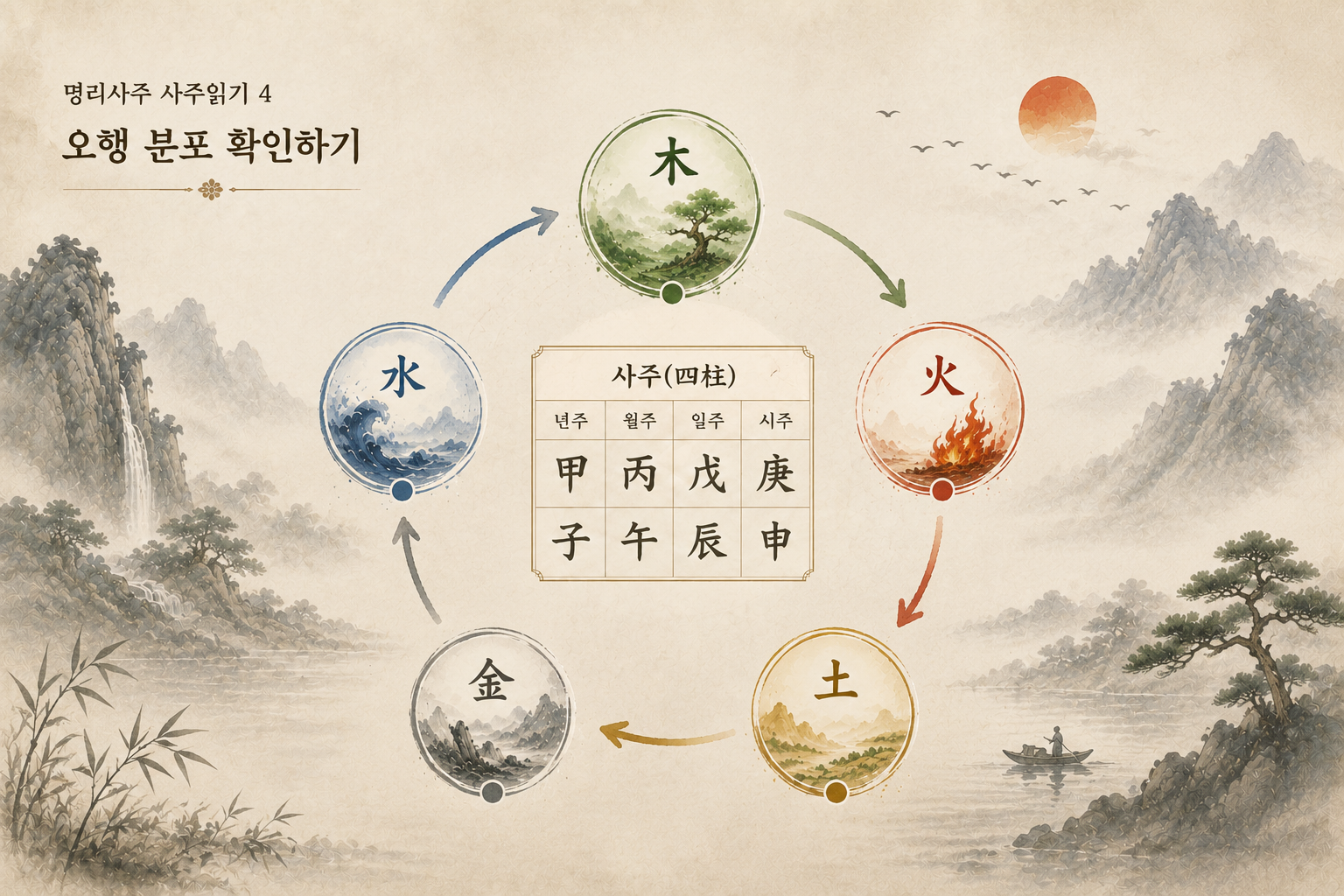
Within the overall process of interpreting the Four Pillars, examining the distribution of the Five Elements is crucial for understanding the fundamental energetic composition of a Myeongsig (natal chart). The primary goal at this stage is to identify which of the Five Elements each of the eight characters forming the Eight Characters (Saju Palja) represents, and to determine their proportions. This helps in understanding the overall energetic flow and specific characteristics of the Four Pillars.
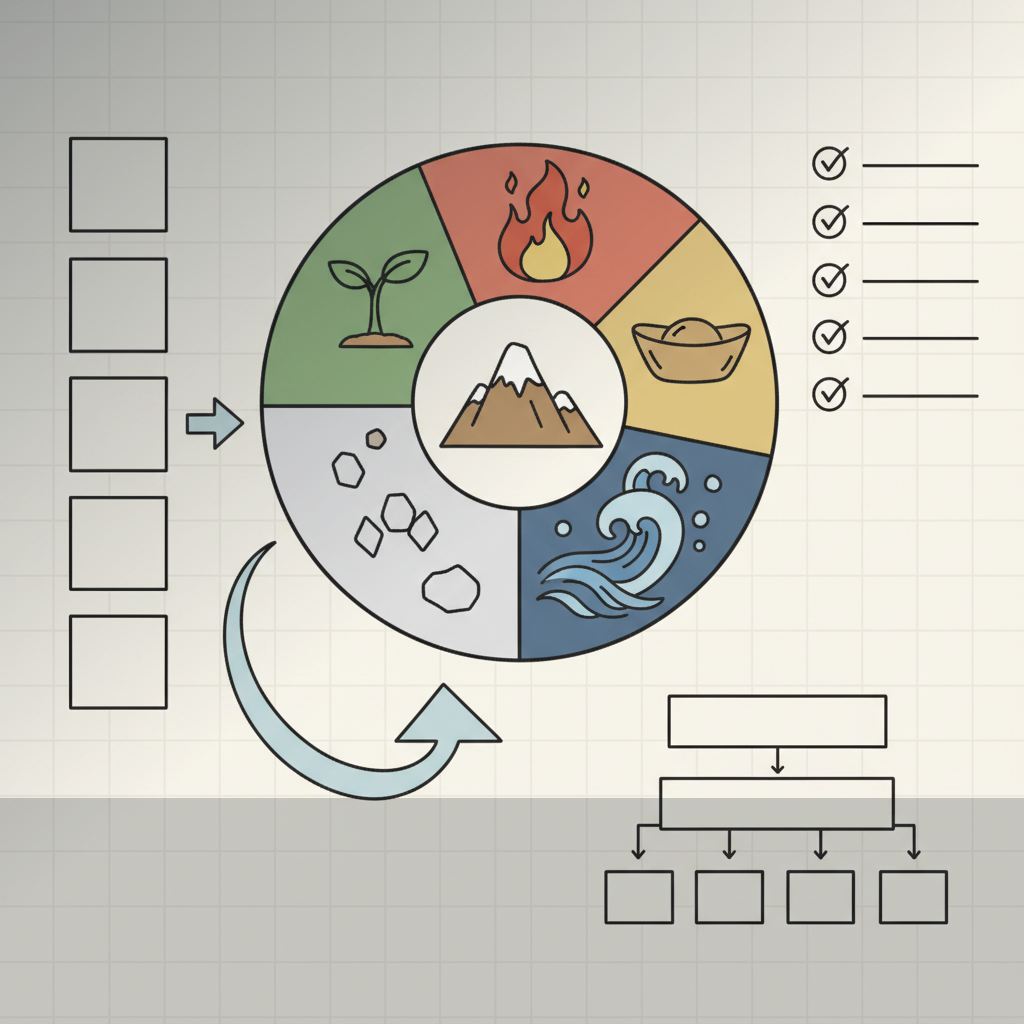
The Five Elements (Wood, Fire, Earth, Metal, Water) are the most fundamental components of the Four Pillars and the energetic source of all fortunes and misfortunes. The basic tendencies and energy of a person’s natal chart are determined by the abundance or scarcity of each element. Grasping this distribution first is crucial for accurately understanding the strength of the Day Master (Ilgan) and the influences of the Ten Gods (Sipsin) later on. An excess or deficiency of a particular element forms a significant characteristic of the Four Pillars itself, offering vital direction for further interpretation.
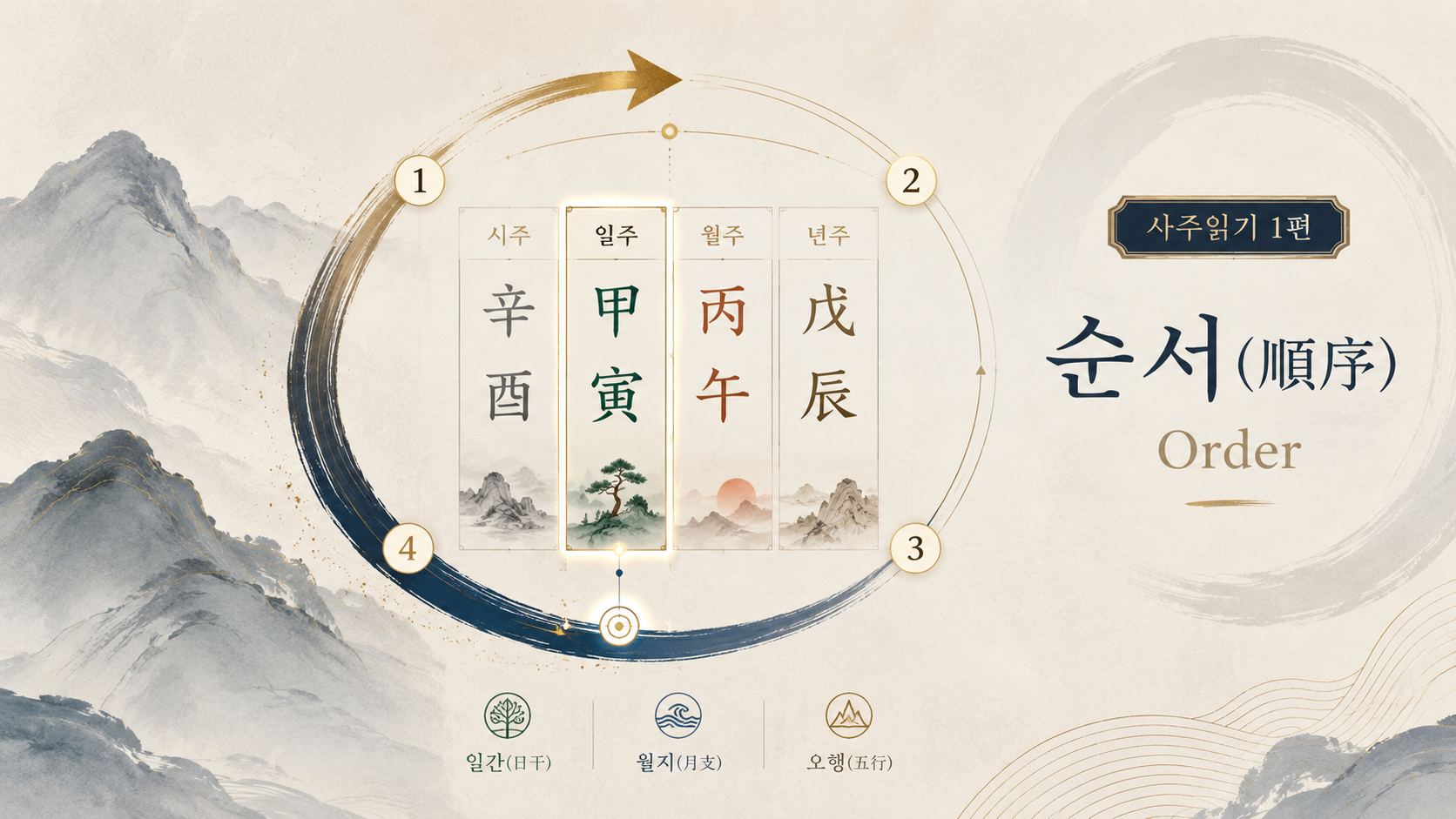
The Myeongsig (natal chart) is structured around four pillars: the Year Pillar (Yeonju), Month Pillar (Wolju), Day Pillar (Ilju), and Hour Pillar (Siju). Each of these pillars comprises a Heavenly Stem (Cheongan) and an Earthly Branch (Jiji). To determine the Five Elements distribution, you must convert each of the four Heavenly Stems and four Earthly Branches within the Myeongsig—a total of eight characters—into their respective Five Elements. For a more accurate assessment, it is also necessary to consider the hidden Heavenly Stems (Jijanggan) concealed within each Earthly Branch.
Mistake of merely counting characters: The strength or weakness of the Five Elements is not solely determined by a simple character count. Various complex factors, including their relationship with the Monthly Branch (Wolji) and interactions like combinations (Hap) and clashes (Chung), collectively determine the actual power of the Five Elements. At this stage, it is advisable to concentrate on identifying the distribution and defer judging their strength to a subsequent step.
Overlooking the importance of Jijanggan: Hidden Heavenly Stems (Jijanggan) represent the concealed Five Elements energy within a Myeongsig. Including them in your analysis provides a more three-dimensional understanding of the Myeongsig’s Five Elements composition. Ignoring Jijanggan can lead to overlooking significant elemental energies.
Immediately judging abundance or scarcity as inherently good or bad: An excess of a particular element is not necessarily favorable or unfavorable, nor is a scarcity automatically a deficiency. Such assessments should be made based on the overall balance and harmony of the Four Pillars, and are later connected to concepts like the Favorable God (Yongsin), Joyful God (Hisin), and Adverse God (Gisin). At this initial stage, the focus should be on ‘identification’ rather than premature judgment.
1. Convert each of the four Heavenly Stems (Year Stem, Month Stem, Day Stem, Hour Stem) in the Myeongsig into their corresponding Five Elements (e.g., Gap and Eul for Wood, Byeong and Jeong for Fire, Mu and Gi for Earth, Gyeong and Sin for Metal, Im and Gye for Water).
2. Convert each of the four Earthly Branches (Year Branch, Month Branch, Day Branch, Hour Branch) in the Myeongsig into their corresponding Five Elements (e.g., In and Myo for Wood, Sa and O for Fire, Jin, Sul, Chuk, and Mi for Earth, Sin and Yu for Metal, Hae and Ja for Water).
3. Identify the Five Elements contained within the hidden Heavenly Stems (Jijanggan) of each Earthly Branch. (For beginners, focus primarily on the main Qi (Bon-gi); more experienced individuals can also consider the secondary Qi (Jung-gi) and initial Qi (Cho-gi).)
4. Count the number of each of the Five Elements (Wood, Fire, Earth, Metal, Water) present within the Myeongsig.
5. Identify any excess or deficiency of specific Five Elements.
Having identified the Five Elements distribution in the Myeongsig, you have now grasped the overall energetic composition of the Four Pillars. In the next stage, you will learn how these Five Elements influence the Day Master (Ilgan), the central component of the Four Pillars, by diagnosing its strength or weakness. Accurately understanding the Day Master’s power, based on the Five Elements distribution, is a crucial key to deeply comprehending the Four Pillars.