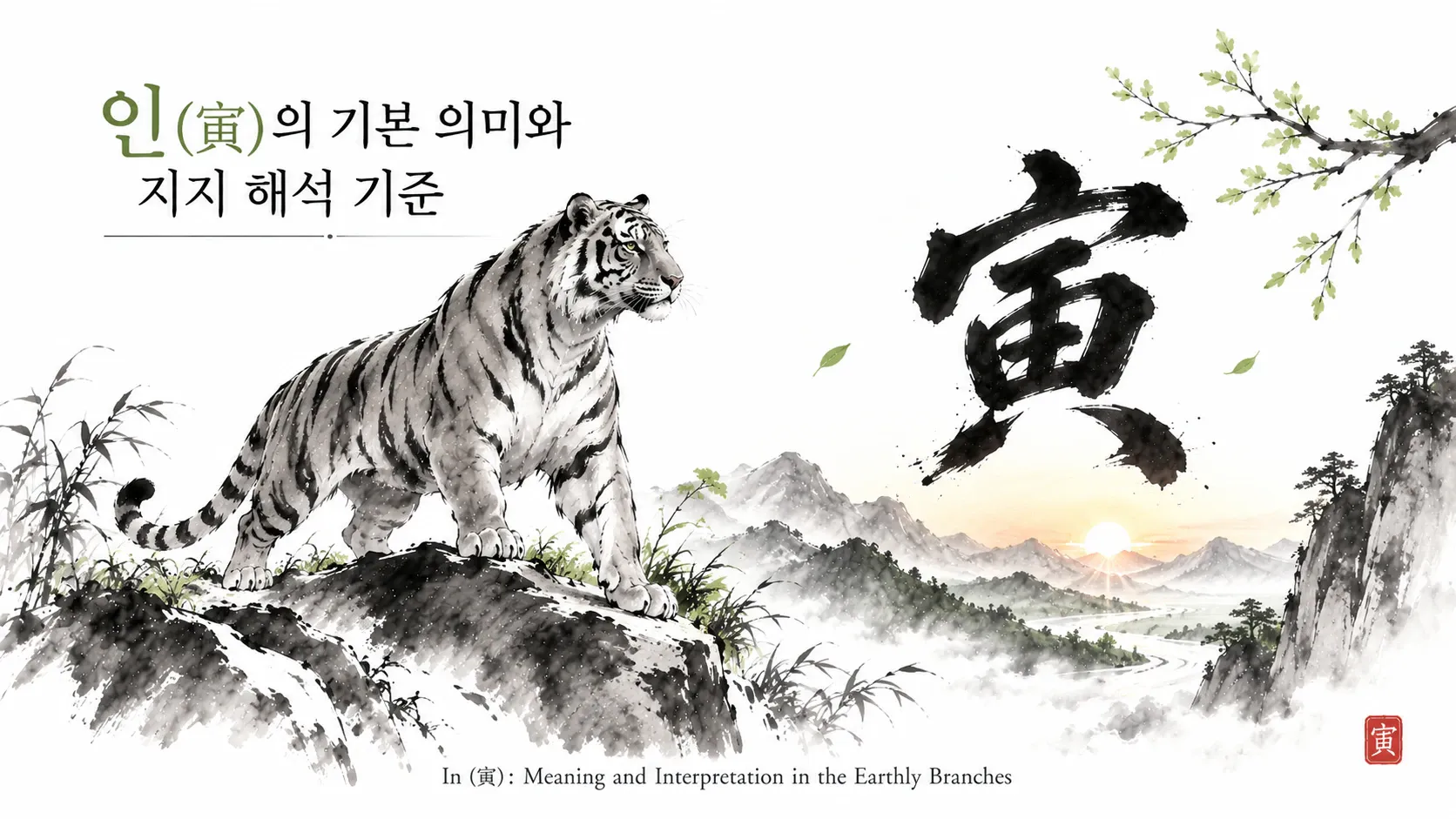
In the fourth installment of our Earthly Branch series, we take an in-depth look at In, the harbinger of spring. Beyond its common association with the Year of the Tiger, In symbolizes the dynamic energy of growth emerging within the cycle of seasons and time. We will explore what In signifies in a Four Pillars theory chart and establish criteria for interpreting it in relation to other branches.
Basic Meanings and Symbolism of In
In is the third of the twelve Earthly Branches. Often associated with the Tiger, in Four Pillars theory theory, it should be understood as the first surge of spring energy—a symbol of vitality and dynamic activity rather than just animalistic traits.
This symbolism relates to the resilient life force of a sprout pushing through frozen earth. In signifies new beginnings, powerful momentum, and a strong drive toward growth and development.
Coordinates of In: Season, Time, and Direction
Season: The Energy of Lipchun (Start of Spring)
In is the first branch of spring, encompassing Lipchun and Usu. It marks the thaw of the winter month’s stagnation, initiating new life. Even amid lingering cold, the earth is primed for the rising energy of a new cycle.
Time: 3:30 AM – 5:30 AM
As the time when the day begins, it aligns with In’s proactive nature. Individuals with this branch in their Four Pillars theory chart are often diligent, inquisitive, and determined to forge ahead.
Direction: East-Northeast
Representing the sunrise, the energy of In is expansive and positive. It rejects stagnation, constantly seeking forward movement.
The Five Elements and Yin-Yang
Five Elements: Wood element and Growth
In represents Yang Wood element, symbolizing a massive tree or a rising sprout. It indicates strong potential for growth, often manifesting as leadership and responsibility.
Yin-Yang: Yang polarity Energy
As a Yang branch, In adds a proactive and extroverted dimension to its traits. Those with this branch are typically energetic and unafraid of challenges.
Hidden Heavenly Stems
In consists of Mu, the Yang Earth Heavenly Stem, Byeong, the Yang Fire Heavenly Stem, and Gap, the Yang Wood Heavenly Stem. This composition—the stability of Earth, the warmth of the sun, and the growth of the tree—perfectly encapsulates the transition from winter’s end to the peak of spring growth.
Interpretive Criteria by Position
- Year Pillar: Ancestral influence and early-life pioneering spirit.
- Month Pillar: Leadership in social and professional life.
- Day Pillar: Individual independence and assertive personality.
- Hour Pillar: Enduring drive for self-development into later years.
Interactions: Branch combination, Branch clash, Branch penalty, Branch break, Branch harm
In undergoes significant changes through its relationships with other branches:
- Branch combination: Enhances growth and ambition.
- Branch clash: Causes friction or shifts in direction through external challenges.
- Branch penalty: Leads to complex conflict requiring careful adjustment.
- Branch break/Branch harm: Can signify subtle internal obstacles to one’s progress.
Common Misconceptions
Beginners should avoid equating In simply with the Tiger, or assuming that because it is “strong” it is always beneficial. True interpretation requires looking at the harmony of the entire chart, as the interaction of the branches can either amplify or hinder the energy of In.
Summary Table
| Category | Details |
|---|---|
| Name | In |
| Element | Wood element (Yang) |
| Yin-Yang | Yang polarity |
| Season | Spring |
| Time | 3:30 AM – 5:30 AM |
| Direction | East-Northeast |
| Stems | Mu, the Yang Earth Heavenly Stem, Byeong, the Yang Fire Heavenly Stem, Gap, the Yang Wood Heavenly Stem |
| Symbol | New beginnings, Growth, Momentum |
Moving Toward Myo, the Rabbit Earthly Branch
While In is the forceful start of spring, the next branch, Myo, the Rabbit Earthly Branch, signifies the full flourishing of that energy. We will discuss this in the next installment.