In the study of Four Pillars of Destiny, Five Elements represents the five fundamental elements that constitute all things. These elements are central to explaining the destiny of the universe and humanity through their unique properties and interactions. However, even if an element is the same, its significance and influence can be interpreted very differently depending on the composition and positioning within the Four Pillars of Destiny and its relationship with other elements. This article explores how to interpret these elements within various contexts beyond their basic definitions.
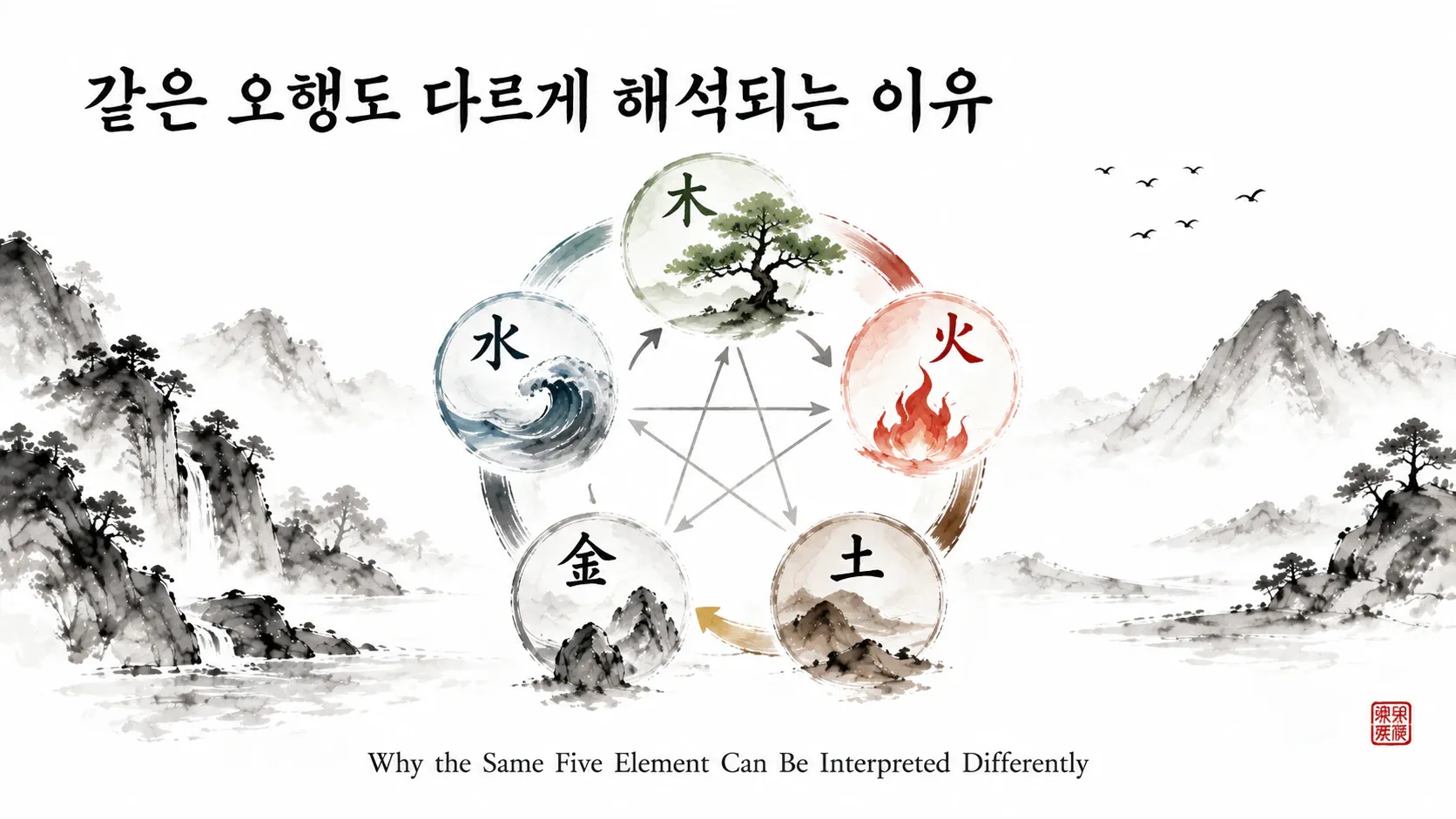
The Five Elements consist of Wood, Fire, Earth, Metal, and Water, serving as the most basic framework for explaining the changes and cycles of nature. Each element has unique qualities and interacts through the generating cycle (generating cycle) and overcoming cycle (overcoming cycle). For instance, Wood represents growth and expansion, Fire denotes heat and radiance, Earth symbolizes stabilization and inclusion, Metal signifies contraction and solidity, and Water represents storage and flow.
These interactions form the generating cycle flow: Wood to Fire, Fire to Earth, Earth to Metal, Metal to Water, and Water to Wood, creating a path of mutual support. Conversely, the overcoming cycle cycle—Wood to Earth, Fire to Metal, Earth to Water, Metal to Wood, and Water to Fire—acts as a mechanism for checking and balancing. Understanding these principles is the first step in judging the auspicious or inauspicious nature of elements when interpreting a Four Pillars of Destiny.
Even with the same elements, their meaning and function vary greatly depending on their placement among the eight characters of the Four Pillars of Destiny and which other characters are present. This is because elements are not merely static symbols but represent flows of living energy. Beginners often try to judge a Four Pillars of Destiny simply by counting the number of elements, but one must comprehensively view the environment and relationships in which these elements are placed.
Four Pillars of Destiny is composed of four Heavenly Stems and four Earthly Branches. The Heavenly Stems represent the energy of the heavens—pure and external manifestations—while the Earthly Branches represent the energy of the earth—complex and internal realities. Even for the ‘Wood’ element, characters like Eul in the Heavenly Stems represent pure Wood energy, whereas Myo or In in the Earthly Branches carry more complex meanings because they contain hidden elements. Thus, Heavenly Stems typically reveal outward tendencies and social activities, while Earthly Branches show essential internal nature and practical environments.
Elements vary in strength, or ‘wang-soe-gang-yak,’ according to seasonal changes. Wood is strongest in spring, Fire in summer, Metal in autumn, and Water in winter. Earth possesses the characteristic of becoming strong during the transition periods between seasons. A ‘Fire’ element born in midsummer may be overwhelming, while one born in midwinter may be weak and require support from other elements. The strength of an element is judged based on the Month Branch, which is a critical criterion for determining its role in a Four Pillars of Destiny.
Elements within a Four Pillars of Destiny do not exist in isolation. Through complex relationships like Branch combination, Branch clash, Branch penalty, Branch break, and Branch harm, their original properties can shift or produce new energy. For example, a ‘Metal’ element next to a strong ‘Fire’ element may be forged into something harder or, conversely, melt away. Similarly, a ‘Water’ element can drain the ‘Metal’ energy. Because roles shift dynamically based on the surrounding environment, understanding the context is more important than the simple presence of an element.
Interpreting elements involves looking beyond their count. The most important factor is the Day Master, the character representing ‘self,’ and how other elements relate to it. Each element provides the significance of the Ten Gods (Ten Gods) to the Day Master, such as peers, output, wealth, authority, or resources. If an element acts as the Wealth stars (wealth star) for the Day Master, it influences matters related to wealth or results. Additionally, considering the overall seasonal regulation—the temperature and humidity regulation of the Four Pillars of Destiny—is crucial. If a chart is too hot or cold, the element that acts to neutralize it becomes the core factor in balancing the Four Pillars of Destiny.
A common misunderstanding is labeling an element as ‘good’ or ‘bad’ based solely on its quantity. For example, assuming an abundance of Fire leads to an impulsive personality is an oversimplification. Four Pillars of Destiny interpretation is not a binary judgment. It is not about whether elements are evenly distributed; rather, it is about how effectively the chart functions as a whole. Some charts require a concentration of a specific element to function well, while others require the supplementation of missing ones. The goal is to understand the organic relationships within the chart rather than seeking a numerical balance.
It is also a misconception that elemental balance is an absolute good. The required composition and strength of elements differ for every chart. The goal is to understand the organic relationships within the chart rather than seeking a numerical balance; therefore, one must set aside preconceptions and strive to understand the context of the entire eight-character set.
We have examined how element meanings shift based on context. In our next article, we will examine why it is misleading to judge personality based solely on the Day Master, and how the rest of the chart shapes character.