Eastern Four Pillars theory and Western astrology differ fundamentally in how they perceive the world, particularly in the core principles they use to explain the origins of the universe. While Four Pillars theory relies on the Five Elements (Five Elements), Western astrology interprets human nature and universal phenomena through the Four Elements. This article compares these two core concepts to explore how each system views and interprets the world.
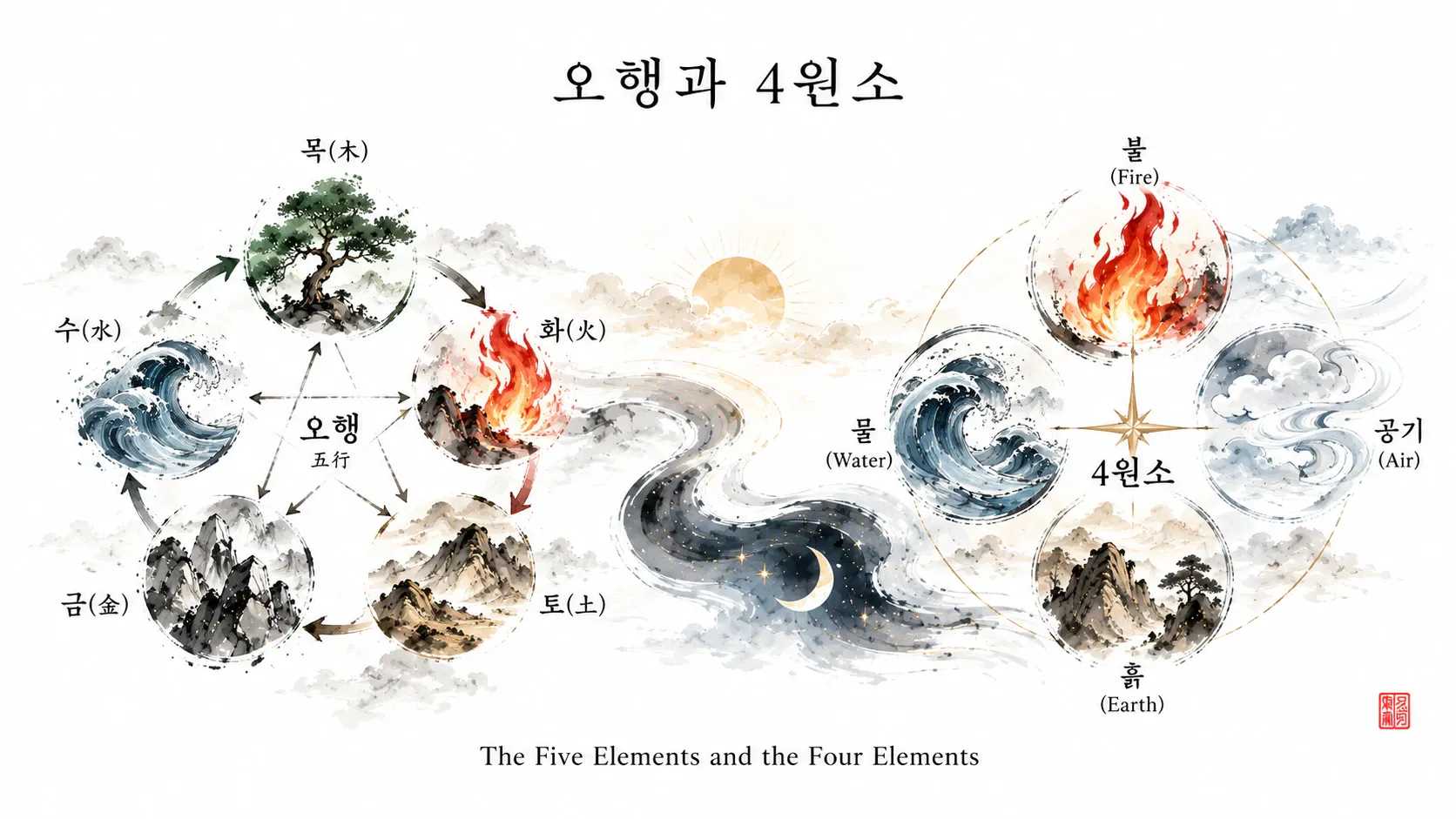
The Five Elements are the foundation of Four Pillars theory, representing five distinct energies: Wood, Fire, Earth, Metal, and Water. These energies go beyond mere physical elements, serving as a framework to explain the fundamental principles and interactions that drive the creation and transformation of everything in the universe. The Five Elements form a dynamic relationship of constant circulation, where they nurture (Sangsaeng) and control (Sanggeuk) one another. For instance, Wood fuels Fire, Fire creates Earth (ash), Earth bears Metal, Metal purifies Water, and Water nourishes Wood. In this way, the Five Elements describe the processes of creation, extinction, development, and decline in all things.
In Four Pillars theory, a person’s birth year, month, day, and hour are analyzed by dividing them into Heavenly Stems and Earthly Branches, both of which embody the attributes of the Five Elements. Consequently, an individual’s Four Pillars chart is essentially a specific combination of these elements. By examining the balance, harmony, and relationships between these elements in one’s chart, practitioners interpret various facets of life, including personality, potential, health, and interpersonal relationships. When certain elements are excessive or deficient, or when they clash, the chart is described as ‘weak’ or ‘strong.’ Understanding the Five Elements is essential for gaining the wisdom needed to balance such disparities and live a more harmonious life.
When interpreting the Five Elements in a chart, one must look beyond simply counting which elements are abundant or scarce and consider their complex relationships. For example, a strong Fire element is not inherently beneficial; it requires the presence of Water to properly regulate it for positive manifestation. Conversely, an excess of Water that extinguishes Fire entirely can lead to issues. Therefore, interpretation requires identifying the flow and balance of energy shaped by nurturing and controlling cycles, while also considering seasonal influences that may strengthen or weaken specific elements.
Those new to the Five Elements often make the mistake of viewing them simply as five physical substances or assuming a one-to-one link between an element and a specific profession or personality trait—such as assuming a strong Wood element dictates a career in forestry. However, the Five Elements are a complex, dynamic system of interactions, and one cannot definitively equate the strength of an element with a fixed outcome. They serve as indicators of potential and temperament rather than absolute determinants of fate or personality. It is crucial to approach them with an open mind to the various possibilities emerging from their combinations.
Western astrology presents the four basic components of the universe as the Four Elements: Fire, Water, Air, and Earth. Rooted in ancient Greek philosophy, each element is believed to hold specific qualities and energy. Fire symbolizes passion, creativity, and action; Water represents emotion, intuition, and healing; Air stands for intellect, communication, and logic; and Earth signifies stability, realism, and practicality. In Western astrology, these elements are integrated with zodiac signs, planets, and houses to explain individual personality, temperament, and life patterns. They are linked to groups of zodiac signs, and their harmony or imbalance is used to identify an individual’s psychological traits and potential.
In Western astrology, the 12 zodiac signs are each assigned to one of the four elements. Aries, Leo, and Sagittarius are Fire signs; Cancer, Scorpio, and Pisces are Water signs; Gemini, Libra, and Aquarius are Air signs; and Taurus, Virgo, and Capricorn are Earth signs. This classification helps in understanding the fundamental energy shared by each sign. For instance, Fire signs tend to be active and passionate, while Water signs are often emotional and intuitive. Astrologers analyze the distribution and interaction of these elements in a birth chart to interpret personality and potential.
The Four Elements system plays a critical role in Western astrology for understanding an individual’s core energy. An excess or deficiency of a particular element in a chart influences one’s basic personality, cognitive style, and method of emotional expression. For example, those with a strong Air influence may prioritize intellect and communication, while those with a strong Earth influence may seek realism and stability. Interpreting this system requires looking at how these elements interact with other components like planets and houses. A harmonious relationship between elements indicates a positive flow of energy, while imbalances may point to challenges in specific areas of life.
Like the Five Elements, the Four Elements are often subject to simplistic interpretations. Assertions like ‘a person with many Fire signs must have a fiery temper’ or ‘a lack of Water signs means an inability to express emotion’ are common but narrow viewpoints. The Four Elements are symbolic frameworks for the complexity of human life, not absolute predictors. Every element has both positive and negative aspects, and their meanings shift depending on their relationships with other elements. They are most useful as tools for self-reflection and personal growth.
Eastern Five Elements and Western Four Elements both stem from a universal endeavor to describe the fundamental principles of the world. Both provide frameworks for understanding the creation, transformation, and interaction of life, as well as human personality. Significant differences exist, however: the Five Elements emphasize a dynamic, cyclical process of constant change through nurturing and controlling cycles, whereas the Four Elements tend to focus more on the inherent qualities and traits of each element. Furthermore, the Five Elements explain clear control relationships—such as Water extinguishing Fire—while the Four Elements describe more complex interactions based on elemental harmony and balance. These differences reflect the distinct worldviews and philosophical backgrounds of their respective cultures.
Although developed in different cultural contexts, both the Five Elements and the Four Elements are results of a universal search to understand humanity and the cosmos. Both systems offer valuable insights for recognizing one’s innate temperament and potential, and for finding balance in life. By understanding the dynamic cycles of the Five Elements and the unique energetic qualities of the Four Elements, we can broaden our perspective on the world. Rather than accepting these concepts in a fatalistic way, it is wiser to use them as tools for self-understanding and growth. In the next article, we will compare the 12 Earthly Branches of Four Pillars with the 12 signs of the Western Zodiac to explore yet another way of interpreting time and the universe.