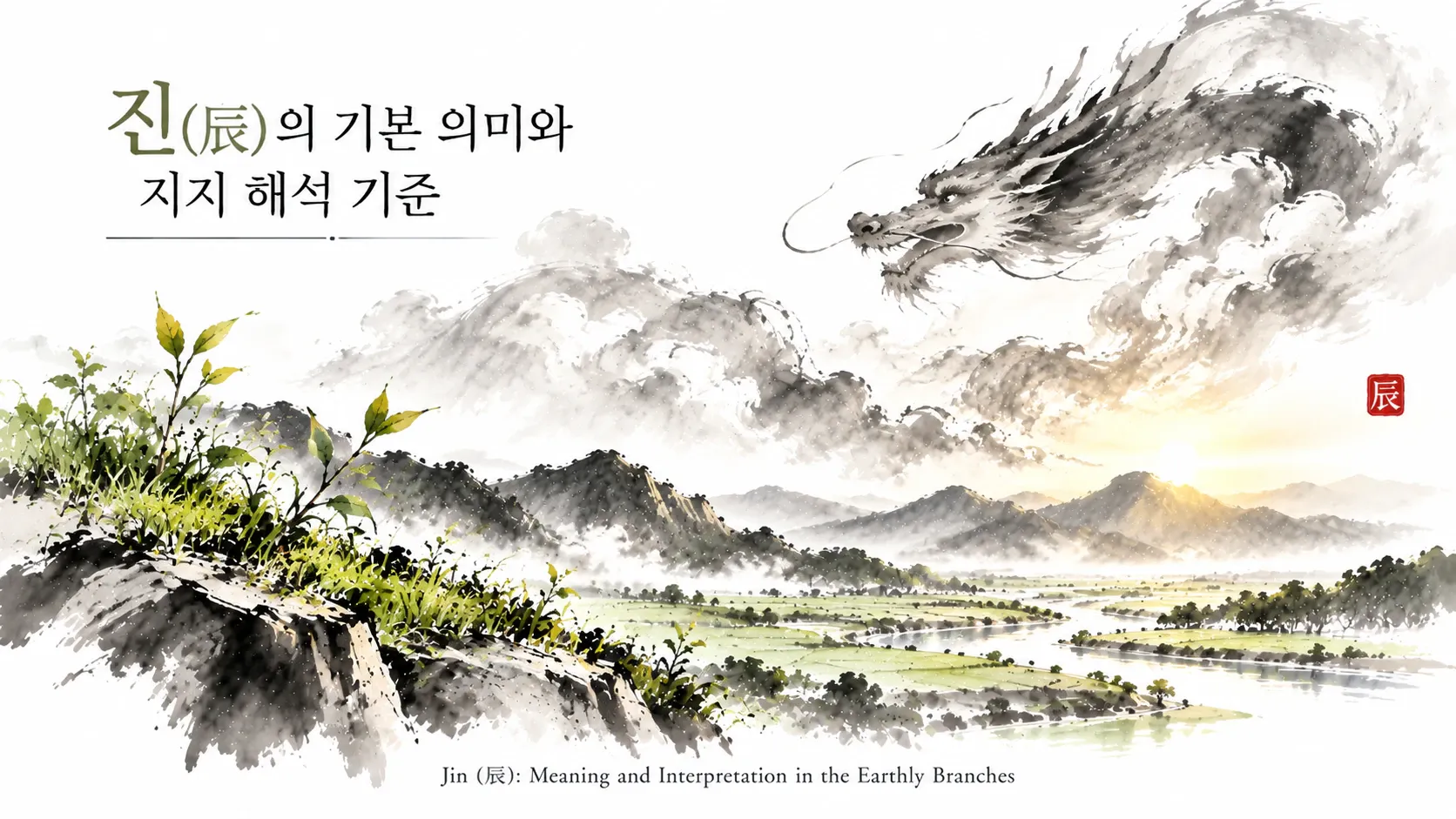
As the fifth of the twelve Earthly Branches, Jin marks a transition period between the end of spring and the beginning of summer. It represents a dynamic energy where earthly forces reach their peak, signaling a time of preparation and transformation for all things. We will explore the significance of Jin in the Four Pillars system through the lenses of seasons, time, and the Five Elements.
The fifth character of the Twelve Earthly Branches, Jin, carries meanings such as ‘time,’ ‘star,’ ‘to vibrate,’ and ‘to move.’ Beyond merely indicating time, it symbolizes a life force that is dynamic and ever-evolving. While associated with the dragon in animal zodiac terms, within the context of the Four Pillars, it is more important to focus on the seasonal and elemental characteristics inherent to the character itself.
Jin embodies the transitional energy of a peak spring moving toward summer. Its role in a Four Pillars chart depends on its position, acting as a key factor that infuses the individual’s personality, environment, and life flow with change and dynamism. Rather than judging fortune solely based on the ‘dragon’ sign, it is crucial to understand the essential nature of Jin as a catalyst for growth and a mediator.
Coordinates: Season, Time, and Direction
Jin is a vital coordinate for mapping seasons, time, and direction. Seasonally, it corresponds to late spring, around April, representing the last month of the season and the transition into summer. This is a time when all things grow vigorously, preparing for the next phase. Timewise, it covers the interval from 7:30 AM to 9:30 AM, a period when activity is at its peak. Directionally, it points to east-southeast, the intersection of the eastern energy of Myo and the southern energy of Sa. This highlights its role as a mediator. Those born in the month of Jin often possess a blend of vernal vitality and the dynamic energy required to prepare for summer.
Properties: Five Elements and Yin-Yang
Jin is Earth element. Specifically, it is categorized as wet Earth element, possessing a motherly, nurturing quality. As one of the ‘four storage grounds’ (along with Chuk, Mi, and Sul), it serves as a mediator that stores and transforms energy. In terms of Yin and Yang, it holds Yang energy. As a Yang Earth element, it shows initiative and leadership. This combination makes Jin a complex sign capable of adapting to change and seizing new opportunities.
Hidden Stems and Latent Energy
The Hidden Stems of Jin consist of three Heavenly Stems: Eul, Gye, and Mu. The initial Eul represents the final breath of spring and the start of new growth. The middle Gye provides the moisture that softens and nurtures. The primary Mu embodies the strong, stable essence of Earth element. Together, these create a multi-faceted sign that balances vitality, flexibility, and stability. When these hidden elements emerge in the Heavenly Stems, their influence becomes even more pronounced in Four Pillars analysis.
Interpretations by Position in the Four Pillars Chart
The impact of Jin varies by position: In the Year Branch, it relates to ancestry and early life. In the Month Branch (Month Branch), it links to career and social life, favoring mediation and adaptation. In the Day Branch (Day Branch), it reflects one’s core personality and spouse, indicating a broad-minded yet unpredictable nature. In the Hour Branch, it suggests an active life in later years. Each placement requires consideration of its role as a mediator of change.
Relationships with Other Earthly Branches
Jin interacts with others in complex ways: Six Combinations (Jin-Yu) forms Metal element, marking new directions. Three Harmony combinations (Sin-Ja-Jin) creates a powerful Water element formation, boosting wisdom and collective action. Directional Combinations (In-Myo-Jin) enhances Wood element energy. It also faces clashes like Branch clash with Sul, internal friction through self-penalty, and potential disturbances like Branch break with Chuk and Branch harm with Myo.
Common Misconceptions
A common mistake is focusing solely on the ‘dragon’ icon, leading to oversimplified assumptions. While Jin is dynamic, it also carries potential for instability. It is not inherently ‘stable’ just because it is Earth element; its value lies in its role as a mediator of change. Mastery of Four Pillars requires moving beyond simple memorization to understanding the interactions of the hidden stems.
Summary Table
| Category | Properties | Analysis Considerations |
|---|---|---|
| Season | Late Spring (April) | Change, preparation for start |
| Time | 07:30 – 09:30 | Activity, planning |
| Direction | East-Southeast | Mediation |
| Element | Earth element (Wet) | Nurturing, storage |
| Yin-Yang | Yang | Leadership |
| Hidden Stems | Eul, Gye, Mu | Vitality, Flexibility, Stability |
Next: Connecting to Sa
While Jin marks the transition from spring to summer, the next branch, Sa, signals the arrival of intense summer heat. We will explore how these transformations continue in the next article.