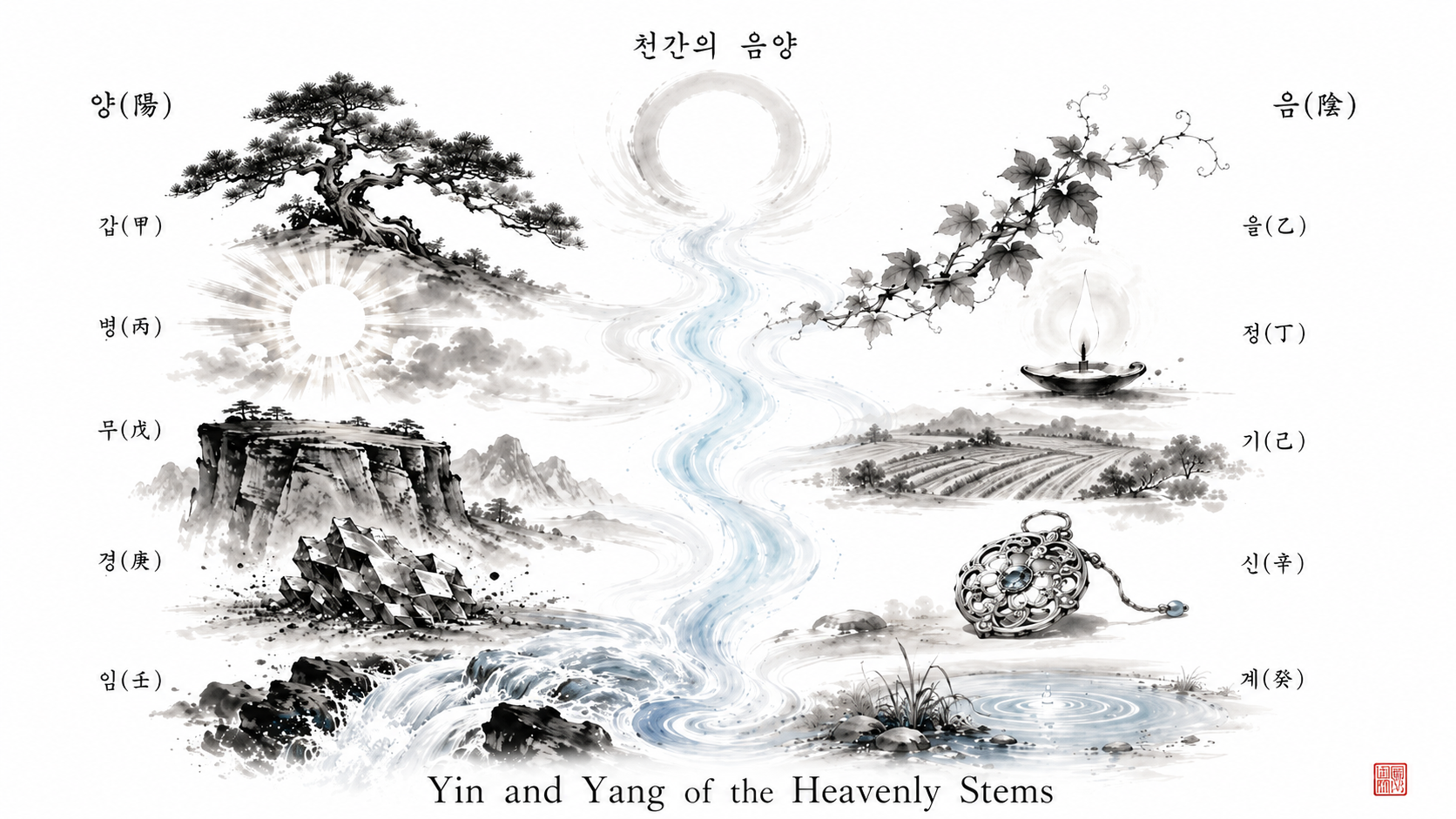
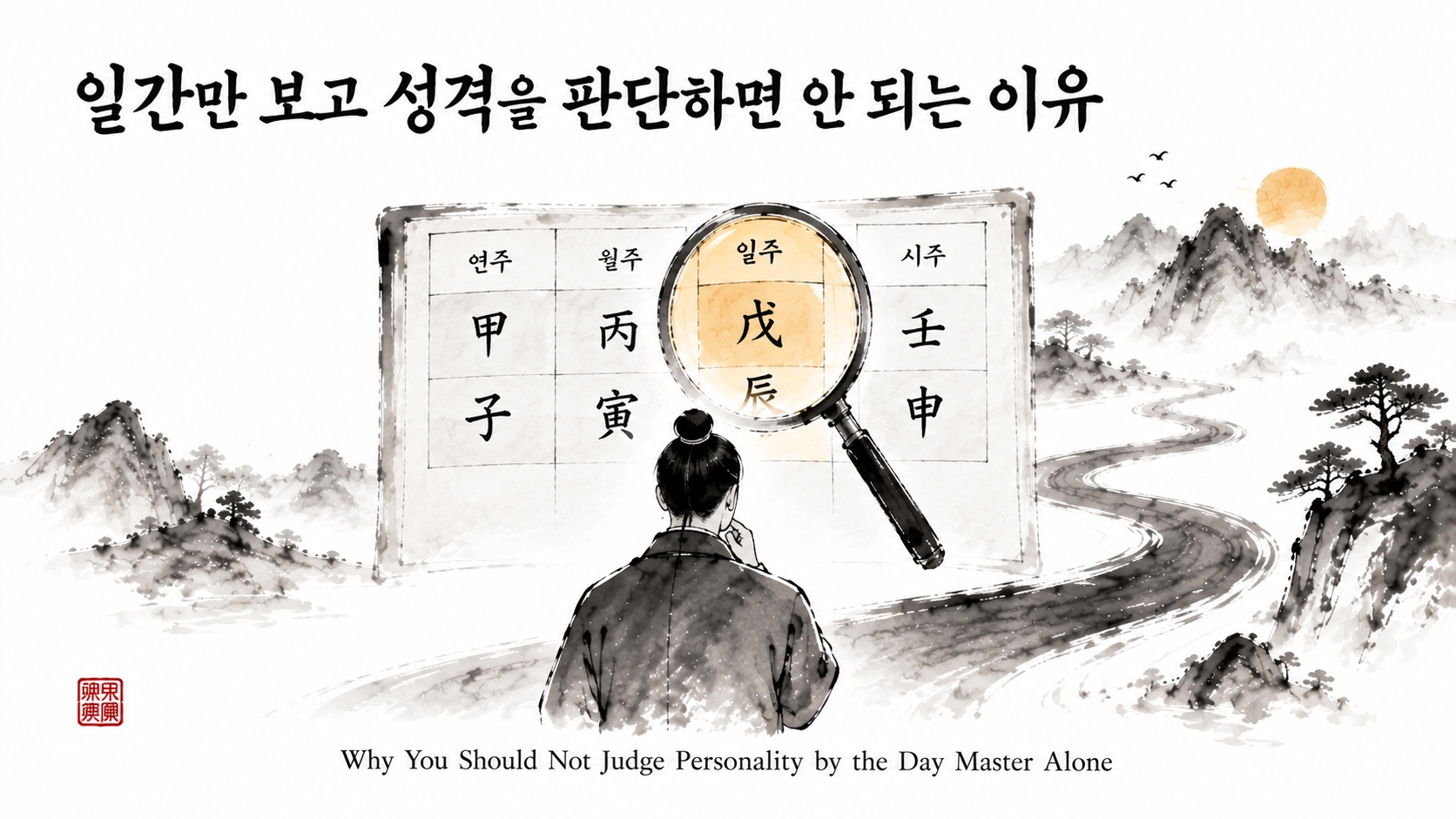
When studying the Four Pillars, one often encounters individuals who share the same Day Pillar (Il-ju) despite having different birth dates. However, sharing a Day Pillar does not mean their life paths are identical; one of the key variables that creates this divergence is the environmental influence of the Month Pillar.
In the Four Pillars, the Day Pillar represents the center and essence of who you are. Conversely, the Month Pillar is a vital framework that signifies the season of your birth, your social environment, and the energy of your parents. Having different Month Pillars, even with the same Day Pillar, is akin to planting the same seed in either spring or autumn; the pattern of growth will be vastly different.
The Month Pillar goes beyond simple seasonal change; it establishes one’s basic attitude toward the world and the direction of social achievement. While the Day Pillar represents an individual’s inner desires, the Month Pillar serves as the stage and channel through which those desires are manifested. Therefore, judging a Four Pillars solely by the Day Pillar is like looking at the stem of a tree without seeing the forest.
Here are two hypothetical individuals. Person A has a Gap-Ja (the 1th sexagenary pair) Day Pillar with a Byeong-In (the 3th sexagenary pair) Month Pillar. Person B also has a Gap-Ja Day Pillar but with a Gyeong-O (the 7th sexagenary pair) Month Pillar. Despite the core essence of Gap-Ja, the environments they face are starkly different.
Born in the In (the Tiger Earthly Branch) month—a time when spring energy is strong—A is more inclined to express and expand their energy. In contrast, B, born in the O (the Horse Earthly Branch) month—where summer energy dominates—experiences both the pressure and tension of having to regulate their energy and achieve results. Thus, the difference in the Month Pillar becomes a crucial factor in determining life’s priorities.
The seasons determine the temperature and humidity of a Four Pillars. When a Gap-Ja Day Pillar meets the In (the Tiger Earthly Branch) month, the Wood element element becomes more vigorous, which can manifest as a firm will to express one’s subjective views. However, if the same Gap-Ja Day Pillar meets the O (the Horse Earthly Branch) month, the Fire element element strengthens, emphasizing a pragmatic approach aimed at connecting activities to tangible outcomes.
We should not approach this as merely ‘good’ or ‘bad.’ For the Gap-Ja in the In month, the challenge is how to manage the energy of initiation and growth; for the Gap-Ja in the O month, the challenge is how to balance activity outcomes with the exhaustion caused by the process. In short, the Month Pillar defines the nature of the ‘homework’ one encounters in life.
The Month Pillar is the starting point for social relationships. In social life, the energy of the Month Pillar is the reflection of oneself perceived by others and is like the business card one presents to the world. A may find it easier to form cooperative and expansive relationships through the energy of the In month, whereas B may be placed in competitive relationships defined by proving personal results through the energy of the O month.
This difference is also evident in career choices and interpersonal styles. A is likely to exercise their capabilities in more creative and expansive fields, while B will seek recognition in more concrete and performance-oriented sectors. This should be viewed as a difference in survival strategies chosen to adapt to one’s environment, rather than a mere difference in personality.
When interpreting the Four Pillars, the most important thing is to avoid becoming obsessed with ‘Day Pillar theory.’ It is a dangerous error to conclude that having the same Day Pillar implies the same personality or career. The Four Pillars must be viewed as a whole; the core lies in observing how the Month Pillar supports or constrains the Day Pillar.
To achieve balance, one must understand the characteristics of their Month Pillar and consider how to supplement lacking energy. For example, a Gap-Ja born in a hot, dry environment (the O month) might need to use the Water element element to consciously calm themselves. Conversely, a Gap-Ja born in a cold environment might need to practice actively revealing themselves through the Fire element element.
A Four Pillars birth chart is not a fixed mold but a map of one’s potential. A different Month Pillar means a different terrain on that map, not a predetermined destination. Depending on the choices made, the results of life can be completely different even in the same environment.
Therefore, when consulting or studying the Four Pillars, never conclude with, ‘Because you have this Month Pillar, you must live this way.’ Instead, adopt an advisory perspective: ‘Because you have these environmental characteristics, moving in this direction might be a bit easier.’ The Four Pillars should not be a tool that dictates fate, but a compass for self-understanding and making better choices.
We have explored how the environment influences individuals through the relationship between the Day Pillar and the Month Pillar. However, the Four Pillars system involves various other connections beyond the Month Pillar, such as branch clash, branch combination, and branch penalty. In the next article, we will examine how to interpret the Four Pillars when such complex relationships are intertwined, particularly by using cases with frequent branch clashes to decode the complexity of these interactions.