In Four Pillars (Saju) theory, Yin and Yang are fundamental principles governing all phenomena and the core of change. While previous articles explored how the Five Elements exhibit different characteristics based on their Yin-Yang polarity, this installment delves into the principles of Yin-Yang as applied to the Heavenly Stems. We aim for a deeper understanding of each Heavenly Stem's unique energy and interactions from the perspective of balance and contrast. Moving beyond mere memorization, we will explore how the Yin-Yang aspects of the Heavenly Stems form the foundation for interpreting Eight Characters.
Yin and Yang represent two complementary yet opposing forces. In Four Pillars (Saju) theory, Heavenly Stems symbolize the energy of the heavens, and each Stem possesses unique Yin-Yang attributes. This isn’t merely a dichotomous division of good and bad, but a crucial framework for understanding the diverse characteristics and patterns of change in all things.
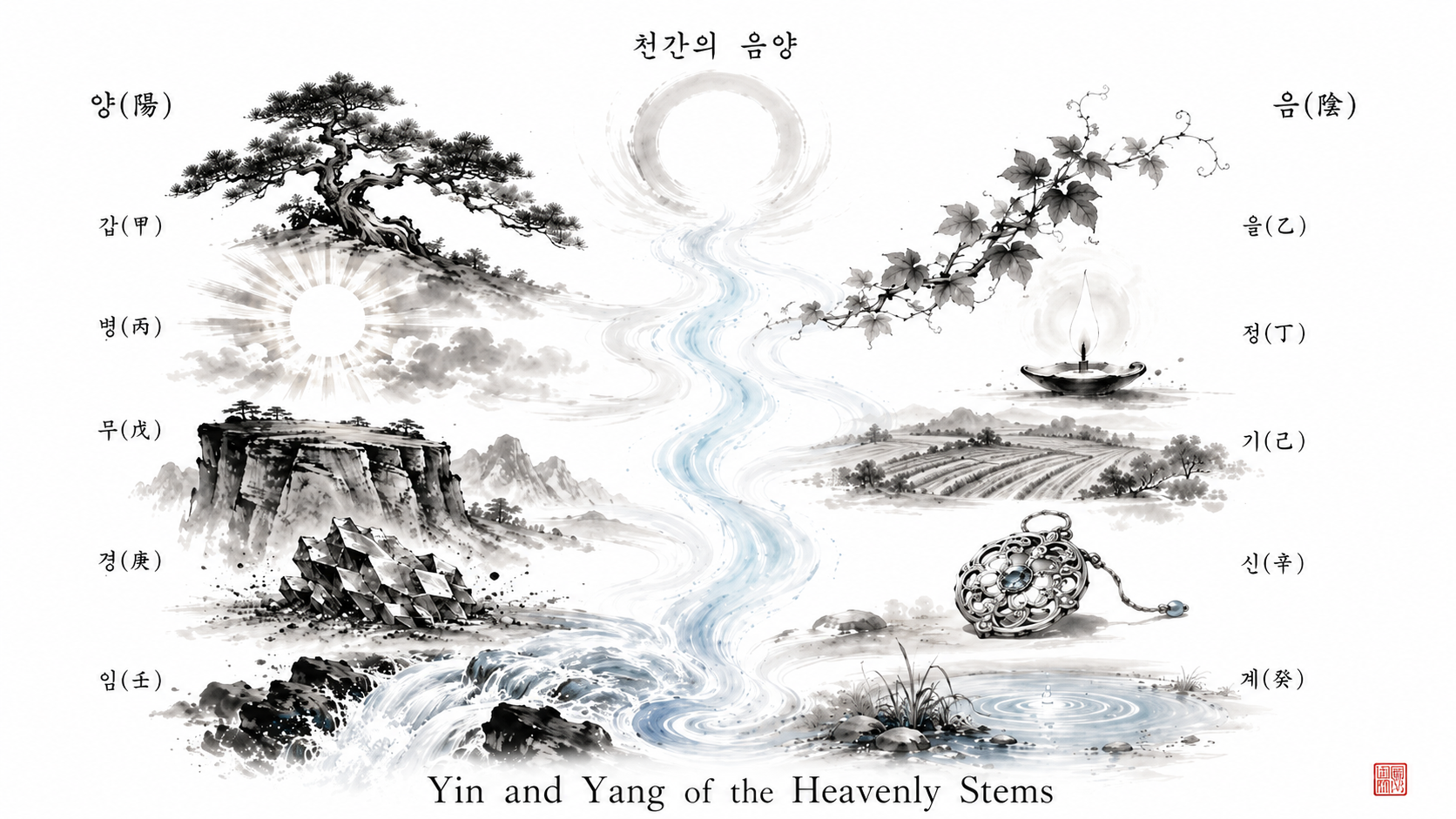
For instance, Gap Wood is akin to a towering tree, embodying the robust spirit of the Yang polarity Wood element, while Eul Wood is compared to flexible vines or grass, representing the Yin polarity Wood element. Thus, even within the same Five Elements, their function and manifestation vary significantly according to their Yin-Yang polarity.
The Yin-Yang aspects of Heavenly Stems are readily observable in natural phenomena and daily life. The Yang polarity polarity symbolizes day, the sun, activity, expansion, and beginnings, while the Yin polarity polarity signifies night, the moon, rest, contraction, and fruition.
Taking Heavenly Stems as examples, Byeong Fire can be likened to the intense sun, radiating warmth and vitality as the Yang polarity Fire. In contrast, Jeong Fire is comparable to a gentle candlelight or a stove, illuminating and warming a specific space as the Yin polarity Fire. Similarly, if Gyeong Metal represents unrefined ore or strong steel, embodying the powerful Yang polarity Metal, then Sin Metal corresponds to refined gems or a precise blade, representing the sophisticated Yin polarity Metal. In this way, Yin-Yang further clarifies the essential characteristics of each Heavenly Stem.
In Eight Characters (Four Pillars), Heavenly Stems primarily represent an individual’s outward personality, social activities, and spiritual aspirations. The Yin-Yang polarity of these Stems profoundly influences how these characteristics manifest.
By understanding the Yin-Yang relationships between the various Heavenly Stems, especially centered around the Day Master, one can gain a more comprehensive insight into a person’s temperament, interpersonal relationships, and social role. For example, a Yang polarity Day Master tends to be active and extroverted, whereas a Yin polarity Day Master might display cautious and introverted tendencies. However, these are not fixed traits but should be interpreted dynamically within the overall combination of the entire Eight Characters.
Heavenly Stems consist of the Ten Heavenly Stems, and each Stem is a combination of one of the Five Elements (Wood, Fire, Earth, Metal, Water) and either Yin or Yang. For example, Gap, the Yang Wood Heavenly Stem, Eul, the Yin Wood Heavenly Stem, Byeong, the Yang Fire Heavenly Stem, and Jeong, the Yin Fire Heavenly Stem are specific combinations.
These combinations impart distinct energies and characteristics to the same Five Elements depending on their Yin-Yang polarity. The Yang polarity elements possess expansive, broad qualities associated with initiation and emanation, while the Yin polarity elements are smaller, delicate, and linked to convergence and completion. Understanding these subtle differences is the first step toward grasping the deeper meaning of the Heavenly Stems.
In Eight Characters, the harmonious balance of the Heavenly Stems’ Yin-Yang is crucial. If a particular Yin-Yang energy is excessively strong or weak, imbalances can manifest in specific areas of life. For instance, an overly dominant Yang polarity energy might lead to excessive activity and quick exhaustion, while an overbearing Yin polarity energy could result in passivity or stagnation.
An ideal Eight Characters exhibits an appropriate Yin-Yang balance where these forces complement and circulate with each other. This doesn’t imply a fixed ratio but rather a dynamic interaction where the Yin-Yang energies of each Heavenly Stem organically align within the overall flow of the Eight Characters. Such equilibrium positively influences an individual’s personality and the flow of their destiny.
A common misconception among those new to Eight Characters is to view Yin polarity as negative and Yang polarity as positive. However, Yin-Yang is not a concept of good versus bad but describes two complementary states of energy.
Characteristics of Yin polarity such as convergence, interiority, night, and rest are just as vital and necessary as the attributes of Yang polarity, which include emanation, exteriority, day, and activity. Everything achieves completion only when Yin and Yang are harmoniously balanced. Maintaining this perspective is essential when understanding the Yin-Yang of Heavenly Stems.
In the next article, we will delve into the principles of Yin-Yang as applied to the Earthly Branches, another crucial component of Eight Characters alongside the Heavenly Stems. We will explore how the Yin-Yang of Earthly Branches interacts with the Heavenly Stem energies to create the complex overall patterns of Eight Characters.