This is the sixth installment in our 'Reading the Four Pillars' series. Following our previous discussion on assessing the strength of the Day Master to establish a foundation for Four Pillars interpretation, this article will guide you through understanding the structure of the Ten Gods within a Saju chart. Our main objective is to clarify the relationship each Ten God holds with the Day Master.
In a Four Pillars chart, the Ten Gods represent the unique meanings and roles of each character. The purpose of this stage is to identify how the Ten Gods are configured within the chart – specifically, which Ten Gods are present and what relationships they form with one another. This understanding is the crucial first step toward comprehending the overall balance and characteristics of the entire Four Pillars.
After diagnosing the strength of the Day Master, examining the Ten Gods structure creates a logical flow for Four Pillars interpretation. The meaning of the Ten Gods is determined by their relationship with the Day Master. Therefore, an accurate assessment of the Day Master’s strength is essential to precisely understand the Ten Gods’ influence. For instance, while Wealth (財星, Jaeseong) may signify prosperity for a strong Day Master, it could become a burden for a weak one. To move beyond the inherent meaning of each Ten God and understand its role within the broader context of the entire Saju chart, it is vital to first identify the Ten Gods structure.
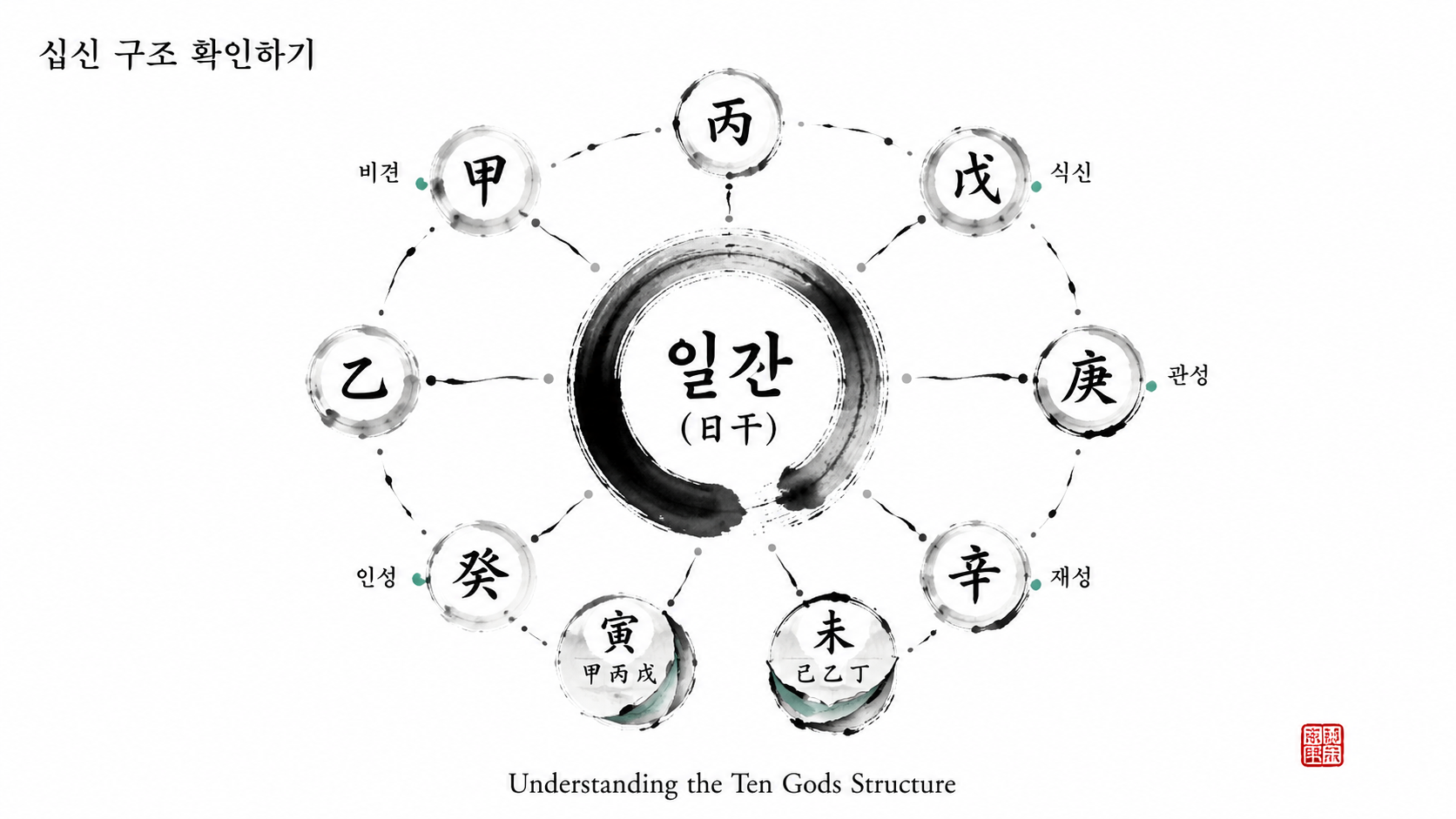
The Ten Gods are names assigned to each character in the Heavenly Stems (천간, Cheongan) and Earthly Branches (지지, Jiji) of a Saju chart, based on their relationship with the Day Master. Therefore, it is necessary to identify which Ten God corresponds to each of the eight characters in the chart (Year Stem, Year Branch, Month Stem, Month Branch, Day Branch, Hour Stem, Hour Branch) relative to the Day Master. For Earthly Branches, it is also crucial to consider the Hidden Stems (지장간, Jijanggan) to uncover any concealed Ten Gods.
Beginners often focus on memorizing the individual meanings of each Ten God, overlooking their interrelationships and overall roles within the chart’s complete structure. For example, while both Food God (食神, Siksin) and Hurting Officer (傷官, Sangwan) are characters that the Day Master produces, they possess distinct tendencies and modes of operation. Furthermore, it’s important to remember that even the same Ten God can have varying influences depending on its position (Heavenly Stem/Earthly Branch, Year/Month/Day/Hour). Beyond merely counting the number of each Ten God, it is essential to consider which characters each Ten God is connected to and what elemental energies (오행, Ohaeng) they carry.
Identify the eight characters of the Saju chart (four Heavenly Stems, four Earthly Branches).
Determine the Five Element (오행, Ohaeng) relationship (generating, controlling, or same element) between each character and the Day Master.
Based on these Five Element relationships, assign the appropriate Ten God name to each character. (For example, if the Day Master is Gapmok wood and the Month Stem is Byeonghwa fire, Byeonghwa is the Food God because wood generates fire).
For Earthly Branches, analyze the relationships between the Day Master and the Hidden Stems (지장간, Jijanggan) to identify any concealed Ten Gods.
Examine the overall structure of the Saju chart to see the distribution of Ten Gods and note if any particular Ten God is excessively present or notably absent.
Once you have grasped the Ten Gods structure, the next step is to understand how these Ten Gods interact with one another. In the upcoming installment, we will explore methods for diagnosing the dynamic changes and phenomena that arise from the relationships between characters within the Saju chart, such as Combination (합, Hap), Clash (충, Chung), Punishment (형, Hyeong), Harm (파, Pa), and Destruction (해, Hae).