In the foundational theory of Four Pillars, Yin and Yang extend beyond a simple dichotomy of good and bad. Even when referring to the same Five Elements, their characteristics and functions subtly transform based on their Yin and Yang attributes. This nuanced understanding is crucial for a deeper interpretation of Four Pillars. This article will explore how variations of Yin and Yang within the Five Elements reveal the diverse flow of energy.
Yin and Yang are the two fundamental forces that underlie all things in the universe. While they appear to be in opposition, they are mutually complementary and work together to maintain harmony. They are not a value judgment of good or bad, but rather a fundamental classification system and an attribute of energy essential for understanding all phenomena. Yang symbolizes bright, active, and ascending energy, while Yin represents dark, passive, and descending energy.
Even water, despite its common essence, exhibits different characteristics: clear stream water (Yang) and deep pond water (Yin). Stream water flows actively, invigorating life, whereas pond water rests quietly, embracing and nurturing life. This illustrates how, even with the same fundamental ‘water’ element, its usage and nature can vary significantly based on its Yin and Yang aspects, a phenomenon easily observed in daily life.
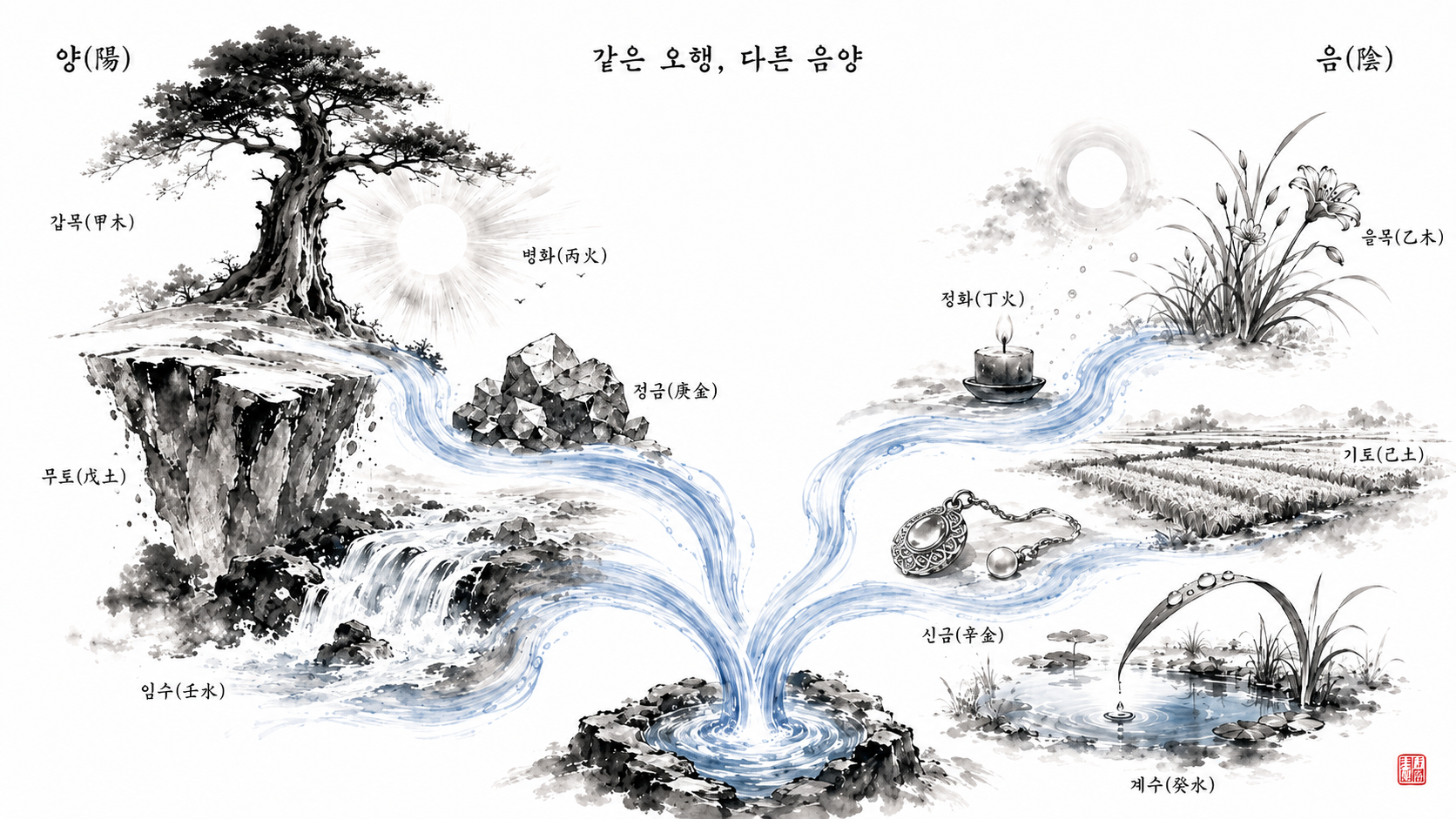
Four Pillars is composed of combinations of Heavenly Stems and Earthly Branches, all of which possess attributes of the Five Elements (Wood, Fire, Earth, Metal, Water) and Yin and Yang. For example, Gapmok (甲木) represents Yang Wood, signifying large trees or pillars, while Eulmok (乙木) represents Yin Wood, symbolizing soft grass or flowers. Although both belong to the ‘Wood’ element, their forms and roles are clearly distinguished by their Yin and Yang aspects.
While each of the Five Elements has its unique characteristics, these become further refined and diversified when viewed through the lens of Yin and Yang. Yang Five Elements tend to be outwardly expressed and active, whereas Yin Five Elements are more inwardly hidden and passive. This distinction provides a crucial clue in Four Pillars interpretation, helping to predict how a particular Five Element will manifest and function.
Wood element: Yang Wood (甲) represents large trees, while Yin Wood (乙) represents grass or flowers.
Fire element: Yang Fire (丙) symbolizes the sun, while Yin Fire (丁) symbolizes candlelight or moonlight.
Earth element: Yang Earth (戊) represents vast land, while Yin Earth (己) represents fertile fields.
Metal element: Yang Metal (庚) signifies raw ore or steel, while Yin Metal (辛) signifies jewels or refined metal.
Water element: Yang Water (壬) represents large rivers or oceans, while Yin Water (癸) represents springs or dew.
In Four Pillars, it is crucial to assess whether a specific Five Element achieves a balance of Yin and Yang, or if it is leaning excessively towards one side. A harmonious balance of Yin and Yang signifies stability and smoothness, while an imbalance can suggest problems stemming from an excess or deficiency of certain energies. This understanding significantly influences the individual’s personality, the flow of their luck, and even their health within the context of Four Pillars analysis.
One of the most common misunderstandings is perceiving Yang as inherently positive and Yin as negative. However, Yin and Yang are not concepts of superiority or inferiority; rather, they are equal entities possessing different attributes. Without Yang, Yin cannot exist, and without Yin, Yang loses its meaning. In Four Pillars, the role of Yin and Yang is not inherently good or bad; instead, its significance depends entirely on how it functions within the overall harmony.
Thus, even the same Five Element can have vastly different meanings and functions depending on its Yin and Yang attributes. In the next article, we will delve into how this concept of Yin and Yang applies to the Heavenly Stems, providing a deeper understanding of Four Pillars through the Yin and Yang of the Heavenly Stems.