This article is the first in a five-part series on the Five Elements in Saju fundamentals, focusing on the Wood element. We will explore the basic meaning of the Wood element, its natural symbolism, and its fundamental interrelationships, such as water generating wood (水生木), wood generating fire (木生火), metal controlling wood (金剋木), and wood controlling earth (木剋土).
What Does the Movement of the Wood element Signify?
In the Five Elements, the Wood element represents the emergence of life, an upward and outward spreading movement. Like a seed sprouting and expanding its stem and branches, it symbolizes the process of growth and territorial expansion from a starting point.
Therefore, the Wood element does not exclusively refer to actual trees. It is a concept that symbolically encapsulates the qualities of growth and development observed in nature.
Understanding the Wood element Through Spring and Trees
The easiest images to associate with the Wood element are sprouts, young trees, forests, upward-reaching stems, and branches spreading in all directions. The way life force, dormant during winter, emerges outwards in spring closely resembles the nature of the Wood element.
In traditional Five Element correspondences, the Wood element is linked to spring, the east, and blue or green colors. The direction of the rising sun, the season when life reactivates, and the color of new leaves all demonstrate a common theme of beginning and growth.
Fundamental Attributes of the Wood element
| Category | Basic Correspondence of the Wood element |
|---|---|
| Representative Meanings | Beginning, growth, expansion, development |
| Representative Season | Spring |
| Direction | East |
| Color | Blue or Green |
| Representative Natural Images | Sprouts, trees, forests, upward-reaching branches |
| Element that generates the Wood element | the Water element |
| Element generated by the Wood element | the Fire element |
| Element controlled by the Wood element | the Earth element |
| Element that controls the Wood element | the Metal element |
| Traditional Bodily Correspondence | Liver (肝) · Gallbladder (膽) |
Traditional bodily correspondences are symbolic classifications used within the Five Elements system for reference. They should not be extended to diagnose actual illnesses or health conditions.
Generative (Sangsaeng) Relationship of the Wood element
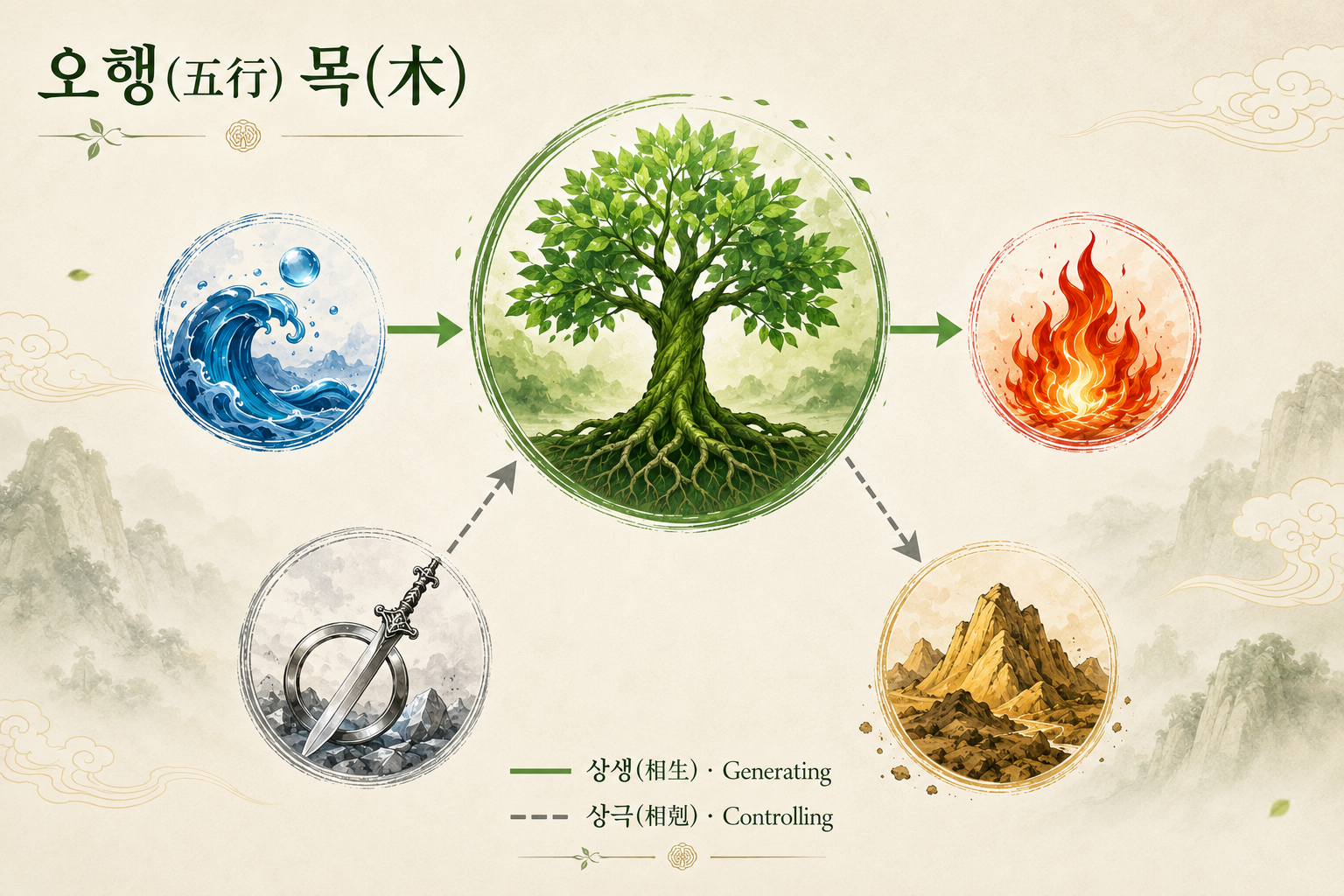
Generative Cycle
the Water element → the Wood element → the Fire element
Water Generates Wood (水生木)
The phrase that the Water element generates the Wood element can be understood from the natural observation that trees need water to grow. The stored and condensed flow of the Water element, when meeting the Wood element, leads to growth and development.
Wood Generates Fire (木生火)
The relationship where the Wood element generates the Fire element is explained by how wood serves as fuel for fire. The initial growth and development movement of the Wood element flows into the stage of the Fire element, which is characterized by wider expression and outward emission.
Controlling (Sanggeuk) Relationship of the Wood element
Controlling Cycle
the Metal element → the Wood element → the Earth element
Metal Controls Wood (金剋木)
The relationship where the Metal element controls the Wood element derives from the way metal tools cut and shape wood. This can be understood as an action that sets boundaries and adjusts the form of the Wood element’s tendency to endlessly spread.
Wood Controls Earth (木剋土)
The relationship where the Wood element controls the Earth element is explained by how tree roots penetrate soil and extract nutrients from it. This describes how the Wood element creates movement and change within the Earth element’s tendency to be fixed and gather.
It is important to understand that the control aspect of the controlling relationship does not necessarily imply destruction or negativity. Rather, it represents a dynamic that adjusts the flow between the Five Elements and checks excesses.
Fundamental Approach to Understanding the Wood element in Saju
When examining the Wood element in Saju, one should first consider its initiating power, growing momentum, and its characteristic of establishing direction and spreading out. This forms the basic starting point for understanding the Wood element.
However, merely observing the presence of the Wood element alone cannot definitively determine a person’s personality or life outcomes. Actual interpretation requires considering the season and position where the Wood element is found, its relationship with surrounding Five Elements, and the overall structure of the entire Saju.
Why the Quantity of the Wood element Alone Cannot Determine Interpretation
While it’s possible to observe whether there are many or few the Wood element characters in a Saju, the number alone cannot determine the strength or auspiciousness of the Wood element.
| Factors to Consider | Basic Reason |
|---|---|
| Season | The strength of the same the Wood element can vary depending on the season of birth. |
| Position | Its manifestation can differ based on its placement in the Heavenly Stems (天干) and Earthly Branches (地支), and within the four pillars. |
| Surrounding Five Elements | The support from the Water element, the flow leading to the Fire element, and its relationship with the Metal element and the Earth element must be considered together. |
| Overall Structure | Prioritize examining the connections and balance of the entire Saju over individual elements. |
Specific judgments of strength and role are covered in advanced articles on the Five Elements or during actual Saju interpretation.
Common Misconceptions When Understanding the Wood element
- the Wood element does not exclusively refer to actual trees. It symbolizes the natural movement of beginning, growing, and spreading.
- The generative (Sangsaeng) relationship is not always good, and the controlling (Sanggeuk) relationship is not always bad. Both relationships are necessary for the circulation and regulation of the Five Elements.
- The number of the Wood element elements does not equate to its actual strength. The season, position, surrounding Five Elements, and overall structure must be considered together.
- the Wood element alone cannot determine personality or occupation. The Five Elements are just one of several factors for understanding the entire Saju.
- Traditional bodily correspondences are not medical diagnoses. They should only be referenced as symbolic representations within the Five Elements.
Key Summary of the Wood element
- the Wood element symbolizes the movements of beginning, growth, expansion, and development.
- It is associated with spring, the east, blue or green colors, and images of sprouts and trees.
- In generative (Sangsaeng) relationships, the Water element generates the Wood element, and the Wood element generates the Fire element.
- In controlling (Sanggeuk) relationships, the Metal element controls the Wood element, and the Wood element controls the Earth element.
- In Saju, one should not only consider the number of the Wood element elements but also the season, position, surrounding Five Elements, and the overall structure.
Guide to the Five Elements Fundamentals Series
Five Elements Fundamentals Series: the Wood element · the Fire element · the Earth element · the Metal element · the Water element
The next article will explore the basic meaning of the Fire element and its Five Element relationships.