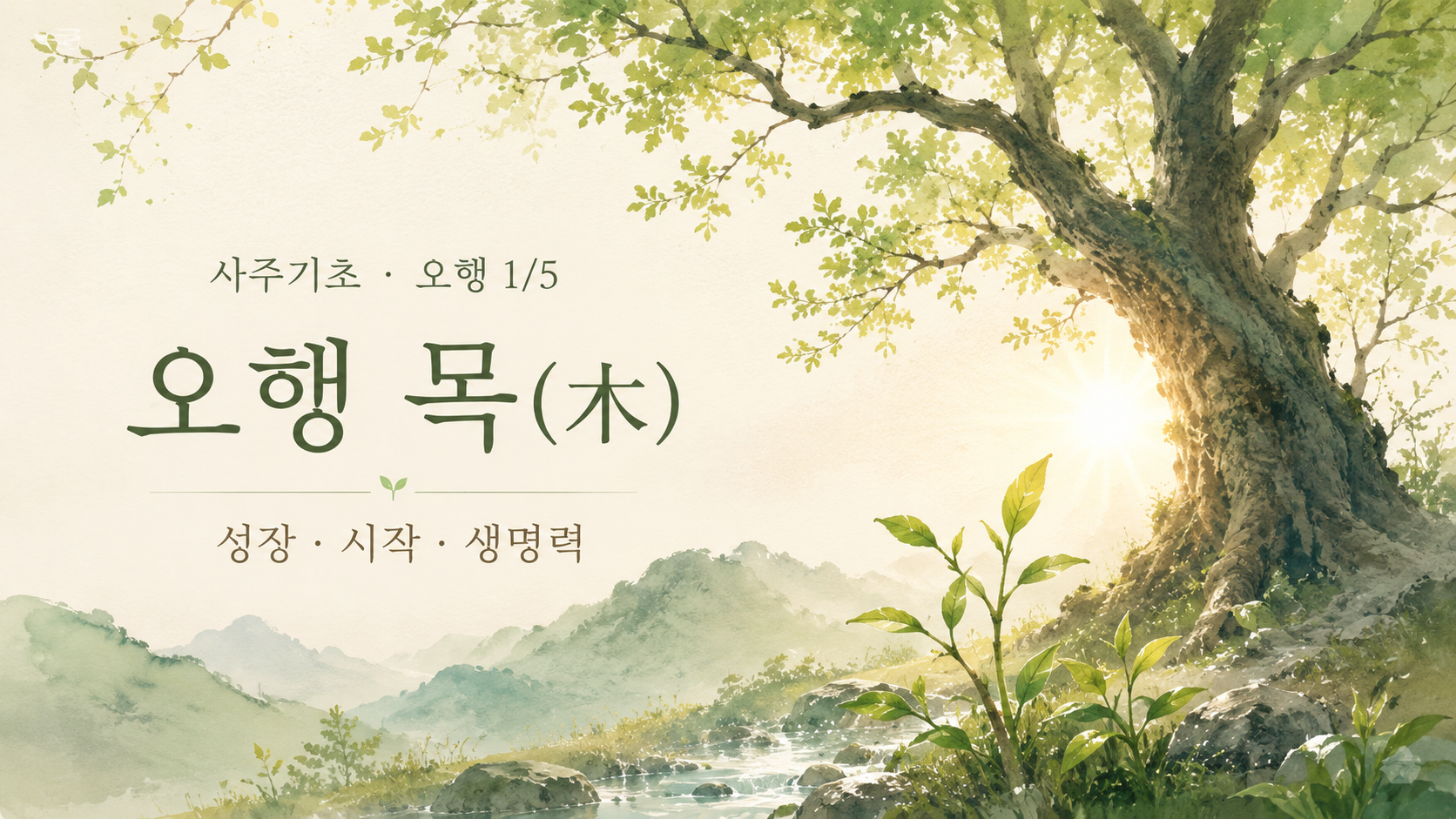
This article is the first in a five-part series on the basic Five Elements of Saju, exploring the fundamental meanings and natural symbolism of the Wood element. It establishes a foundational understanding of the Wood element through its interrelationships, such as 'Water generating Wood' (水生木), 'Wood generating Fire' (木生火), 'Metal controlling Wood' (金剋木), and 'Wood controlling Earth' (木剋土).
Fundamental Meaning of the Wood Element
In the Five Elements, the Wood element symbolizes the outward and upward movement of nascent life. Just as a seed sprouts and a stem and branches grow, the Wood element is a fundamental concept for understanding the flow of initiation, growth, expansion, and development.
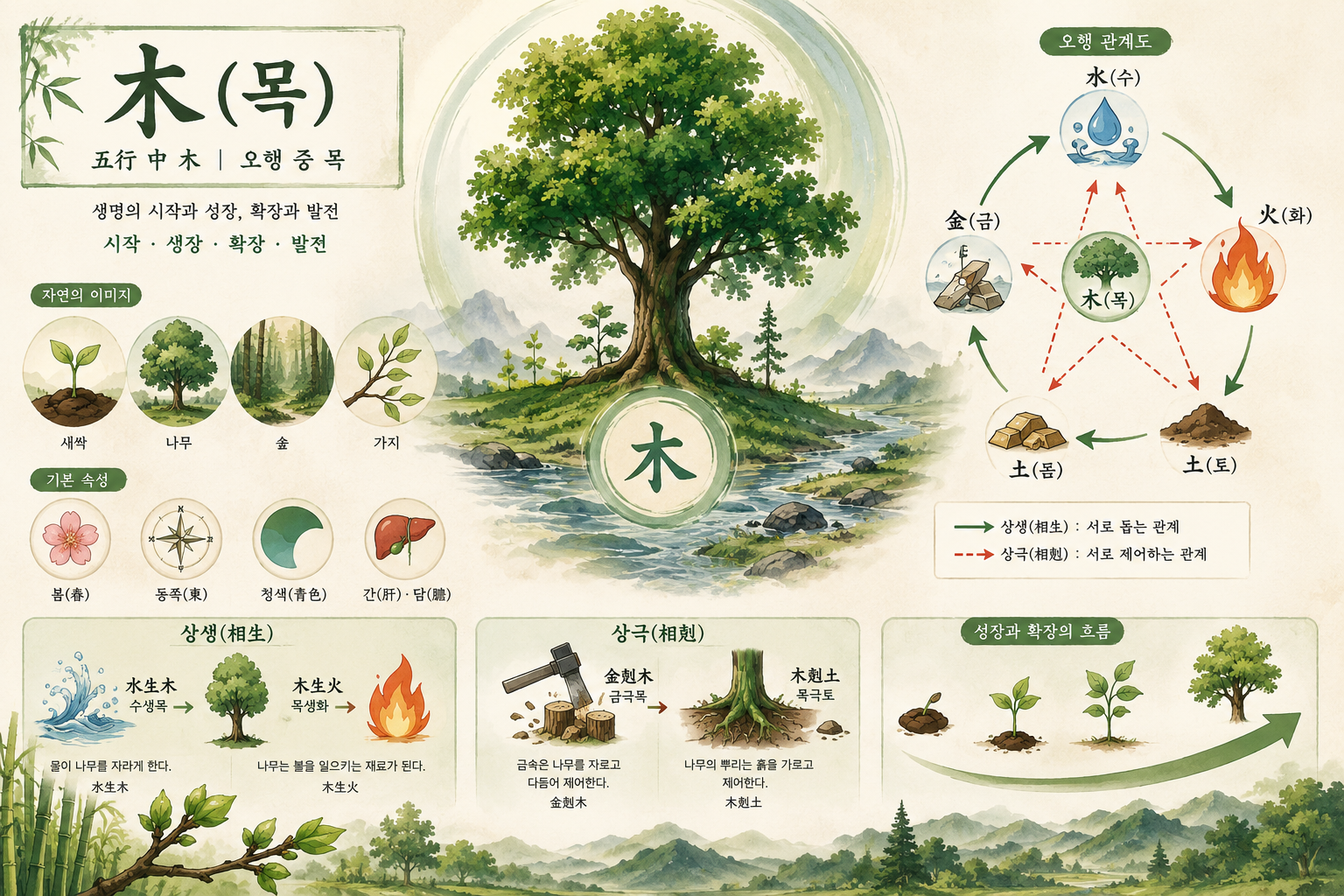
Here, the Wood element does not refer solely to an actual tree. In Myeong-ri (Korean traditional astrology), it represents the nature of emergence and unfolding amidst natural changes, expressed as a symbolic system.
Natural Imagery and the Symbolism of Spring
When understanding the Wood element, the most representative natural images are sprouts, trees, forests, straight-growing stems, and branches spreading in all directions. The energy condensed during winter emerges and grows outwards in spring, closely resembling the movement of the Wood element.
In traditional Five Elements correspondence, the Wood element is associated with spring, the East, and blue or green colors. These are not separate pieces of information but rather symbols that collectively describe the ‘flow of new beginnings and growth,’ like the direction of the rising sun, the season when life reactivates, and the color of new sprouts and leaves.
Summary of the Wood Element’s Core Attributes
| Category | Core Correspondences of the Wood Element |
|---|---|
| Primary Meaning | Beginning, growth, expansion, development |
| Representative Season | Spring |
| Direction | East |
| Color | Blue/Green |
| Representative Natural Images | Sprouts, trees, forests, spreading branches |
| Element that Generates the Wood Element | the Water element |
| Element Generated by the Wood Element | the Fire element |
| Element Controlled by the Wood Element | the Earth element |
| Element that Controls the Wood Element | the Metal element |
| Traditional Bodily Correspondence | Liver (肝) · Gallbladder (膽) |
Traditional bodily correspondences are reference information summarizing symbolic classifications used in the Five Elements system. This should not be expanded into judgments about diseases or actual health conditions.
Generative Cycle (Sangsaeng) of the Wood Element
Generative Flow
the Water element → the Wood element → the Fire element
Water Generates Wood (水生木): the Water element Generates the Wood Element
Based on the natural phenomenon that trees need water to grow, the Water element is described as supporting the growth and development of the Wood element. The condensed and stored flow of the Water element can be understood as beginning to manifest externally through the Wood element.
Wood Generates Fire (木生火): the Wood Element Generates the Fire Element
Similar to how wood serves as fuel for fire, the growth and expansion of the Wood element lead to the emission and activity of the Fire element. In the flow of the Five Elements, the movement of the Wood element (initiating and growing) is seen as transitioning to the more outwardly expressive stage of the Fire element.
Controlling Cycle (Sanggeuk) of the Wood Element
Controlling Flow
the Metal element → the Wood element → the Earth element
Metal Controls Wood (金剋木): the Metal element Controls the Wood Element
This relationship derives from the image of metal tools cutting and shaping wood. The Metal element can be understood as the action of setting boundaries and adjusting forms to prevent the Wood element from endlessly extending.
Wood Controls Earth (木剋土): the Wood Element Controls the Earth Element
This relationship is explained by the image of tree roots penetrating the ground, breaking through soil, and absorbing nutrients. The Wood element can be seen as an action that disturbs the fixed, consolidating nature of the Earth element to create movement.
The ‘control’ (剋) in Sanggeuk does not signify absolute destruction or negativity. It is important to understand it as a checks-and-balances relationship that regulates excessive flows and maintains balance among the Five Elements.
Fundamental Approach to Understanding the Wood Element in the Four Pillars
When observing the Wood element in the Four Pillars, one can first think of the initiating force, the growing movement, and the tendency to set direction and expand. However, this is merely a starting point for interpretation and not a definitive criterion for determining a person’s personality or life outcomes solely based on the presence of Wood.
Even for the same Wood element, its actual influence can vary depending on the season it appears in, its position within the Four Pillars, and its relationship with the Water, Fire, Earth, and Metal elements. In the basic stage, it is appropriate to learn the symbols and relationships of the Wood element, and to examine specific strengths, weaknesses, and roles in advanced interpretations later.
Why Quantity Alone Cannot Determine the Strength of the Wood Element
While it is possible to identify whether there are many or few Wood element characters in the Four Pillars, the quantity alone cannot determine if the Wood element is strong or weak.
| Factors to Consider | Basic Reason |
|---|---|
| Season | Even the same Wood element can gain different levels of strength depending on the season it is born in. |
| Position | Its manifestation can vary depending on its position in the Heavenly Stems, Earthly Branches, and the four pillars. |
| Surrounding Elements | The support of the Water element, the flow towards the Fire element, and the relationships with the Metal and Earth elements must be considered together. |
| Overall Structure | The overall connection and balance of the entire Four Pillars take precedence over a single element. |
Therefore, judgments such as ‘it’s unconditionally good because there’s a lot of Wood’ or ‘there must be a problem because there’s no Wood’ do not align with basic principles. Specific assessments of strength and weakness are covered in advanced Five Elements studies or actual Four Pillars interpretation stages.
Common Misconceptions
- The Wood element does not refer solely to an actual tree. It is a symbol representing the growing and unfolding movement of nature.
- The generative cycle (Sangsaeng) is not always good, and the controlling cycle (Sanggeuk) is not always bad. Both relationships are necessary for the circulation and regulation of the Five Elements.
- The quantity of the Wood element and its actual strength are not the same thing. Season, position, surrounding elements, and overall structure must be considered together.
- One cannot determine personality or occupation based on the Wood element alone. Basic symbolism is just one factor in interpreting the entire Four Pillars.
- Traditional bodily correspondences are not medical diagnoses. They should only be referenced as a symbolic correspondence chart within the Five Elements.
Key Takeaways for the Wood Element
- The Wood element symbolizes the movement of initiation, growth, expansion, and development.
- It is connected with the images of spring, the East, blue/green colors, and sprouts/trees.
- In Sangsaeng, the Water element generates the Wood element, and the Wood element generates the Fire element.
- In Sanggeuk, the Metal element controls the Wood element, and the Wood element controls the Earth element.
- In the Four Pillars, one must consider the season, position, surrounding elements, and overall structure, not just the quantity of the Wood element.
Introduction to the Basic Five Elements Series
Basic Five Elements Series: the Wood element · the Fire element · the Earth element · the Metal element · the Water element
The next article will examine the fundamental meaning, natural symbolism, and Sangsaeng and Sanggeuk relationships of the Fire element.