As the sixth of the Heavenly Stems, Gi (己) Day Master embodies the Yin polarity Earth (土) energy. Much like soft, fertile earth, Gi (己) Day Master represents stability, nurturing growth, and embracing all things, playing a pivotal role in a Four Pillars theory chart. This article will thoroughly examine the fundamental meaning of Gi (己) Day Master and practical guidelines for its interpretation in Four Pillars theory.
The Basic Meaning of Gi (己) Day Master and Its Chinese Character Interpretation
己, the Chinese character, originally signifies ‘self’ or ‘body,’ also encompassing the meaning of ‘already.’ In Four Pillars theory, beyond this self-centeredness, it is primarily interpreted as the image of ‘cultivated land’ such as ‘paddy fields’ or ‘gardens’—soft earth that nurtures all things. This symbolizes not merely hard ground, but fertile soil that embraces life and cultivates growth.
This meaning connects to the tendency of individuals with a Gi (己) Day Master Day Master to value their personal space, care for their surroundings, and seek stable relationships. Furthermore, it demonstrates a characteristic of steadfastly protecting oneself while flexibly embracing external changes and harmoniously blending with them.
Key Characteristics of Gi (己) Day Master in Yin-Yang and Five Elements Theory
Gi (己) Day Master corresponds to the Yin polarity Earth (土). While the Yang polarity Earth element Mu (戊) can be likened to vast, magnificent mountains or great plains, the Yin polarity Earth element Gi (己) is closer to the image of small, soft, fertile earth, such as a paddy field or a garden patch. This signifies that Gi (己) is deeply associated with productive activities like planting, nurturing, and bringing forth fruition.
Due to the nature of the Earth (土) Five Elements, Gi (己) Day Master seeks balance and stability, acting as a connector and regulator for all things. As a Yin polarity Earth element, it tends to slowly absorb and process external stimuli internally, transforming them in its own way, rather than reacting immediately. This characteristic explains Gi’s (己) tendency to grow stably while harmonizing with its environment.
Interpreting Gi (己) Day Master Through Natural Imagery and Energy Direction
When Gi (己) Day Master is compared to natural elements, it is like a well-tended paddy field, garden, or soil in a pot. This soil holds seeds, absorbs water, and receives sunlight to nurture life. Its energy expands from the center in all directions, embracing all things, while simultaneously drawing external energy inward to store and mature.
This imagery vividly demonstrates Gi’s (己) ‘receptivity’ and ‘cultivating capacity.’ Rather than unconditionally rejecting external stimuli or changes, Gi (己) Day Master excels at bringing them into its own domain, transforming them to suit its needs, and creating new value. It’s much like fertile soil that accepts various seeds and allows them to bear different fruits.
The Position and Role of Gi (己) Day Master in a Four Pillars Chart
In a Four Pillars theory chart, the influence of Gi (己) varies depending on its position. If Gi (己) is in the Year Pillar, it relates to ancestry or early childhood environment. If in the Month Pillar, Gi’s (己) characteristics manifest in one’s profession, social life, and relationship with parents. If Gi (己) is in the Day Pillar, it most significantly impacts one’s personality and marital relationship. If in the Hour Pillar, the energy of Gi (己) Day Master can be observed in one’s later years, children, and personal activities.
Specifically, individuals with a Gi (己) Day Master tend to be stable and realistic, with a deep capacity for empathy and care for others. However, they may sometimes struggle to express their inner feelings or exhibit resistance to change. A nuanced understanding is required to determine how the positive and negative aspects of Gi (己) Day Master manifest through its harmony with other characters within the chart.
How Gi (己) Day Master Changes When Interacting with Other Heavenly Stems and Earthly Branches
When Gi (己) Day Master encounters other Heavenly Stems and Earthly Branches, its nature transforms in diverse ways. For instance, meeting Gap (甲) Wood forms a ‘Gap-Gi Earth combination’ (甲己合土), generating new Earth (土) energy, which signifies stability and fruition. Conversely, meeting Eul (乙) Wood can imply conflict or change, as Eul (乙) Wood is depicted as digging into and disturbing the Gi (己) Earth.
The relationship with the Earthly Branches is also crucial. Gi (己) Earth prefers damp energy, so meeting Water element energy like Hae, the Pig Earthly Branch Water or Ja, the Rat Earthly Branch Water makes it more fertile and vibrant. However, encountering other Earth (土) Earthly Branches such as Jin, the Dragon Earthly Branch, Chuk, the Ox Earthly Branch, Mi, the Goat Earthly Branch, or Sul, the Dog Earthly Branch can lead to an excess of Earth (土) energy, potentially resulting in stubbornness or a feeling of being stifled. Thus, one must interpret the dynamic changes of Gi (己) Day Master through its interactions with surrounding characters.
Common Misconceptions When Novices Interpret Gi (己) Day Master
One common misconception among novices when interpreting Gi (己) Day Master is to simply regard it as ‘weak and passive earth.’ However, while Gi (己) Day Master is a Yin polarity Earth element, it possesses an active power to cultivate fertility and nurture life. Though outwardly gentle, it holds strong patience and perseverance inwardly, demonstrating resilience in consistently fulfilling its role.
Another misconception is to assume that Gi (己) Day Master is ‘insensitive to change.’ While Gi (己) Day Master seeks stability, it also possesses an excellent ability to adapt and transform itself in response to its environment. This wisdom implies utilizing external stimuli in a favorable way, much like soil that absorbs water and nutrients to grow diverse plants.
Key Checkpoints for Interpreting Gi (己) Day Master
When interpreting Gi (己) Day Master in a Four Pillars theory chart, it is good to approach it focusing on the following questions:
- The strength of Earth (土) energy within the chart: How strongly are other Earth (土) Five Elements positioned besides Gi (己) Earth? An excess of Earth (土) can lead to stubbornness or feeling stifled, while a deficiency can result in a lack of stability.
- Presence and harmony of Water element energy: Gi (己) Earth needs appropriate Water element energy to be fertile. Check if there is a suitable amount of Water element energy in the chart, or if there is too much, making the soil soggy.
- Relationship with Wood element energy: Gi (己) Earth plays a role in nurturing Wood element energy. If Wood (木) is too strong, the soil can be dug up; if too weak, Gi (己) Earth’s nurturing ability may not manifest effectively.
- Role of Fire element energy: Fire element warms Gi (己) Earth, infusing it with vitality. Observe if the Fire element energy is appropriate, or if it is too strong, causing the soil to dry out.
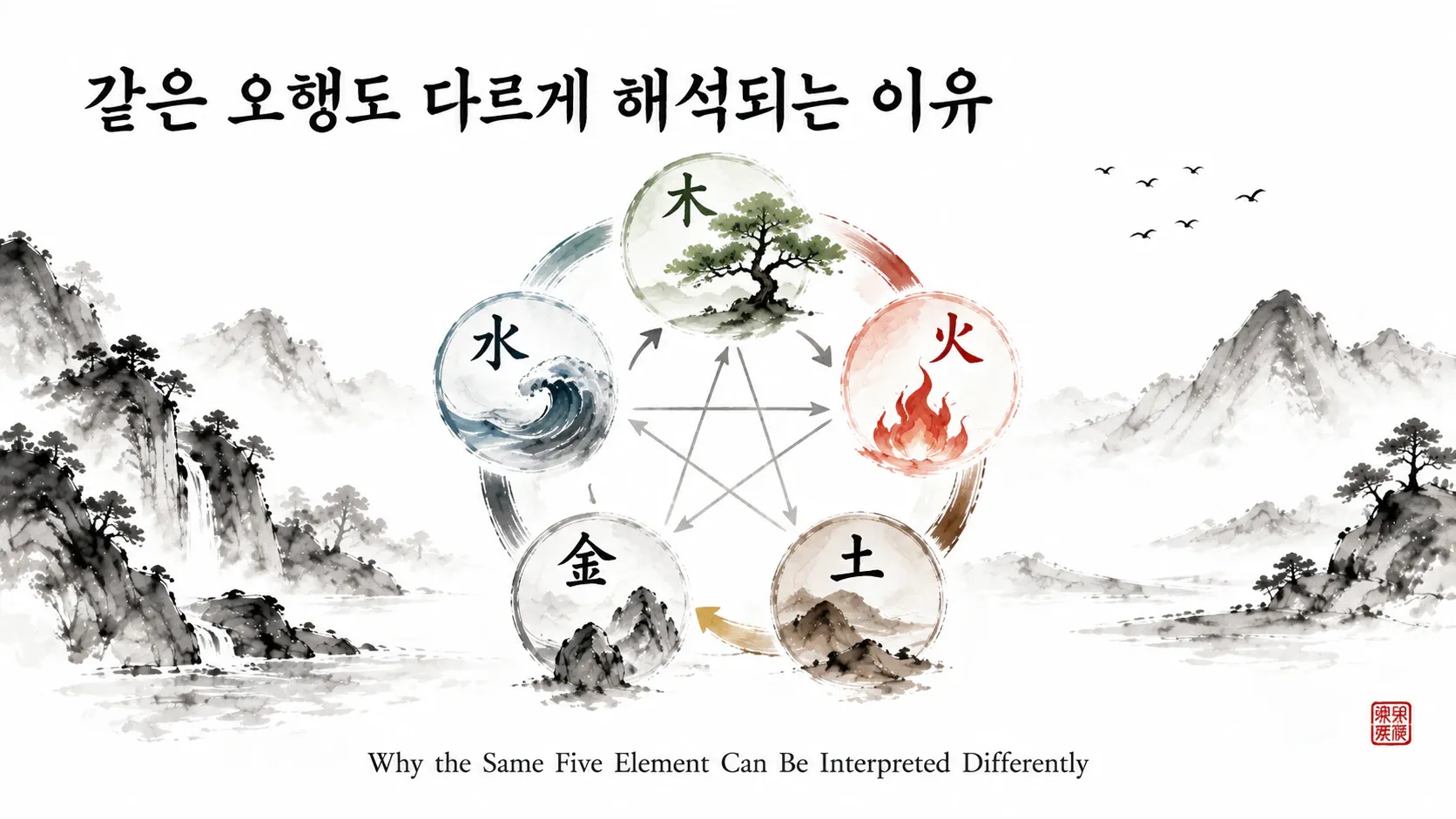
- Interaction with Metal element energy: Metal element can drain the energy of Earth (土), and Gi (己) Earth can also generate Metal element. Understand how Metal element energy affects Gi (己) Earth.
- Presence of Heavenly Stem combinations (天干合) and clashes (天干沖): Predict changes in Gi (己) Day Master through its relationships with other Heavenly Stems, such as combinations with Gap (甲) Wood or clashes with Gye, the Yin Water Heavenly Stem Water.
- Relationship with Earthly Branches: Consider the characteristics of the Earthly Branches where Gi (己) Earth is located (e.g., Gi (己) Earth above Hae, the Pig Earthly Branch Water, Gi (己) Earth above Chuk, the Ox Earthly Branch Earthly Branch) to concretize the nature of Gi (己) Day Master.
Through these checkpoints, one can move beyond the simple meaning of Gi (己) Day Master and develop a three-dimensional understanding of its role and manifestation within the broader context of the entire chart.
Connecting to the Next Heavenly Stem: Gyeong, the Yang Metal Heavenly Stem (Gyeong)
We have explored the diverse meanings and interpretation criteria of Gi (己) Day Master, the fertile earth that nurtures and embraces all things. Just as Gi (己) Earth completes the cycle of life by holding seeds and bringing forth fruition, the next Heavenly Stem, Gyeong, the Yang Metal Heavenly Stem Metal, symbolizes the time when these fruits manifest in a solid form.
Gyeong, the Yang Metal Heavenly Stem is the Yang polarity Metal element, representing sturdy and unyielding energy like cast iron or rock. If Gi (己) Earth represented the ‘process’ of nurturing life, then Gyeong, the Yang Metal Heavenly Stem Metal is the ‘result’ of that process and a ‘tool’ for new beginnings. In the next article, we will delve into the basic meaning of the strong and firm Gyeong, the Yang Metal Heavenly Stem Metal and its interpretation criteria in Four Pillars theory.