The Four Pillars Four Pillars theory acts as a map of the energy an individual is born with, but that map does not equate to a fixed destiny. It is common for two people with identical Four Pillars charts to lead completely different lives. This serves as an important example showing that the Four Pillars do not simply dictate fate; rather, they reveal an individual's potential and tendencies, with the final outcomes depending on how those are utilized and the environment in which one lives.
The Four Pillars Four Pillars theory acts as a map of the energy an individual is born with, but that map does not equate to a fixed destiny. It is common for two people with identical Four Pillars charts to lead completely different lives. This serves as an important example showing that the Four Pillars do not simply dictate fate; rather, they reveal an individual’s potential and tendencies, with the final outcomes depending on how those are utilized and the environment in which one lives.
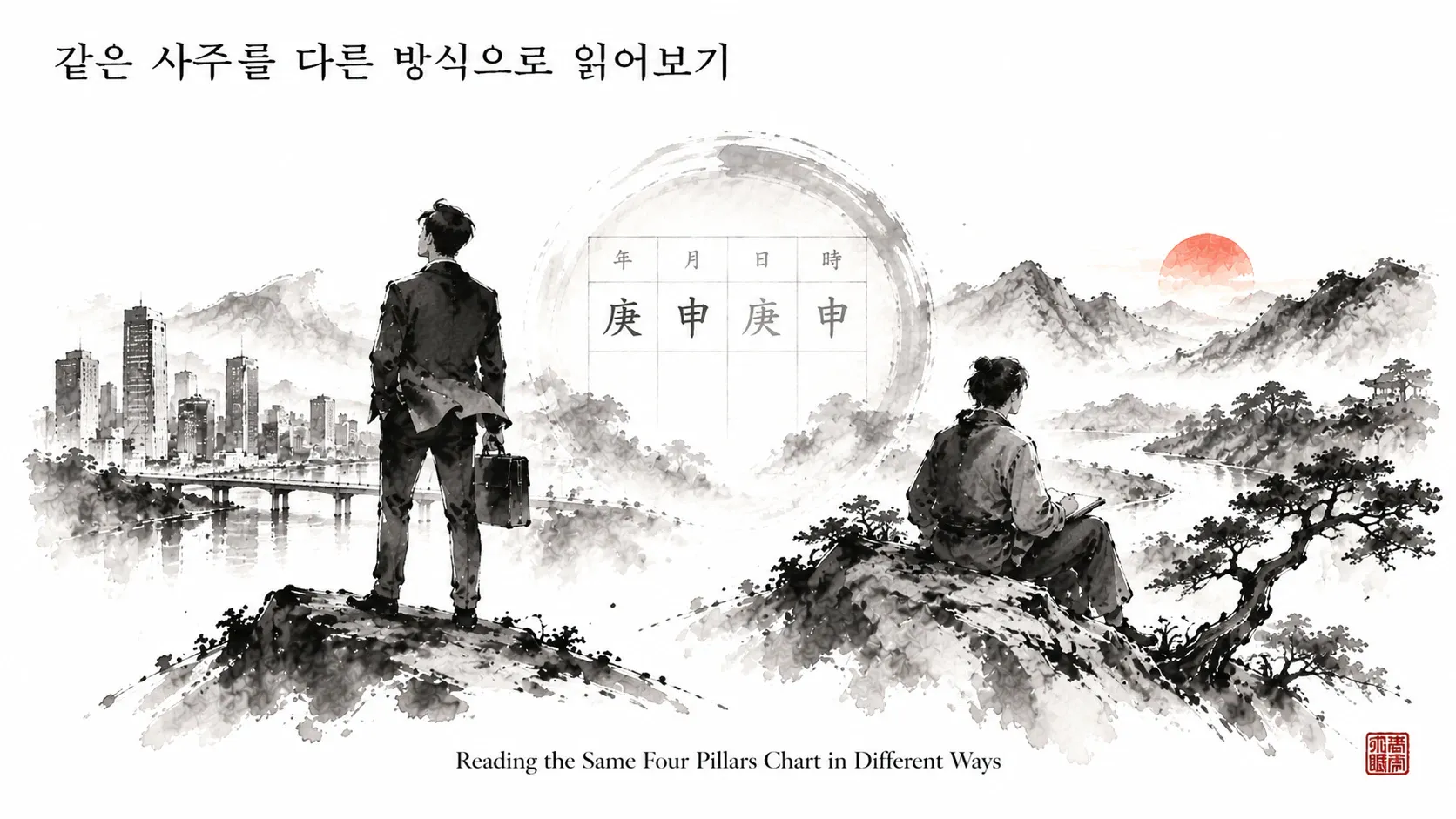
For instance, let’s assume a hypothetical chart where the Day Master is Geng Metal and the Month Branch is Shen Metal, resulting in a very strong Metal element energy. Such a chart is typically interpreted as having high potential for strong willpower, decisiveness, and goal-oriented tendencies. However, how this potent metal energy manifests in the lives of two different individuals can vary drastically based on their choices and surroundings.
The hypothetical chart mentioned above is structured with a Geng Metal Day Master born in the month of Shen, leading to a highly vigorous metal energy. This embodies the characteristics of metal within the five elements: rigidity, skilled technique, analytical thinking, and sometimes sharpness. This energy can act as a powerful driving force, providing the stamina to persist toward goals. Additionally, metal is closely associated with specialized skills or precise work, indicating a high potential for expertise in specific fields.
However, as with any intense energy, if this metal is not properly regulated or balanced, it can lead to stubbornness, interpersonal conflict, or excessive perfectionism. When reading Four Pillars, it is crucial not just to look at the intensity of elements, but to examine how that energy interacts with others to achieve balance.
The reason two people with the same Four Pillars live different lives is that the Four Pillars represent a ‘map of possibilities,’ not a ‘fixed script of fate.’ While Four Pillars reveals one’s inherent temperament and potential, the direction in which that potential manifests depends heavily on the surrounding environment, individual will, and choices.
One person might channel strong metal energy into a career in the military or the legal profession, where strict discipline and order are valued, thereby contributing to the realization of social justice. In this case, their strong metal energy manifests positively, symbolizing leadership and fairness. Conversely, another person with similar metal energy might find themselves in a fiercely competitive and unfair environment, leading them to use that same intensity to suppress or criticize others. This demonstrates how the same energy can produce entirely different social roles and outcomes depending on the environment.
The energy shown in the Four Pillars is like a seed. Just as any seed needs good soil, proper water, and sunlight to grow well, an individual’s potential can blossom according to their own efforts and resolve. A person with strong metal energy could sharpen their focus to master precise technical skills or become an expert who solves complex problems with keen insight. Conversely, if that energy is left unutilized, they might simply be perceived as stubborn and inflexible. Ultimately, Four Pillars only shows what kind of seed one was born with; how that seed is cultivated is entirely up to the individual.
When reading Four Pillars, the key is not to look only at the dominant elements, but to understand the overall balance and find ways to supplement what is lacking. If metal energy is too strong, as in the hypothetical example, other elements—such as Fire element or Water element—may be needed to regulate and harmonize it. Fire tempers metal to make it more useful, while water softens the sharpness of metal, adding flexibility.
This supplementation is not just sought within the native Four Pillars chart. Individuals can consciously shape their environment, choose specific careers, or engage in hobbies to fill in missing energies. For example, a person with strong metal energy might find harmony through artistic activities (water energy) or by interacting with warm-hearted people (fire energy). This represents a wise attitude of actively carving out one’s life rather than passively accepting the Four Pillars.
While attempting to understand oneself through Four Pillars is highly beneficial, hasty conclusions can be harmful. It is dangerous to blindly trust the tendencies presented by the Four Pillars and force a specific career or personality, or to assume that a certain fate is inescapable. Human life possesses a complexity and diversity that cannot be explained solely by the eight characters of the Four Pillars Eight Characters. The meanings within the Four Pillars are infinite, and there are many ways to interpret them.
When looking at Four Pillars, one should always approach it with the language of possibility, such as ‘this tendency may exist.’ Just because a specific element is strong does not mean that only its negative aspects will appear, nor does a lack of an element mean that part of life will remain permanently unfulfilled. Four Pillars interpretation is merely a reference material to understand one’s life and move in a better direction; it cannot be an absolute standard for judgment.
Human life is a process of constant change and development. Decisions made today can alter tomorrow, and unexpected encounters can shift the direction of one’s life. No matter how meticulously the Four Pillars are analyzed, they cannot capture all the dynamics and unpredictability of life. Four Pillars merely shows the ‘archetype’ of the energy given at birth; how that archetype evolves and changes over time holds infinite possibilities depending on the interaction between individual effort and the external environment.
Therefore, while using Four Pillars to understand yourself, you must not fall into the error of limiting your own potential or judging others’ lives prematurely. Four Pillars is like a compass that tells us what potential we were born with and what energies we react to more sensitively. It is entirely our own choice which path we walk while holding that compass.
As demonstrated, even with the same Four Pillars chart, there can be various ways to interpret and apply it to life. We need the wisdom to deeply understand ourselves through Four Pillars while using it as an opportunity for change and growth rather than accepting it as a fixed destiny. Four Pillars informs us of the characteristics of the energy given to us, but it is the individual’s role to decide how to use that energy, and we must remember that infinite possibilities open up during that process.
In the next article, I will delve deeper into specific methods for transforming Four Pillars interpretation from a definitive diagnosis into an expression of possibility. We will continue to explore the wisdom of creating a richer and more self-directed life through Four Pillars.