This is the fifth installment in the Saju Reading series. Following the previous four parts, which outlined the overall structure of a Saju chart by examining the distribution of the Five Elements, we now turn to assessing the strength and weakness of the Day Master, which represents the core self. This article will explore key criteria for determining the Day Master's vitality and how to apply them in an actual chart.
Diagnosing the strength and weakness of the Day Master is a crucial first step in interpreting a Saju chart. The Day Master signifies ‘self,’ and its relative strength or weakness determines whether it holds dominance or is heavily influenced by the surrounding Five Elements and the Ten Gods. The objective at this stage is not merely to classify it as strong or weak, but to understand the specific circumstances under which it exhibits strength or weakness.
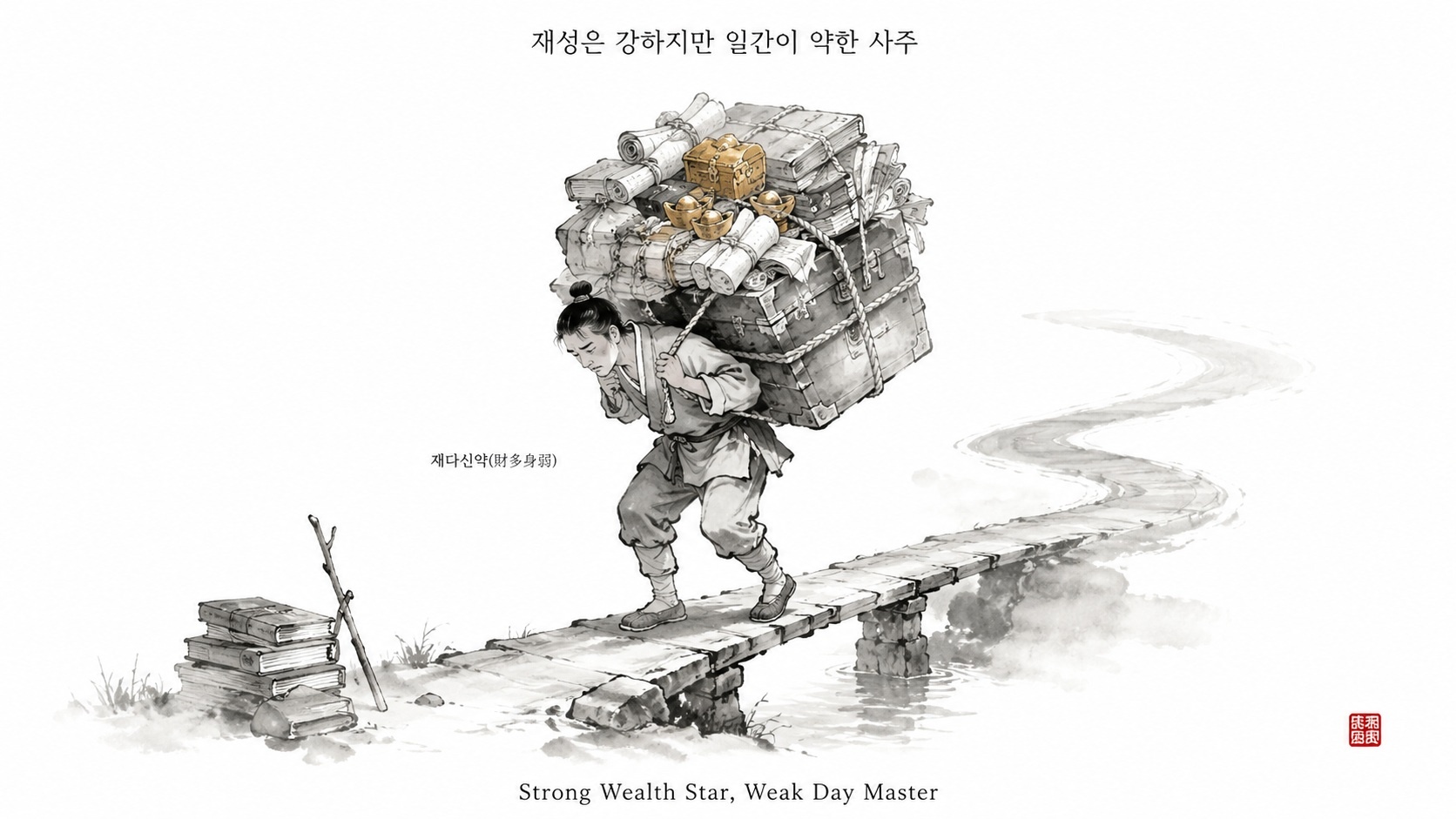
In previous installments, we covered the overall sequence for reading a Saju chart, identified the position of the Day Master, and examined the distribution of the Five Elements. Understanding the Day Master’s strength and weakness is essential for accurately grasping the interplay of the Ten Gods in the subsequent stages. For instance, even with an abundance of Wealth stars (재성), a weak Day Master may struggle to manage finances. Conversely, a strong Day Master can effectively utilize powerful Authority stars (관성). Thus, the Day Master’s strength and weakness serve as a fundamental benchmark for all interpretations, re-establishing the meaning of other elements. Skipping this crucial step makes it difficult to comprehend the overall balance and harmony of the entire Saju chart.
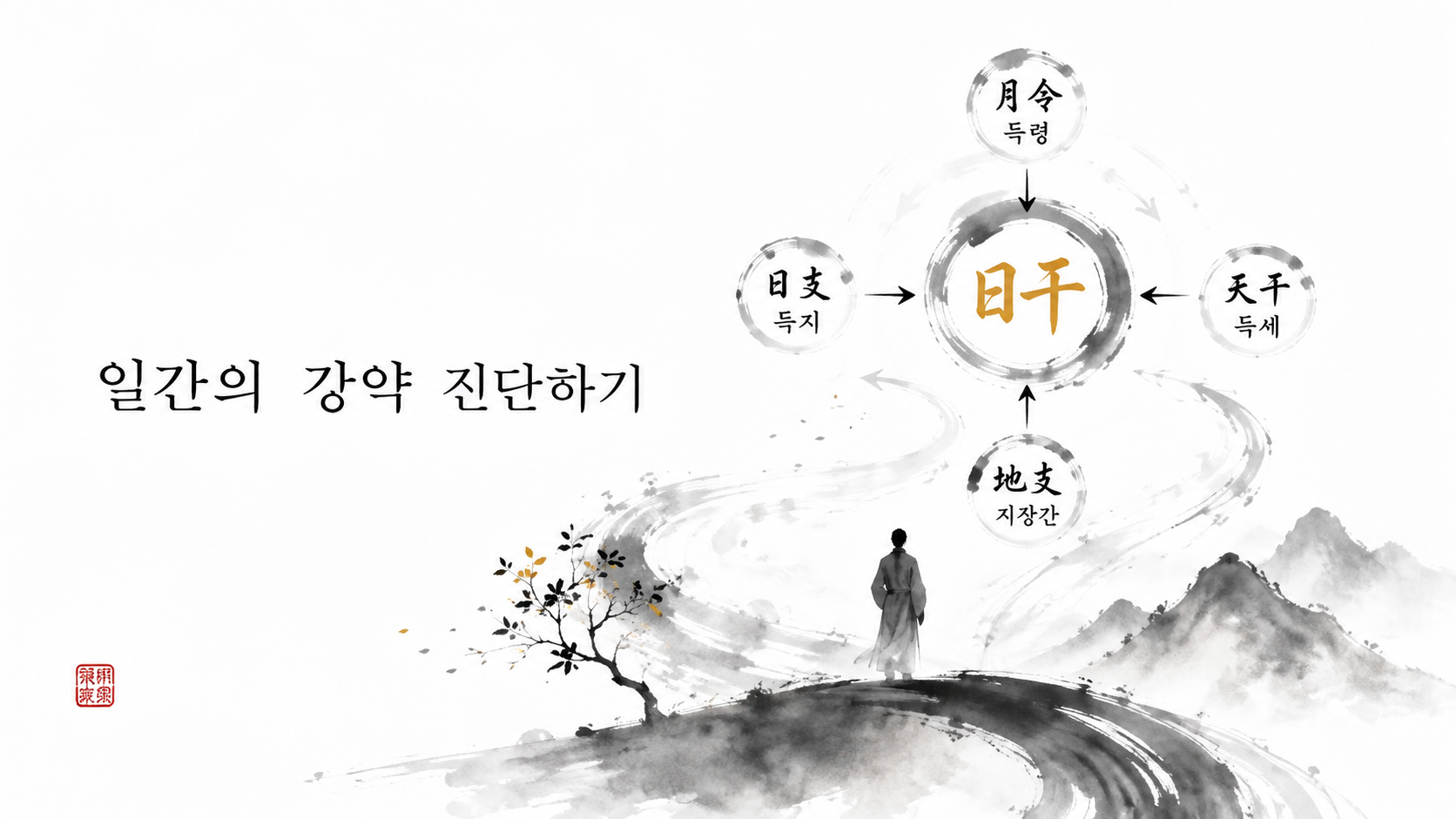
The Day Master is located in the Heavenly Stem of the Day Pillar. When diagnosing the Day Master’s strength and weakness, three main criteria are used for assessment:
Monthly Command seasonal support: This refers to cases where the Month Branch, where the Day Master was born, belongs to the same Five Element as the Day Master or generates the Day Master. Since the Month Branch represents the environment and season of the Saju chart, gaining power from the Month Branch is the most critical criterion for determining the Day Master’s strength and weakness.
root support from Branches: This refers to cases where the Day Branch, which is the seat of the Day Master, belongs to the same Five Element as the Day Master or generates the Day Master. The Day Branch acts as the root for the Day Master.
support from allied elements: This refers to cases where, excluding the Month Branch and Day Branch, other Heavenly Stems and Earthly Branches (especially the Hidden Heavenly Stems, or Jijanggan) have many Five Elements that are the same as or generate the Day Master. It indicates how much support is received from the surroundings.
These three criteria are combined to determine the Day Master’s strength and weakness. It is crucial to consider the importance of each position, rather than simply counting the number of characters.
Beginners often make the following mistakes when assessing the Day Master’s strength and weakness:
Simply Counting Characters: There’s a tendency to assume a Day Master is strong if it has many Five Elements that assist it. However, the influence of the Month Branch is far greater than other Earthly Branches, and the roles of Heavenly Stems and Earthly Branches also differ, so judgment should not be based solely on numbers.
Confusing Strength/Weakness with Good/Bad Fortune: There’s a tendency to think a strong Day Master is inherently good, and a weak one is bad. The Day Master’s strength or weakness itself does not denote good or bad fortune; rather, it serves as a criterion for understanding the overall balance and harmony of the entire Saju chart. Both strong and weak Day Masters have their own corresponding life paths and fortune flows.
Overlooking Hidden Heavenly Stems: Often, beginners assess only the Five Elements of the Earthly Branches themselves without checking the Hidden Heavenly Stems concealed within them. Since Hidden Heavenly Stems represent the Day Master’s hidden roots or potential, they must always be considered.
Here is a simple procedure for diagnosing the Day Master’s strength and weakness:
1. Check the Month Branch: First, determine if the Day Master receives support and aid (생조) from the Month Branch or is controlled and depleted (극설) by it. The relationship with the Month Branch is considered to determine over 50% of the Day Master’s strength and weakness.
2. Check the Day Branch: Determine if the Day Master receives support and aid (생조) from the Day Branch, its seat, or is controlled and depleted (극설) by it. The Day Branch serves as the direct root for the Day Master.
3. Check Surrounding Heavenly Stems: Determine if other Heavenly Stems surrounding the Day Master provide support and aid or control and deplete it.
4. Check Surrounding Earthly Branches and Hidden Heavenly Stems: Excluding the Month Branch and Day Branch, determine if other Earthly Branches and the Hidden Heavenly Stems within them provide support and aid or control and deplete the Day Master.
5. Comprehensive Judgment: Synthesize the above elements to determine if the Day Master is generally strong, weak, or close to neutrality (중화). When doing so, consider the influence of each element (Month Branch > Day Branch > other Earthly Branches > Heavenly Stems).
Once the Day Master’s strength and weakness have been accurately diagnosed, you are ready to understand the structure of the Ten Gods, a core element of the Saju chart. In the next installment, we will delve into how the Ten Gods operate and their meanings based on the Day Master’s strength and weakness. This will provide a more concrete understanding of the interconnected relationships within the Saju chart.