This eighth article in the Four Pillars Reading series focuses on how to integrate the Daeun (Major Fortune) and Seeun (Minor Fortune) cycles. While the previous installment explored the dynamic changes within one's Myeongshik (natal chart) through Branch combination, clash, penalty, break, and harm, this article examines how these changes manifest within the flow of Daeun and Seeun. It aims to provide a framework for understanding how the Myeongshik's energy interacts at the intersection of Daeun and Seeun, offering practical criteria for interpreting these flows in an actual Four Pillars analysis.
The eighth step in the Four Pillars Reading series involves connecting the Daeun (Major Fortune) and Seeun (Minor Fortune) cycles to understand the dynamic changes within a Myeongshik (natal chart). The objective is to learn the criteria for interpreting how Daeun and Seeun influence the Myeongshik and how their interaction reveals the flow of fortune.
A Four Pillars (Four Pillars) Myeongshik is not static; it constantly changes within the temporal flow of Daeun and Seeun. Daeun represents the overarching trends and environment over a 10-year period, while Seeun signifies specific events and energies within a single year. Interpreting these independently without considering their connection makes it difficult to grasp the relationship between detailed events occurring within the broader direction. Since the Myeongshik’s energy specifically manifests through Seeun within the larger framework of Daeun, understanding this link is a core criterion for Four Pillars interpretation.
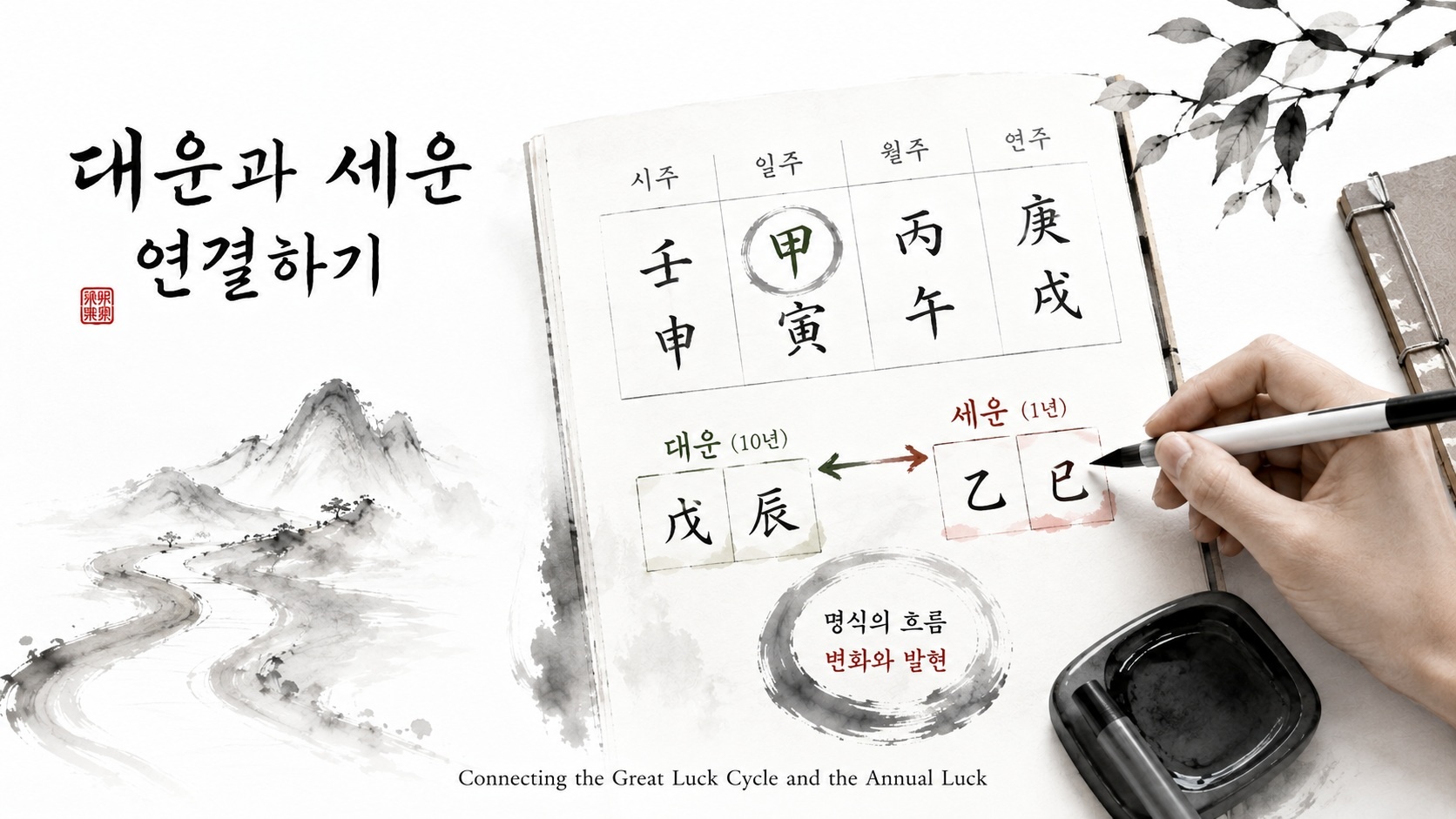
Daeun is typically indicated on the bottom or side of the Four Pillars Myeongshik chart, showing 10-year cycles. Seeun refers to the annual changing Heavenly Stems and Earthly Branches, which are usually not explicitly marked on the chart but are applied during interpretation. It is crucial to identify how Daeun and Seeun interact with the Myeongshik’s Heavenly Stems and Earthly Branches through relationships such as Branch combination (Branch combination), Branch clash (Branch clash), Branch penalty (Branch penalty), Branch break (Branch break), and Branch harm (Branch harm). Furthermore, it’s important to observe how the Heavenly Stems and Earthly Branches of Daeun and Seeun interact with each other.
Beginners often tend to view Daeun and Seeun as independent fortune cycles or solely focus on their relationship with the Myeongshik. However, it’s easy to overlook that Daeun acts as a ‘major environment’ that moderates the auspiciousness or inauspiciousness of Seeun. For instance, if the Daeun is flowing in a positive direction, any unfavorable energies from Seeun might be mitigated. Conversely, if the Daeun is unfavorable, even minor disruptions from Seeun could feel significant. Moreover, the multi-layered interactions that occur when Daeun and Seeun simultaneously create complex Branch combination, clash, penalty, break, and harm relationships with the Myeongshik are frequently missed.
Determine the relationship between the Heavenly Stems and Earthly Branches of the current Daeun and each of the Myeongshik’s pillars (Year Pillar, Month Pillar, Day Pillar, Hour Pillar), observing for combination, clash, penalty, break, and harm.
Determine the relationship between the Heavenly Stems and Earthly Branches of the current Seeun and each of the Myeongshik’s pillars.
Identify the relationship between the Heavenly Stems and Earthly Branches of Daeun and Seeun themselves.
Synthesize all these relationships to establish criteria for predicting how the Myeongshik’s energy flow will change and what events are likely to occur.
Thus, connecting Daeun and Seeun to interpret the dynamic changes in a Myeongshik is a core process in Four Pillars analysis. We have systematically learned the sequence for reading a Four Pillars and the criteria for identifying each element. The next installment will conclude this Four Pillars Reading series by covering how to synthesize all the learned elements to interpret and organize a complete Myeongshik chart.