Yin and Yang is one of the most fundamental concepts for understanding Four Pillars, yet it is often misunderstood as a dichotomy of good versus bad. However, the essence of Yin and Yang lies in balance and contrast, where neither aspect is inherently superior or inferior. This article aims to clarify common misconceptions about Yin and Yang and present the correct perspective for building a solid foundation in Four Pillars interpretation.
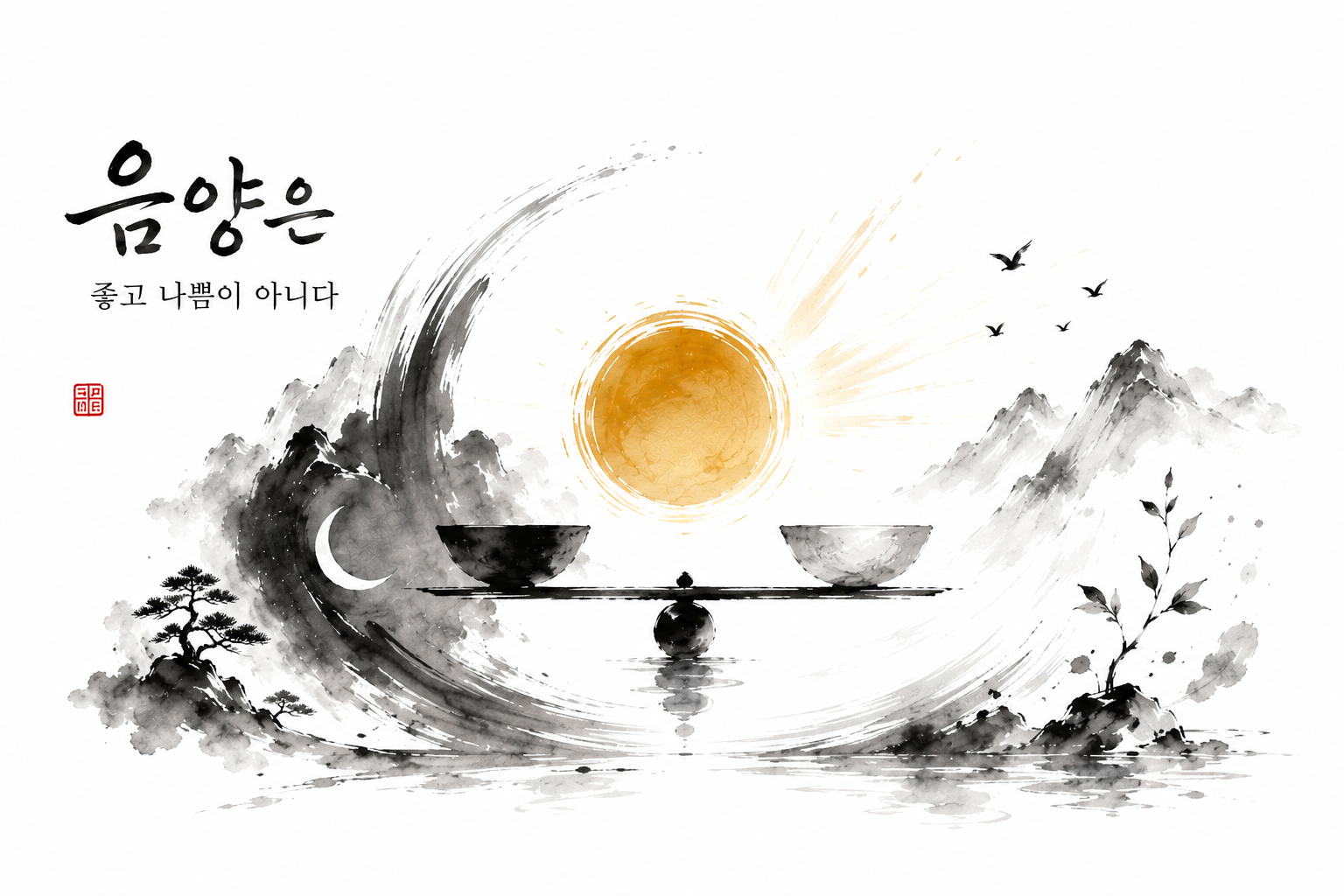
Yin and Yang refer to the two opposing yet complementary energies that constitute all things in the universe. It’s common to mistakenly view Yin as dark and negative, and Yang as bright and positive, but this distorts the true nature of Yin and Yang. They are not subject to value judgments; rather, they give meaning to each other’s existence and maintain a state of balance.
For instance, if day is Yang, then night is Yin. Just as one cannot say day is good and night is bad, Yin and Yang are simply different states with distinct characteristics. The crucial point is that these two energies harmonize to create and transform all phenomena.
The concept of Yin and Yang can be easily observed in our daily lives. All phenomena, such as male and female, sun and moon, hot and cold, movement and stillness, inherently possess Yin and Yang attributes. These are not merely opposites but exist by influencing and interacting with each other.
Male (Yang) and Female (Yin): While they play different roles in the process of conception and nurturing life, neither can be complete without the other.
Sun (Yang) and Moon (Yin): They create day and night, enabling life on Earth.
Respiration (Inhale – Yin, Exhale – Yang): Life is sustained only when inhalation and exhalation occur in harmony.
Thus, Yin and Yang are not fixed attributes of specific objects or phenomena but rather reveal their meaning within relative relationships.
In Four Pillars Four Pillars theory, Yin and Yang form the foundation of all theories. The Heavenly Stems (Cheongan) and Earthly Branches (Jiji) that constitute the Eight Characters of the Four Pillars, as well as the Five Elements (Wood element, Fire element, Earth element, Metal element, Water element), are each assigned Yin or Yang attributes. For instance, even within the Wood element, ‘Gapmok (甲木)’ is classified as Yang Wood, while ‘Eulmok (乙木)’ is Yin Wood. This distinction goes beyond merely categorizing wood types; it signifies differences in the characteristics and manifestation of their energies.
When analyzing Four Pillars, Yin and Yang are not used as criteria to determine fortune or misfortune, but rather as crucial tools to understand an individual’s tendencies, temperament, and the flow of their destiny. It cannot be unconditionally deemed good or bad if a particular Yin or Yang energy is strong or weak; the core lies in examining the overall harmony and balance.
The Five Elements refer to five energies: Wood element, Fire element, Earth element, Metal element, and Water element. Each of these elements is further divided into Yin and Yang. For example, the Wood element element is categorized into Yang Gapmok (甲木) and Yin Eulmok (乙木). If Gapmok symbolizes the strong, upright energy of a large tree or a forest, Eulmok is likened to the flexible, trailing nature of small grasses or flowers.
As such, even within the same Five Element, its characteristics and manifestations differ significantly depending on its Yin or Yang aspect. This serves as a crucial clue for identifying subtle individual differences in Four Pillars interpretation. A precise understanding requires not just looking at the type of element, but also considering whether that element possesses Yin or Yang attributes.
Yin and Yang are not about good or bad, but about balance. In Four Pillars, when Yin and Yang are skewed, creating an imbalance, we can anticipate specific tendencies or challenges that may arise. For example, an excessively strong Yang energy might make an individual active and assertive, but also impatient and impulsive. Conversely, an overly strong Yin energy could lead to caution and calmness, but also passivity or indecisiveness.
The important thing is not to judge such imbalances as ‘bad,’ but rather to explore how to find balance and lead a harmonious life. Four Pillars Four Pillars theory offers wisdom to maximize individual potential and compensate for weaknesses through this balance of Yin and Yang.
One of the most common misunderstandings among those new to Four Pillars is perceiving Yin and Yang as concepts of good versus evil, or superiority versus inferiority. It bears repeating: Yin and Yang are not criteria for value judgment. One must move beyond the simplistic notion of Yin as passive and dark, and Yang as active and bright.
Yin and Yang are interdependent and derive meaning from each other’s existence. Just as night is necessary for day to shine, and rest makes activity meaningful, Yin and Yang are principles of nature that continuously transform and cycle. By understanding Yin and Yang from this perspective, one can take a step closer to the profound wisdom of Four Pillars Four Pillars theory.
In the next article, we will delve deeper into how the characteristics of the same Five Element can differ based on its Yin or Yang aspect.