This article explores how an imbalance of the Five Elements, specifically a hypothetical Four Pillars chart with strong Metal element energy and weak Wood element energy, offers insights into Four Pillars interpretation. While a specific chart is used as an example, it serves as a learning tool for understanding Four Pillars, rather than a definitive statement about an individual's actual fate or personality. The focus is on understanding the importance of balance and harmony through the interaction of each of the Five Elements.
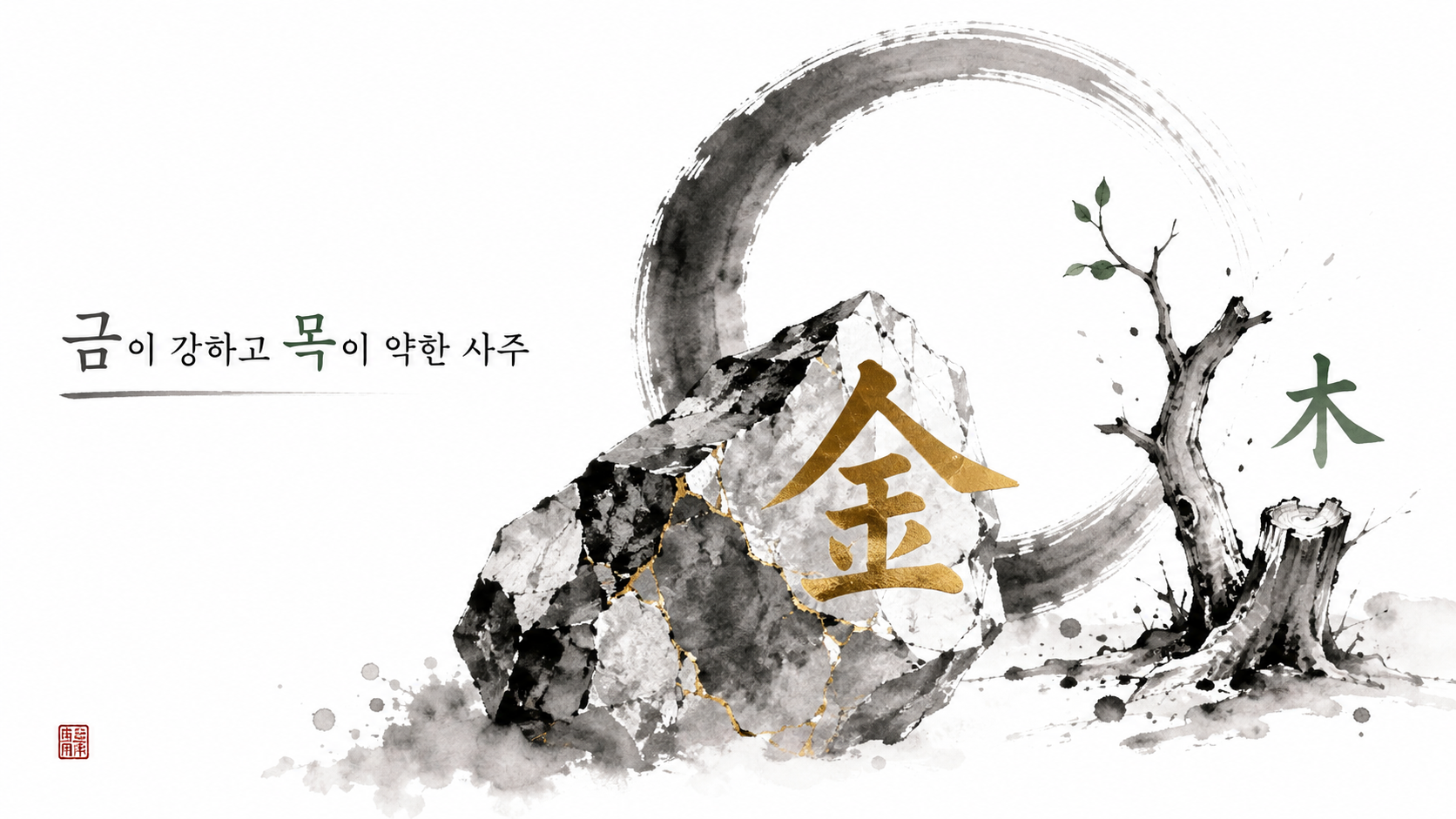
The hypothetical Four Pillars chart discussed in this article features a relatively strong Metal element element and a weak Wood element element. The distribution of the Five Elements within a Four Pillars chart provides crucial clues for understanding an individual’s potential characteristics and their interactions with their environment. Through this hypothetical case, we aim to explore how the strength or weakness of specific Five Elements impacts the overall Four Pillars.
The Metal element element symbolizes fruition, a cutting or transformative energy (肅殺之氣, *suksaljigi*), firmness, and loyalty. In contrast, the Wood element element represents growth, new beginnings, benevolence, and drive. In this hypothetical Four Pillars, an overdeveloped Metal element energy can suppress the Wood element element. This dynamic is comparable to strong metal cutting down wood, illustrating a specific imbalance in the Five Elements’ creative and destructive cycles (상생상극, *sangsangsaeng-sanggeuk*).
A strong Metal element element and weak Wood element element is more than just a quantitative comparison of the two. Powerful Metal element can burden weak Wood element, manifesting in various ways depending on its relationship with other Five Elements within the Four Pillars. For instance, if the Metal element element receives support from the Earth element element, its strength can further intensify. Alternatively, the Water element element might deplete the Metal element’s energy while nourishing Wood element. The crucial aspect is to understand the overall flow and interaction of the Five Elements, rather than focusing solely on the individual strength or weakness of each.
Balance and complementarity are vital concepts in Four Pillars interpretation. In a structure where Metal element is strong and Wood element is weak, balance may require reinforcing the Wood element element or appropriately moderating the strong Metal element element. This could manifest as using the Water element element to deplete Metal element’s energy and nourish Wood element, or employing the Fire element element to refine strong Metal element, thereby creating an environment where Wood element can flourish. This perspective helps in understanding the potential characteristics of a Four Pillars chart and utilizing them in a positive direction.
While learning the principles of the Five Elements through hypothetical Four Pillars cases is beneficial, it is highly risky to apply them directly to an individual’s life to definitively determine personality, profession, health, or destiny. The Four Pillars is a complex interplay of numerous factors; even charts with similar strengths and weaknesses in the Five Elements can manifest vastly different outcomes depending on factors such as the Grand Cycle (대운, *daeun*), Annual Cycle (세운, *seun*), personal effort, and environment. Defining an individual’s characteristics solely by the strength or weakness of specific Five Elements overlooks the inherent depth of Four Pillars.
A Four Pillars chart is not merely a combination of a few Five Elements; it is an organic integration of countless factors, including the Heavenly Stems and Earthly Branches, Hidden Stems, Shin-sal (divine and evil spirits), and 12 Life Stages. Surface-level information, such as strong Metal element and weak Wood element, cannot fully capture a person’s complex inner world or life path. Four Pillars interpretation requires an approach that respects each individual’s unique characteristics and embraces possibilities. While it is possible to understand the ‘tendency’ for certain elemental strengths or weaknesses to correlate with particular dispositions, it is crucial to refrain from accepting these as ‘definitive facts’.
In this article, we examined the imbalance of the Five Elements and its interpretive perspective through a hypothetical Four Pillars with strong Metal element and weak Wood element. In the next article, we will explore the characteristics and interpretation methods of another Five Element combination: a hypothetical Four Pillars with a strong Water element element and a weak Fire element element. We hope you look forward to the next installment.