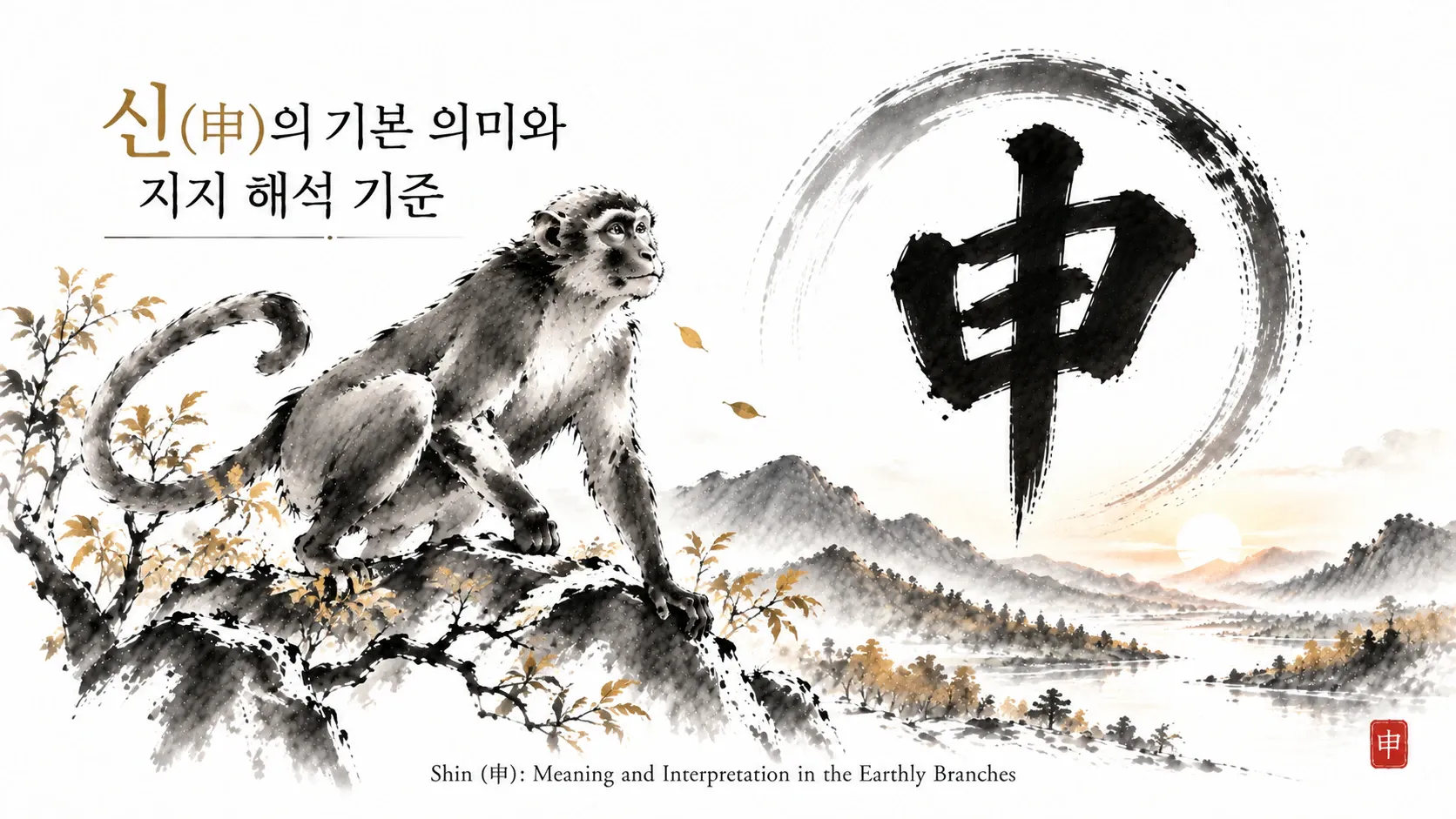
As the ninth Earthly Branch, Sin, the Monkey Earthly Branch is often associated with the Monkey. However, its significance in Four Pillars extends far beyond the traits of a simple animal. Representing the height of autumn, Sin, the Monkey Earthly Branch symbolizes a time when all things reach fruition and prepare for harvest. This article explores the core meaning of Sin, the Monkey Earthly Branch, detailing how to interpret it within a Four Pillars chart by considering factors such as season, time, direction, Five Elements, yin-yang, and hidden stems.
Sin, the Monkey Earthly Branch is the ninth of the twelve Earthly Branches and is commonly associated with the Year of the Monkey. However, interpreting Sin, the Monkey Earthly Branch solely through the characteristics of a monkey is a superficial approach in Four Pillars. The Kanji for Sin, the Monkey Earthly Branch carries meanings such as ‘to lay out,’ ‘to spread,’ ‘to speak,’ and ‘to reveal,’ symbolizing the process by which all things reach fruition and unveil their results to the world. It also implies ‘bending the body,’ which represents the energy condensation and preparation needed for this fruition. These complex layers are essential for understanding the dynamic and transformative energy of Sin, the Monkey Earthly Branch.
Sin, the Monkey Earthly Branch shares the clever and talented image of the monkey while embodying an active drive to finalize results and broadcast them to the world. Therefore, it is more accurate to interpret Sin, the Monkey Earthly Branch not just as ‘being talented,’ but as the wisdom to plan and execute new ventures based on established outcomes.
Sin, the Monkey Earthly Branch marks the middle of autumn, specifically the period from mid-August to mid-September in the solar calendar, when the intense heat of summer recedes and the harvest ripens. As autumn is the time for fruition and harvesting, Sin, the Monkey Earthly Branch signifies achievement and the reaching of conclusions. Chronologically, it corresponds to the hours between 3:00 PM and 5:00 PM—the time when the sun begins to tilt toward the west—signifying a turning point where activities conclude and the next phase is prepared. Directionally, it points to the west, the sunset horizon, and the center where harvests are gathered.
Understanding these coordinates is vital for grasping the energy of Sin, the Monkey Earthly Branch. The abundance of autumn, the calm introspection of the late afternoon, and the western direction all reinforce the theme of ‘wisdom and execution based on results.’
Sin, the Monkey Earthly Branch corresponds to the Metal element element. Metal element symbolizes fruition, ‘Suksalsigi’ (the energy of harvest and decline), decisiveness, justice, and logical thinking—traits that align perfectly with the autumn season. In terms of Yin-Yang, Sin, the Monkey Earthly Branch is classified as Yang polarity. As Yang polarity represents active and outward energy, Sin, the Monkey Earthly Branch tends to use the harvest-oriented power of Metal element to actively manifest results in the world. This leads to a strong drive for planning and execution.
Possessing Metal element in a Yang polarity polarity suggests that those with Sin, the Monkey Earthly Branch are skilled at achieving goals and solving problems through logic and analysis. However, if this sharp, rigid energy is excessive, it can manifest as stubbornness or a hyper-critical nature.
Each Earthly Branch contains hidden stems known as the hidden stems inside the Branches. The hidden stems inside the Branches for Sin, the Monkey Earthly Branch are Mu, the Yang Earth Heavenly Stem, Im, the Yang Water Heavenly Stem, and Gyeong. Here, Mu, the Yang Earth Heavenly Stem is Earth element energy, which fosters inclusion and mediation; Im, the Yang Water Heavenly Stem is Water element energy, representing wisdom and flow; and Gyeong is Metal element energy, symbolizing sharpness and fruition. These reveal the complex energy of Sin, the Monkey Earthly Branch.
The hidden stems inside the Branches suggest that Mu (Earth) grounds the autumn harvest, Im (Water) provides the wisdom gained for future preparation, and Gyeong (Metal) signifies the final completion of the harvest. As the ‘King’s Land’ for Metal element, Sin, the Monkey Earthly Branch represents the strongest manifestation of this element, granting individuals the ability to not only achieve results but to leverage the wisdom gained during that process for their next steps.
The role of Sin, the Monkey Earthly Branch varies depending on its position in the Four Pillars chart. If it appears in the Month Branch, the individual may exhibit strong logical and analytical tendencies alongside a great ability to produce results. In the Day Branch, it may influence the nature of one’s spouse or one’s own approach to relationships, favoring decisive and logical partners. In the Hour Branch, it may reflect talent in offspring or a fruitful later life. To interpret Sin, the Monkey Earthly Branch accurately, one must look beyond its isolated meaning and consider the overall context of the chart, including relationships with other stems and branches.
The nature of Sin, the Monkey Earthly Branch shifts significantly through its interactions with other branches. For example, when it joins with Ja or Jin, the Dragon Earthly Branch to form a Three Harmony combinations, it generates Water element energy, suggesting that the harvest power of Metal element is shifting toward wisdom and new directions. Conversely, a Branch clash with In, the Tiger Earthly Branch brings a clash between the harvest of autumn and the birth of spring, often resulting in movement or change. Relationships such as Branch penalty with Sa, the Snake Earthly Branch and Hae, the Pig Earthly Branch can signal hidden conflicts or internal transformations.
Analyzing these relationships is crucial for predicting potential obstacles or the manifestation of hidden potential. If Sin, the Monkey Earthly Branch clashes with In, the Tiger Earthly Branch, plans may face unexpected delays, while a Three Harmony combinations can enhance one’s ability to acquire and utilize information.
Beginners often mistake Sin, the Monkey Earthly Branch simply as the ‘Monkey’ and over-emphasize the animal’s traits. While the monkey is clever, this is only a fraction of Sin, the Monkey Earthly Branch’s deeper symbolic meaning—which includes autumn fruition, logical decision-making, and wisdom for the next phase. Another misconception is that Sin, the Monkey Earthly Branch is always positive. Because it carries the sharp, ‘Suksalsigi’ energy of Metal element, it can be critical and inflexible. Its overall impact depends on the balance of the entire Four Pillars chart.
Sin, the Monkey Earthly Branch’s interpretation relies on several key criteria: Basic Meaning: Autumn fruition, harvest, logical thinking, decisiveness, execution, preparation; Season/Time/Direction: Mid-autumn, 3:00-5:00 PM, West; Five Elements/Yin-Yang: Metal element / Yang polarity; hidden stems inside the Branches: Mu (Earth), Im (Water), Gyeong (Metal); Positional interpretation: Varies by Month, Day, and Hour branches; Relationships: Three Harmony combinations with Ja, the Rat Earthly Branch and Jin, the Dragon Earthly Branch, Branch clash with In, the Tiger Earthly Branch, etc.; Note: Do not limit analysis to the animal zodiac.
We have explored how Sin, the Monkey Earthly Branch signifies the height of autumn, focusing on fruition and preparation. Now, we move to its successor, Yu, the Rooster Earthly Branch, which represents the late autumn period where the final harvest is concluded. While Sin, the Monkey Earthly Branch focuses on the process and preparation for the harvest, Yu, the Rooster Earthly Branch represents the finalization and sorting phase. The next article will delve into the fundamental meanings and interpretation criteria for Yu, the Rooster Earthly Branch.