As the concluding part of our foundational Five Elements series, we delve into the the Earth element, which stands as the center of all things and a mediator of change. This guide explains the fundamental meaning of the the Earth element, its natural symbolism, and its generating cycle and overcoming cycle relationships with other elements in an accessible way for beginners. We will also explore the significance of the Earth element in Four Pillars analysis.
What the the Earth element Signifies
In the Five Elements system, the the Earth element represents more than just the physical form of earth. It symbolizes the central force that balances all things, regulates change, and connects and mediates other elements. Much like a seed taking root and bearing fruit, the the Earth element is linked to the fundamental power that nurtures life and brings forth fruition. This symbolism demonstrates that the Earth element encompasses meanings of stability and harmony, extending beyond mere soil.
Natural Symbolism of the the Earth element Through Earth and Seasonal Changes
Key natural images associated with the the Earth element include land, soil, the great earth, and mountains. These images represent the foundation upon which all life relies and takes root, showcasing its vast capacity to accept and embrace change. Seasonally, it corresponds to the transitional periods (환절기) between spring and summer, summer and autumn, and autumn and winter, symbolizing the Earth element’s role in mediating times of change and transition. It is associated with the center direction and the color yellow, further emphasizing its meaning of centrality and harmony.
Summary of the the Earth element’s Core Attributes
| Attribute | Symbol | Meaning |
|---|---|---|
| Centrality | Center, Great Earth | Balance, Harmony, Mediation |
| Stability | Land, Mountain | Firmness, Patience, Trust |
| Inclusiveness | Soil, Great Earth | Acceptance, Nurturing, Storage |
| Change | Transitional Periods | Transition, Connection, Regulation |
The generating cycle Relationship of the the Earth element
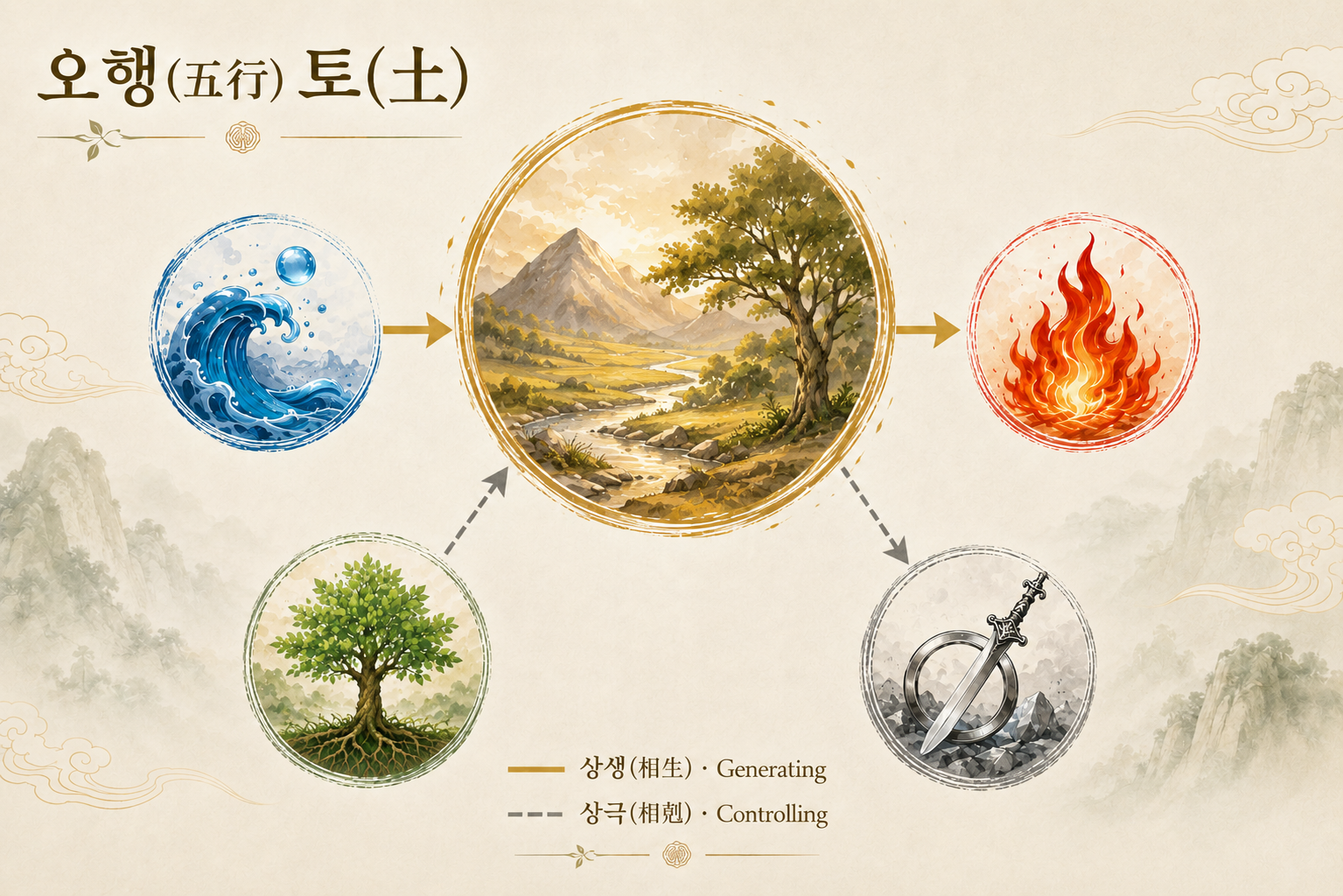
The generating cycle describes a relationship where elements support and foster one another. The the Earth element plays a vital role by either receiving assistance from other elements or providing aid to them.
Fire Generates Earth (火生土)
When fire (火) burns, it transforms into ash (土) that returns to the earth, making it fertile. This symbolizes the cooling of intense energy into a stable form or the creation of a new foundation (土) from the results of active endeavor (火). It represents a relationship where the energy of the the Fire element strengthens and enriches the the Earth element.
Earth Generates Metal (土生金)
Within the earth (土), metals (金) are formed and extracted. This signifies the earth’s role in containing and nurturing the raw materials for metal. It symbolizes the stability and concentrated energy of the the Earth element manifesting as the solid and refined form of the Metal element.
The overcoming cycle Relationship of the the Earth element
The overcoming cycle denotes a relationship where elements mutually overcome and control each other. However, this is not merely a negative interaction but rather a dynamic of checks and balances essential for maintaining overall equilibrium.
Wood Overcomes Earth (木剋土)
The roots of a tree (木) penetrate the earth (土), breaking up the soil and absorbing nutrients. This symbolizes how wood consumes and controls the energy of the earth. When the Earth element is excessively strong, the Wood element appropriately checks it, preventing the earth from becoming too rigid and aiding its circulation.
Earth Overcomes Water (土剋水)
The earth (土) can block or absorb the flow of water (水). Just as a dam or embankment holds water, and soil absorbs it, the the Earth element regulates and stores the overflow of the Water element. This demonstrates the controlling power of the the Earth element in preventing floods and creating a stable environment.
Criteria and Considerations for Interpreting the the Earth element in Four Pillars
In Four Pillars, the the Earth element signifies centrality, mediation, stability, trustworthiness, and inclusiveness. When the Earth element’s energy is well-balanced, it can indicate a stable, trustworthy, and highly capable mediator. However, an excess of Earth element can lead to stubbornness and resistance to change, while a deficiency might result in a lack of grounding and instability.
When interpreting Four Pillars, it is crucial to avoid defining personality or destiny based on a single element alone. Understanding how the the Earth element interacts with other elements, and its role within the overall harmony and balance of the Five Elements, is essential. For instance, rather than simply concluding that an abundance of Earth element means dullness or stubbornness, one should comprehensively consider whether its stability manifests positively in relation to other elements or, conversely, as excessive attachment.
Concluding the Five Elements Series
In this series, we have explored the fundamental meanings and the generating cycle and overcoming cycle relationships of the five elements: the Wood element, the Fire element, the Earth element, the Metal element, and the Water element. While each element possesses independent significance, they are intimately interconnected, forming a crucial concept that explains all phenomena in the universe. We hope this series has provided you with a foundational understanding of the Five Elements, serving as a solid basis for future in-depth study of Four Pillars. Remember that the Five Elements encapsulate principles of change and circulation, extending beyond a mere categorization of attributes.