One of the most common questions for those new to Four Pillars is, 'Is it a problem if my Four Pillars chart is missing a specific element?' or 'What does it mean if an element is too weak?' While both the absence and weakness of an element are significant factors in Four Pillars analysis, their meanings and impacts differ significantly. This article clarifies the distinction between these two states and explains how to interpret each situation.
The Four Pillars consists of eight characters derived from the year, month, day, and hour of birth, converted into Heavenly Stems and Earthly Branches. These eight characters may contain an even distribution of the five elements—Wood, Fire, Earth, Metal, and Water—or certain elements may appear strong, weak, or entirely absent. Beginners often confuse ‘absence’ with ‘weakness,’ but these concepts demand entirely different interpretive approaches in Four Pillars.
The presence, absence, and strength of elements are not merely criteria for judging good or bad fortune. Instead, they serve as vital clues to understanding the balance and flow of the Four Pillars chart, as well as an individual’s innate temperament and potential. Just as each element holds unique symbolism, the way these elements exist within the Four Pillars can reveal different life paths and fluctuations. Therefore, clearly distinguishing and correctly interpreting these two concepts is the first step toward a deeper understanding of Four Pillars.
When examining the eight characters of the Four Pillars (four Heavenly Stems and four Earthly Branches), along with the hidden Heavenly Stems within the Earthly Branches, the ‘absence’ of an element means that not a single character of that specific element is present. For example, if no characters representing Wood energy (Jia, Yi, Yin, Mao) are found in the stems, branches, or hidden stems of the Four Pillars chart, the element is considered missing.
This absence suggests that the energy or characteristics associated with that element may not manifest directly in one’s life. However, this does not equate to a deficiency or misfortune. Rather, it often indicates that other elemental energies act more strongly, or that the characteristics of the missing element are compensated for through one’s external environment or interactions with others. Like an empty space waiting to be filled, the role of a missing element can be fulfilled or resolved through other means.
When a Four Pillars chart lacks a specific element, it can manifest unique patterns in the six kinship relations, social roles, or psychological traits associated with that element. For instance, a Four Pillars without Wealth stars should not be automatically labeled as having no wealth. Instead, it may suggest a unique value system regarding money, a different approach to financial activities, or a reduced obsession with material gain. It could also imply unconventional methods of acquiring wealth or a unique form of relationship with a spouse.
Interpreting a missing element in a Four Pillars requires focusing on how other elements interact due to that absence, rather than stopping at the fact that it is ‘missing.’ Sometimes, the absent element plays a role in balancing the overall Four Pillars chart, or major shifts may occur when that element enters during a 10-year major cycle or an annual cycle. The key is to understand how the absence impacts the overall harmony and flow of the Four Pillars.
An element is considered ‘weak’ when it exists within the Four Pillars chart but is either few in number (e.g., only one character) or lacks support from surrounding elements, suffering instead from control or having its energy drained. For example, if there is only one Wood character but it is surrounded by many Metal characters that control Wood, or strong Fire characters that drain Wood’s energy, that Wood element is considered weak.
Although a weak element exists, its influence is minimal and it remains vulnerable to external changes. This implies that the energy associated with that element is unstable, requiring more effort or external support to function properly. Much like a tree with weak roots that sways easily in the wind, it can grow sturdy if provided with proper support and nutrition.
Weak elements can introduce instability or fluctuation into the kinship relations or social roles they represent. For example, a Four Pillars with weak Authority stars might experience frequent worries about one’s career or status, or see many changes in professional life. This does not necessarily mean poor career luck, but rather that the process of finding the right career may take longer, or that the person may adopt a more flexible professional outlook.
When interpreting a weak element, one must carefully observe which elements provide support and which exert control. A weak element can gain strength and act positively when an element that generates it appears in the 10-year or annual cycles, or when the elements that suppress it weaken. Thus, a weak element carries potential for growth, leaving room for it to exert power when the right timing and environment are provided.
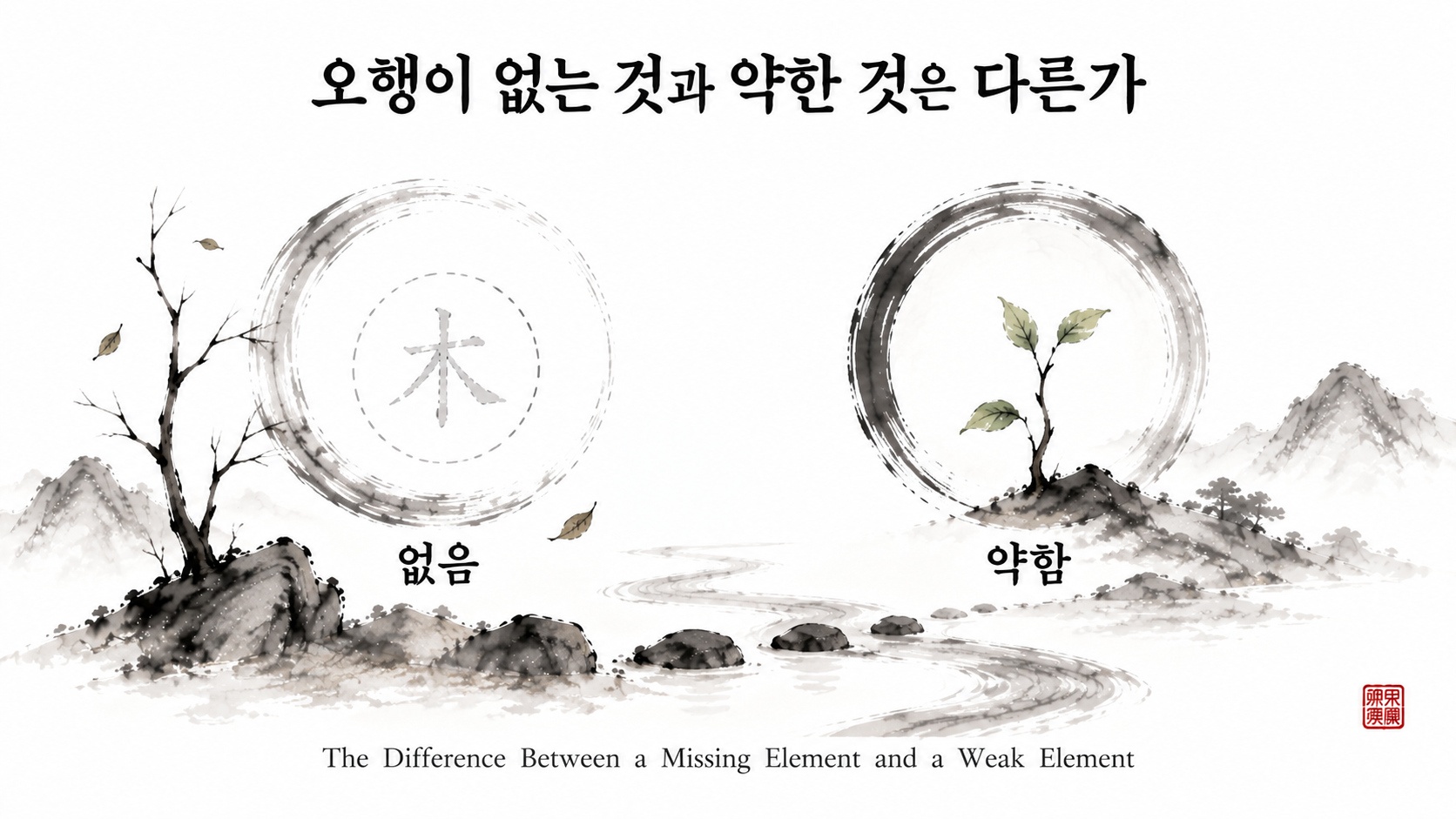
The fundamental difference between ‘absence’ and ‘weakness’ lies in the state of existence. A missing element is entirely absent from the Four Pillars chart, meaning its characteristics are more likely to appear indirectly or be supplemented from the outside rather than manifesting directly. Conversely, a weak element exists; it is not entirely gone but remains in a latent or unstable state. This is akin to the difference between a seed that has yet to sprout and a sprout that has emerged but is still fragile.
A missing element acts as a fixed trait of the Four Pillars itself, whereas a weak element carries ‘changeability,’ as it can strengthen or weaken depending on the surrounding environment. A missing element might manifest as a longing for or indifference toward that energy, while a weak element may manifest as a will to develop through constant effort and supplementation. Consequently, the direction of interpretation changes accordingly.
To judge the presence or strength of an element in a Four Pillars, one must first identify the eight characters of the Heavenly Stems and Earthly Branches, then carefully examine the hidden Heavenly Stems. If a specific element exists even within the hidden stems, it should be viewed as ‘weak’ rather than ‘missing.’ This is because hidden elements function as internal potential or suppressed temperament, even if they are not outwardly visible.
Elemental strength is not determined solely by the number of characters. One must comprehensively consider the impact of the seasons (the month branch), the interactions of generation and control among the elements, and the relationship with the Day Master. For example, if someone born in winter has only one Fire character, it might be seen as weak; however, if that Fire element is a Resource star supporting the Day Master and receives support from Wood energy, it cannot be simply labeled as weak. As such, reading a Four Pillars requires understanding the dynamic interactions between elements, not just their individual existence.
Many people mistakenly assume that missing a specific element in a Four Pillars implies ‘deficiency’ or ‘misfortune,’ or that being weak implies ‘incompetence.’ In Four Pillars theory, however, the absence or weakness of an element does not necessarily carry negative implications. In some cases, a missing element can lead to a freer life unburdened by obsession, or provide an opportunity to excel in specific fields by maximizing the energy of other elements. For example, a Four Pillars without Wealth stars might lead someone to live a life of integrity, unburdened by greed, or find success in professions that manage others’ wealth.
Furthermore, a weak element signifies the potential to become more robust through constant effort and supplementation. One might face difficulties in areas symbolized by a weak element, but the process of overcoming these challenges can lead to greater growth or the development of unique strengths. The important thing is to use the Four Pillars chart to identify one’s strengths and weaknesses and set a wise life direction based on that insight. Elemental presence and strength are not grounds for absolute judgment, but tools for self-understanding and personal development.
This article has clarified the differences between missing and weak elements in Four Pillars and how to interpret each situation. The presence and strength of elements are key to understanding individual characteristics and potential. In our next installment, we will delve into why ‘having many Wealth stars does not automatically make one rich,’ addressing another common misconception in Four Pillars interpretation.