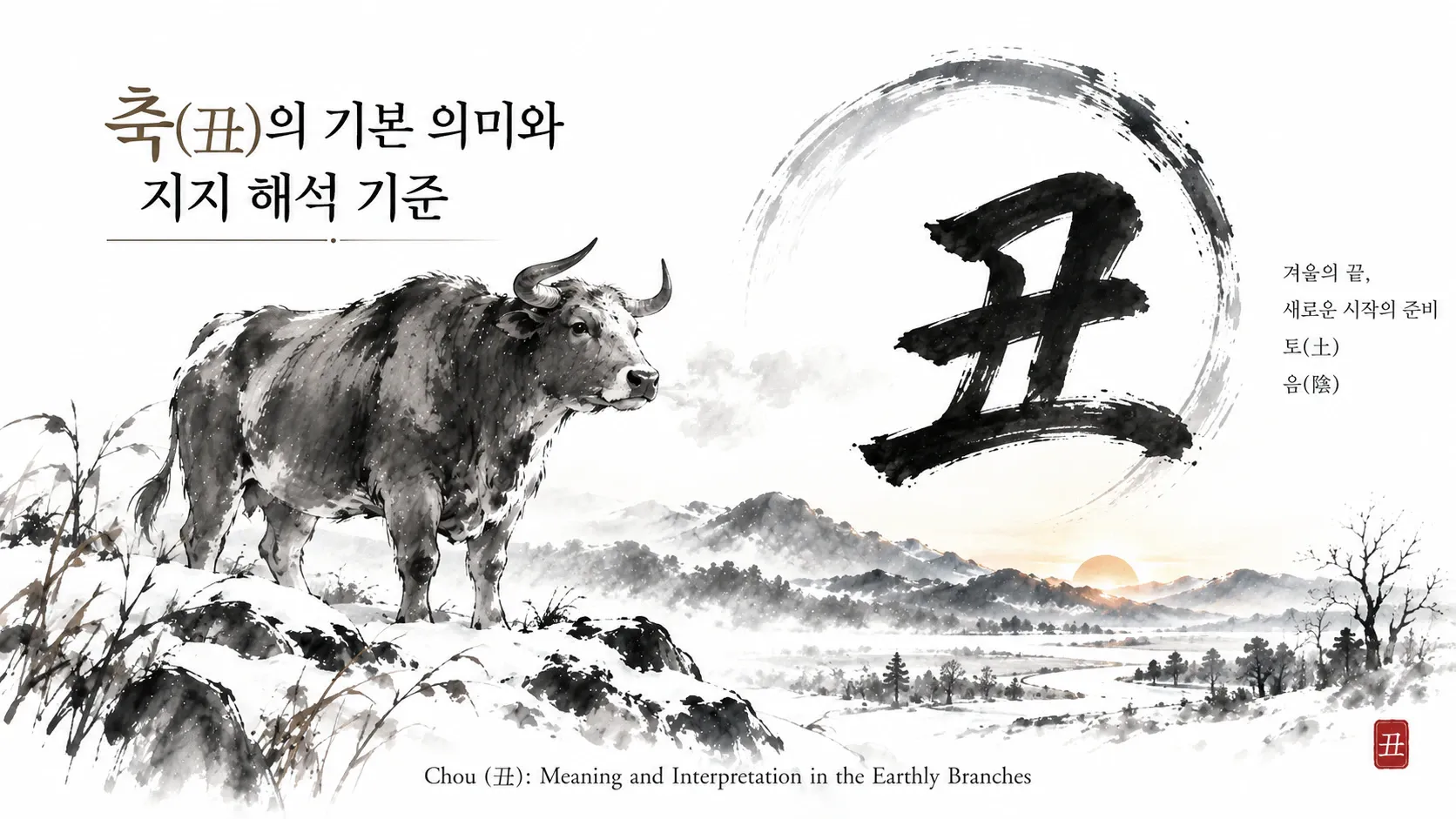
As the third of the twelve Earthly Branches, Chuk, the Ox Earthly Branch represents the tail end of winter and a period of preparation for a new beginning. Beyond its association with the Ox, gaining a deep understanding of the seasonal, temporal, directional, and elemental properties of Chuk, the Ox Earthly Branch is key to interpreting the Four Pillars. This article explores the fundamental essence of Chuk, the Ox Earthly Branch and the core standards for its interpretation.
Fundamental Meaning and Interpretation of Chuk, the Ox Earthly Branch
Chuk, the Ox Earthly Branch carries the literal meaning of being ‘young’ or ‘immature,’ signifying a state of incompleteness or the initial phase of development. While it corresponds to the Ox in the zodiac, one should not define Chuk, the Ox Earthly Branch solely by the characteristics of that animal within the Four Pillars. It represents the final stretch of winter—a pivotal turning point where the energy of Yin peaks and the energy of Yang begins to sprout. As a time for rest, energy condensation, and preparation for new life, it appears tranquil on the surface while concealing a powerful inner force for change.
Chuk, the Ox Earthly Branch also embodies qualities of ‘heaviness’ and ‘silence.’ Like the Ox waiting patiently for spring through the harsh winter cold, it symbolizes perseverance, consistency, and responsibility. These traits may manifest positively or present as stubbornness or frustration, depending on where it is placed within the Four Pillars chart.
Coordinates of Season, Time, and Direction
In the Four Pillars, Earthly Branches are crucial coordinates that extend beyond zodiac animals to represent seasons, time, and direction. Chuk, the Ox Earthly Branch corresponds to the 12th lunar month, the final month of winter. It marks the coldest part of the year, characterized by short days and long nights. Thus, it represents a period of rest and energy storage while waiting for spring.
Temporally, it points to the hours between 1:00 AM and 3:00 AM—the darkest, quietest time of day just before dawn. This timing emphasizes the potential and initiatory nature of Chuk, the Ox Earthly Branch. Directionally, it corresponds to the north-northeast (the Gan direction), reflecting the transition from winter into spring.
Properties of Chuk, the Ox Earthly Branch via Five Elements and Yin-Yang
Regarding the five elements, Chuk, the Ox Earthly Branch belongs to Earth element. This element possesses the nature to embrace, mediate, and bring things to fruition. Because it is located at the end of winter, it strongly exhibits the traits of a ‘storage house’ (庫, Go-ji), holding warmth within cold energy, much like a seed preparing to sprout deep underground.
In terms of Yin and Yang, it corresponds to Yin. While the seasonal and temporal context highlights strong Yin energy, it simultaneously suggests the preparation for new life (Yang). Thus, Chuk, the Ox Earthly Branch is a complex entity that appears cold, static, and Yin-natured on the outside, yet holds vibrant life force and potential for change within. This can manifest as a calm, prudent exterior that unleashes strong drive at critical moments.
The hidden stems inside the Branches of Chuk, the Ox Earthly Branch
Every Earthly Branch has hidden stems, known as the hidden stems inside the Branches. The hidden stems of Chuk, the Ox Earthly Branch are Gye, Sin, and Gi. This means that within Chuk, the Ox Earthly Branch, the cold water energy of Gye (Water), the metal energy of Sin (Metal), and the earth energy of Gi (Earth) coexist. Notably, the first hidden stem, Gye, symbolizes the cold water remaining at winter’s end, while the last, Gi, symbolizes the energy of new life preparing underground for spring.
These hidden stems clarify the complex nature of Chuk, the Ox Earthly Branch. The water energy reflects calmness and depth; the metal energy signifies perseverance and results; the earth energy represents inclusivity and stability. This combination proves that Chuk, the Ox Earthly Branch is not merely a static, cold entity but a dynamic state containing diverse energies.
Position in the Four Pillars Chart
The interpretation changes depending on where Chuk, the Ox Earthly Branch sits in the Four Pillars chart. If in the Month Branch, it implies a birth at the end of winter, often leading to a personality that endures cold environments while waiting for spring—sometimes showing as patience or, conversely, a sense of frustration. If in the Day Branch, it relates deeply to one’s spouse or inner self; the spouse may be calm and prudent, though occasionally stubborn, while the individual may be someone who keeps their thoughts deeply guarded. If in the final position, it affects later years or relationships with children, often pointing toward a pursuit of stability or finding fulfillment through one’s offspring.
Changes in Relationship: Combinations, Clashes, and Penalties
Chuk, the Ox Earthly Branch undergoes various changes in relationship with other branches. It forms part of the Mi penalty, with penalty being a Branch penalty and Branch clash being a Branch harm. If it forms a Branch combination with another branch, its nature may strengthen or shift. For example, when it meets the Gye (Rat), the resulting Branch combination strengthens the Earth element energy, manifesting the nature of the Metal element. Conversely, if Chuk, the Ox Earthly Branch is struck by Branch clash, the transition from winter to spring may become unstable. Analysis of the surrounding branches is essential for accurate interpretation.
Common Misconceptions
The most common mistake is understanding Chuk, the Ox Earthly Branch solely as the ‘Ox.’ While the symbolic animal is a reference point, the essence of Chuk, the Ox Earthly Branch involves a complex interplay of seasons, time, elements, and hidden stems. Furthermore, one should not view its strong Yin energy as exclusively negative; it is a reservoir of energy and potential for a new beginning. Similarly, labeling it as merely ‘stubborn or frustrating’ is an oversimplification. While it symbolizes perseverance, this is often the root of strong responsibility and sincerity. Four Pillars interpretation requires a comprehensive view of how elements harmonize within the chart.
Summary of Chuk, the Ox Earthly Branch Interpretation
| Category | Core Meaning of Chuk, the Ox Earthly Branch |
|---|---|
| Basics | End of winter, rest, condensation, preparation, patience, responsibility |
| Season/Time | 12th lunar month, 1:00 AM – 3:00 AM |
| Element/Yin-Yang | Earth element, Yin |
| Hidden Stems | Gye, Sin, Gi |
| Relationships | Branch combination with Gye, Mi penalty |
| Considerations | Tranquil surface with powerful potential, turning point for new beginnings, warmth within cold |
Connection to the Next Branch: In
We have explored Chuk, the Ox Earthly Branch, which prepares for spring from the depths of winter. While Chuk, the Ox Earthly Branch focuses on condensed energy, the next branch, In, signals the true beginning of spring. In represents a season of awakening and activity, symbolizing intense vitality and progressive energy. The transition from Chuk, the Ox Earthly Branch to In is a dynamic shift from the end of winter to the peak of spring. The next article will detail the specific meanings and interpretive standards of In.