In our previous installment, we explored the distinct characteristics of Japanese Four Pillars fortune-telling compared to its Korean and Chinese counterparts. This article delves into Yin-Yang philosophy, a fundamental concept underlying East Asian divination culture, tracing its formation and evolution. Join us as we examine how ancient East Asians used Yin-Yang thought to comprehend and explain the world around them.
Yin-Yang philosophy is one of the most crucial concepts for understanding the fortune-telling and philosophical traditions of East Asian cultures. More than merely representing opposing elements like black and white or day and night, it is a profound philosophical system that explains the principle of constant change and interaction throughout the universe. This article explores how Yin-Yang philosophy originated, how it developed uniquely across different regions of East Asia, and its significance in our lives today.
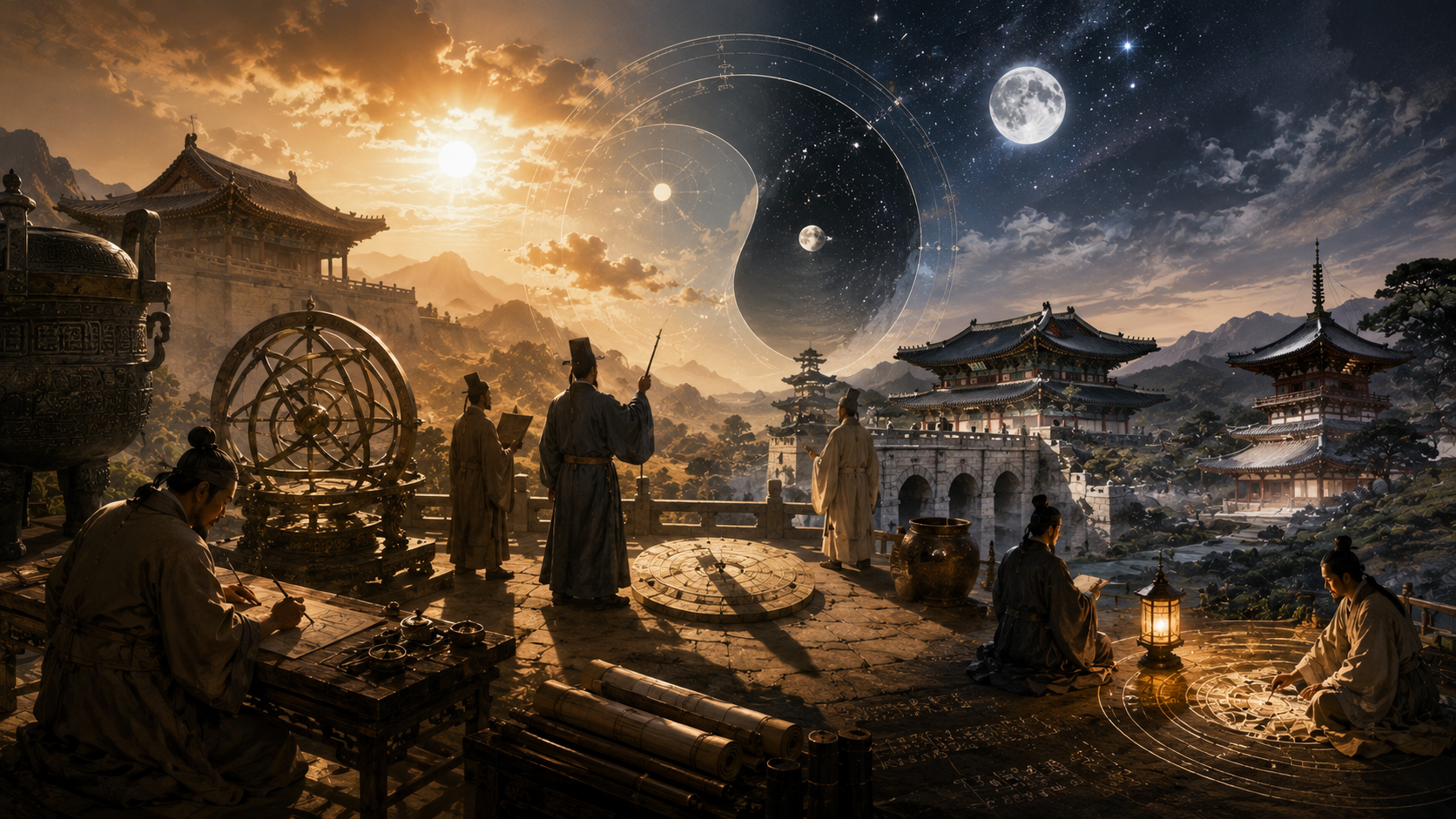
The origins of Yin-Yang philosophy lie in the insights ancient Chinese people gained from observing natural phenomena. By observing how everything — such as the sun and moon, day and night, warmth and cold — opposes yet harmonizes, they posited two fundamental energies: ‘Yin polarity’ and ‘Yang polarity’. The I Ching (Book of Changes), believed to have formed around the 8th century BCE, laid the philosophical groundwork for Yin-Yang thought by explaining the principles of cosmic change through Yin-Yang symbols.
During the Spring and Autumn and Warring States periods, the ‘Yin-Yang School’ emerged among the Hundred Schools of Thought, systematically developing Yin-Yang philosophy. Notably, Zou Yan integrated the concept of Five Elements (Five Elements) into Yin-Yang thought, establishing the ‘Yin-Yang and Five Elements philosophy.’ This framework subsequently provided the core for East Asian views on nature, the universe, history, and divination philosophies like Four Pillars theory.
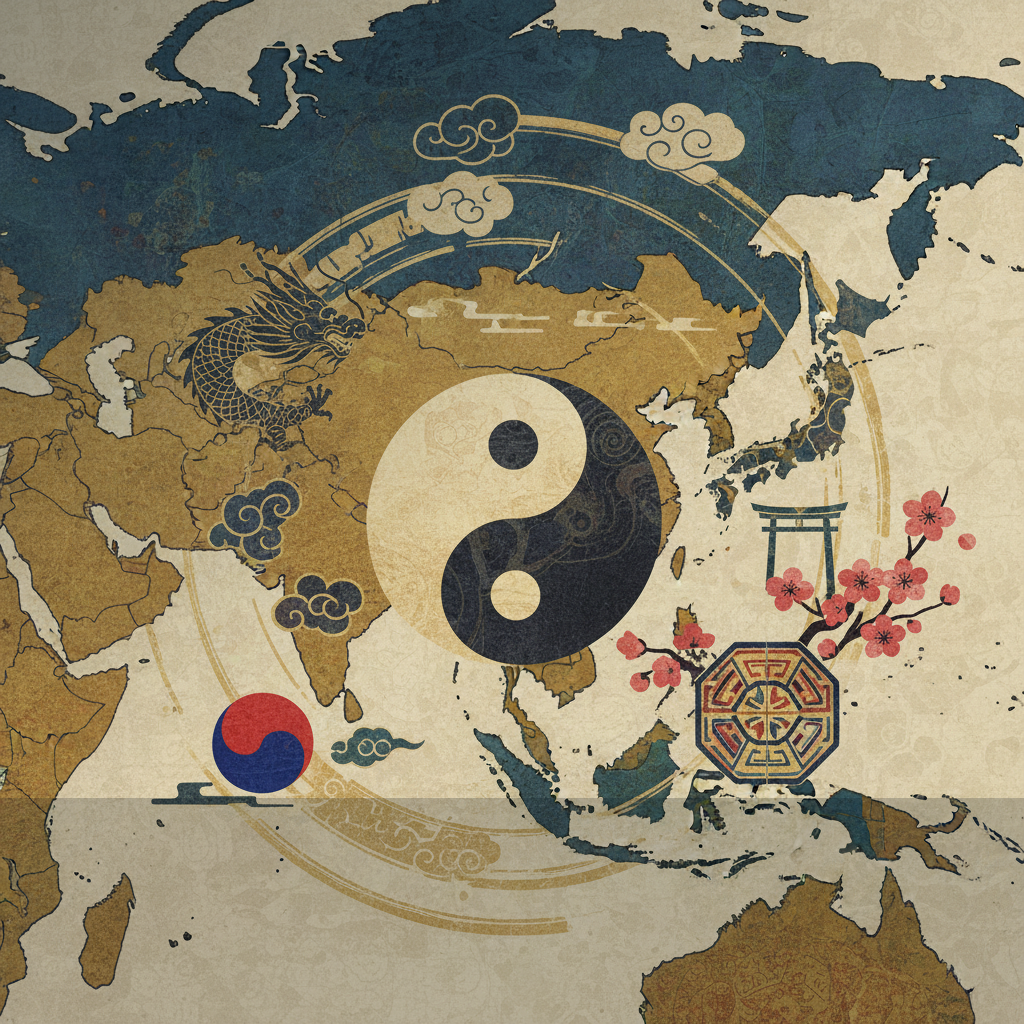
Although Yin-Yang philosophy originated in China, it spread to various East Asian regions, including Korea and Japan, developing uniquely within different cultural and social contexts.
China: Yin-Yang philosophy combined with major philosophical traditions like Confucianism and Taoism, influencing a wide range of fields such as state governance, Traditional Chinese Medicine, and art. It formed the theoretical foundation for divination systems like Four Pillars (Saju Palja) and Japyeong Myeongri, establishing a sophisticated system.
Korea: Yin-Yang philosophy was introduced during the Three Kingdoms period and integrated with Buddhism, Confucianism, and Taoism, establishing itself as a unique Korean thought. It deeply permeated Feng Shui, folk beliefs, and even the principles of state administration during the Joseon Dynasty. Its essence has also continued through divination cultures such as Four Pillars divination (Saju Chumyeong).
Japan: Yin-Yang philosophy evolved into a distinct form called Onmyodo, combining with Shinto, Japan’s indigenous religion. Onmyoji (diviners) were responsible for astronomy, calendrical calculations, and magic, participating in important state rituals. This also influenced the unique development of Japanese Four Pillars divination, as discussed in a previous article.
The varying development of Yin-Yang philosophy across regions can be attributed to each area’s social structure, geographical environment, and interactions with existing indigenous beliefs and philosophies. For example, in China, it developed in a direction that emphasized order and harmony, combining with centralized governance ideals, whereas in Japan, it transformed into Onmyodo with strong mystical elements. In Korea, it integrated with philosophies that valued harmony with nature, deeply rooting itself in practices like Feng Shui. Thus, Yin-Yang philosophy is not a fixed concept but has continuously evolved and been reinterpreted according to the needs and interpretations of each culture.
In modern times, Yin-Yang philosophy is recognized for its value in various fields, moving beyond a mere ancient philosophy. In Traditional Korean Medicine, it serves as a core principle for explaining the body’s balance, and in psychology, it provides a framework for understanding diverse aspects of the human psyche. Furthermore, in divination fields like Four Pillars theory, it functions as an important tool for analyzing an individual’s innate energy through Yin-Yang harmony and imbalance, suggesting life directions. Yin-Yang philosophy conveys a wise message that reminds us of the importance of balance and harmony in a rapidly changing world.
One of the most common misconceptions about Yin-Yang philosophy is that it simply categorizes things into binary opposites like ‘good and bad’ or ‘right and wrong.’ However, Yin and Yang are not opposing concepts but rather relative attributes that complement and cycle through each other to form all things. Just as Yin begins when Yang reaches its peak, and Yang begins when Yin reaches its peak, everything is constantly changing, interacting, and achieving balance. Moreover, limiting Yin and Yang to only male and female is also a misunderstanding. Yin and Yang are universal principles that explain the relative characteristics of all existence in a much broader sense.
In the next installment, we will delve deeper into the Five Elements philosophy, which, alongside Yin-Yang philosophy, forms the two main pillars of East Asian divination philosophy, exploring its origins and development. We will examine how the combination of Yin and Yang with the Five Elements has influenced East Asian fortune-telling culture.