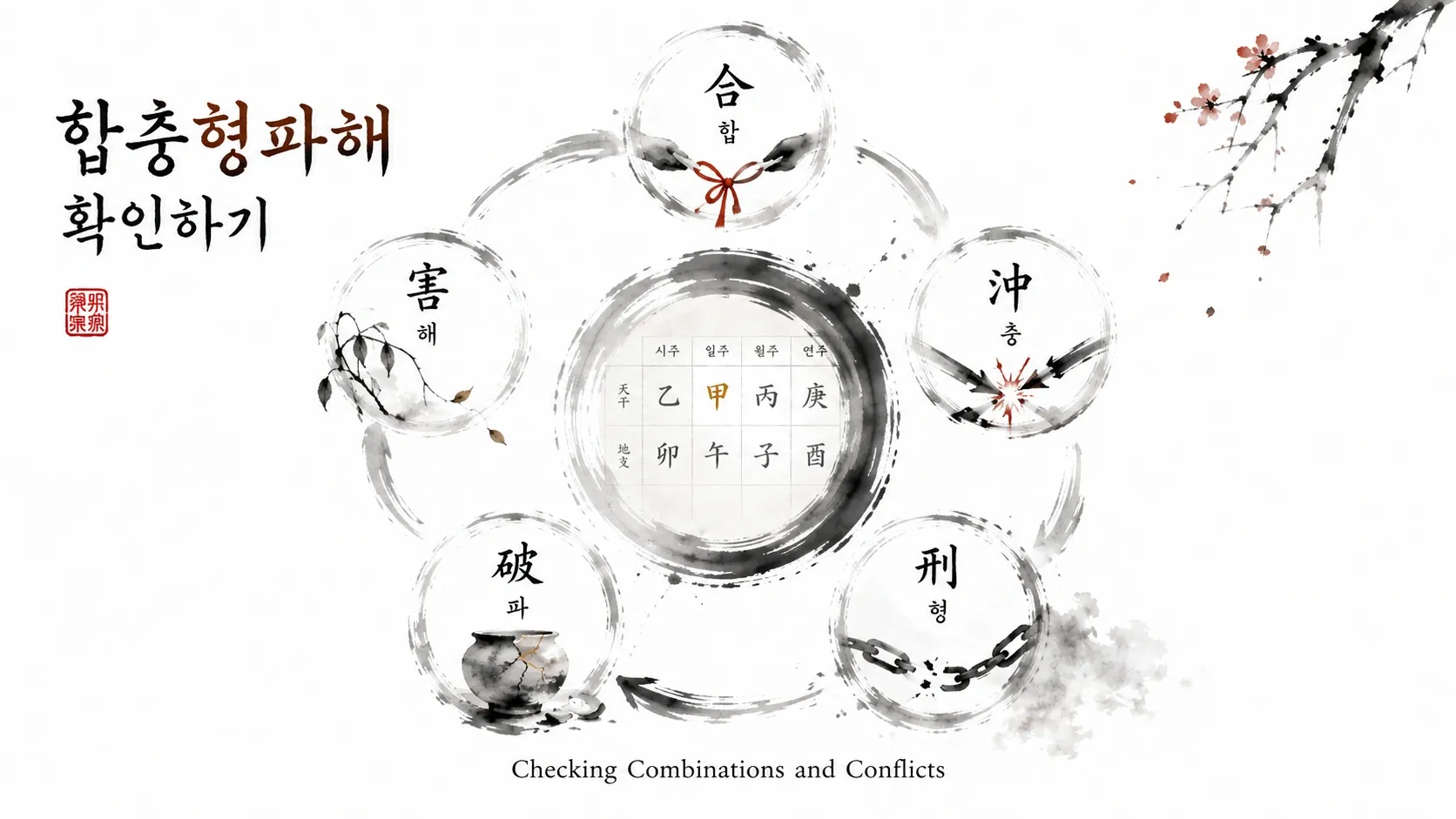
This is the seventh installment in our Four Pillars of Destiny Reading series. Having previously explored the structure of the Ten Gods, we now turn our attention to the dynamic interactions among the characters within a natal chart: specifically, combinations (合), clashes (沖), penalties (刑), harms (害), and breaks (破). This article will outline the sequential steps and criteria for identifying and interpreting these crucial interactions.
While understanding the individual meanings of characters is important when interpreting a Four Pillars of Destiny natal chart, it is even more crucial to grasp the dynamic relationships between them. This seventh part of our Four Pillars of Destiny Reading series explains how to identify how the Heavenly Stems and Earthly Branches within a natal chart interact with each other, specifically through Branch combination, Branch clash, Branch penalty, Branch break, and Branch harm. This step will reveal that the characters in a Four Pillars of Destiny chart are not merely a static list, but form a living network of relationships.
The primary purpose of identifying these branch interactions (combinations, clashes, penalties, harms, and breaks) is to understand the interplay among the characters in the natal chart, thereby grasping the overall flow and potential transformations of the entire Four Pillars of Destiny. Certain characters might combine to form a new Five Element, or their existing strength could be weakened or strengthened by a clash. Furthermore, penalties, harms, and breaks indicate conflicts or damage between characters, which can influence the life of the Four Pillars of Destiny owner in various ways. This stage focuses on identifying the types of these interactions and the potential changes they might bring.
The reason for prioritizing the identification of branch interactions when interpreting a Four Pillars of Destiny chart is that these interactions can fundamentally alter the chart’s structure, preceding the individual meanings of characters or the functions of the Ten Gods. For instance, if characters combine and lose their original Five Element properties, transforming into a different element, the interpretation of their Ten God roles or their strength and weakness assessments could change significantly. Therefore, this step is an essential prerequisite for accurately understanding the Five Element strengths, Ten God interpretations, and the relationships with the Grand Cycle (Daewoon) and Annual Cycles (Sewoon) later on. Skipping this process greatly increases the likelihood of interpretive errors.
Branch interactions (combinations, clashes, penalties, harms, and breaks) can occur between all Heavenly Stems and Earthly Branches within a natal chart. They manifest in various forms, including Heavenly Stem Branch combination, Earthly Branch Branch combination, Heavenly Stem Branch clash, Earthly Branch Branch clash, Earthly Branch Branch penalty, Earthly Branch Branch break, and Earthly Branch Branch harm. The identification sequence is as follows:
Heavenly Stem Combinations/Clashes: Check for combinations and clashes between adjacent Heavenly Stem characters, in the order of Year Stem, Month Stem, Day Stem, and Hour Stem.
Earthly Branch Combinations/Clashes/Penalties/Harms/Breaks: Examine for Six Combinations (Yukhap), Three Combinations (Samhap), Seasonal Combinations (Banghap), Three Penalties (Samhyeongsal), Six Clashes (Yukchung), Breaks, and Harms between adjacent Earthly Branch characters, in the order of Year Branch, Month Branch, Day Branch, and Hour Branch. Special attention should be paid to the relationships between adjacent branches, such as Month Branch and Day Branch, or Day Branch and Hour Branch.
Relationships Between Non-Adjacent Characters: While combinations, clashes, penalties, harms, and breaks can occur between non-adjacent characters under specific conditions (e.g., Gyeokgak), for beginners, it is crucial to first focus on interactions between adjacent characters.
Beginners often make the following common mistakes when identifying branch interactions:
Overlooking the conditions for ‘Hap-hwa’ (合化 – combination and transformation): A combination does not automatically mean a transformation into a new Five Element. The conditions for ‘Hap-hwa’ to establish (e.g., influence of the Month Branch or Sa-ryeong) must be considered. One should not assume transformation simply by observing a combination.
Ignoring the intensity of ‘Chung’ (clash): A clash is more than just a ‘collision’; its impact varies greatly depending on the strength and position of the characters involved. A strong character clashing with a weak one can cause one-sided damage, whereas characters of similar strength might create a balancing effect.
Complex effects of ‘Hyeong,’ ‘Pa,’ and ‘Hae’ (penalty, break, and harm): Penalties, harms, and breaks have more subtle and complex effects than combinations or clashes. Rather than simply labeling them as ‘bad,’ it’s crucial to meticulously analyze which characters are involved and what Five Element characteristics they possess.
Confusing the priority of Earthly Branch interactions: Earthly Branches involve various interactions, including Six Combinations, Three Combinations, Seasonal Combinations, Six Clashes, Three Penalties, Breaks, and Harms. Misunderstanding their priorities and actual effects can lead to incorrect conclusions. Generally, combinations take precedence over clashes, and among combinations, the Three Combinations exert the strongest influence.
Here is a simple procedure for identifying branch interactions in a natal chart:
1. Examine the Heavenly Stems of the natal chart to find Heavenly Stem combinations (甲己合土, 乙庚合金, 丙辛合水, 丁壬合木, 戊癸合火) and Heavenly Stem clashes (甲庚沖, 乙辛沖, 丙壬沖, 丁癸沖).
2. Look at the Earthly Branches of the natal chart to find Six Combinations (子丑合土, 寅亥合木, 卯戌合火, 辰酉合金, 巳申合水, 午未合火), Three Combinations (申子辰水, 亥卯未木, 寅午戌火, 巳酉丑金), and Seasonal Combinations (寅卯辰木, 巳午未火, 申酉戌金, 亥子丑水).
3. Identify Earthly Branch Six Clashes (子午沖, 丑未沖, 寅申沖, 卯酉沖, 辰戌沖, 巳亥沖).
4. Locate Earthly Branch Three Penalties (子卯刑, 寅巳申刑, 丑戌未刑, 辰午酉亥自刑).
5. Find Earthly Branch Breaks (子酉破, 丑辰破, 寅亥破, 卯午破, 巳申破, 未戌破) and Harms (子未害, 丑午害, 寅巳害, 卯辰害, 申亥害, 酉戌害).
6. Based on these findings, comprehensively assess whether each interaction transforms due to the influence of other characters in the natal chart or the Month Branch, and determine the intensity of any clashes.
In this installment, we have identified the branch interactions within a natal chart, namely combinations, clashes, penalties, harms, and breaks. This process should have illuminated that the characters are not merely a static arrangement but a dynamic structure where they influence and transform each other. In the next part, building on these identified interactions, we will delve into a more in-depth analysis of the Five Element strengths across the entire Four Pillars of Destiny. We will explore how the altered Five Element forces, resulting from these interactions, impact the Four Pillars of Destiny.