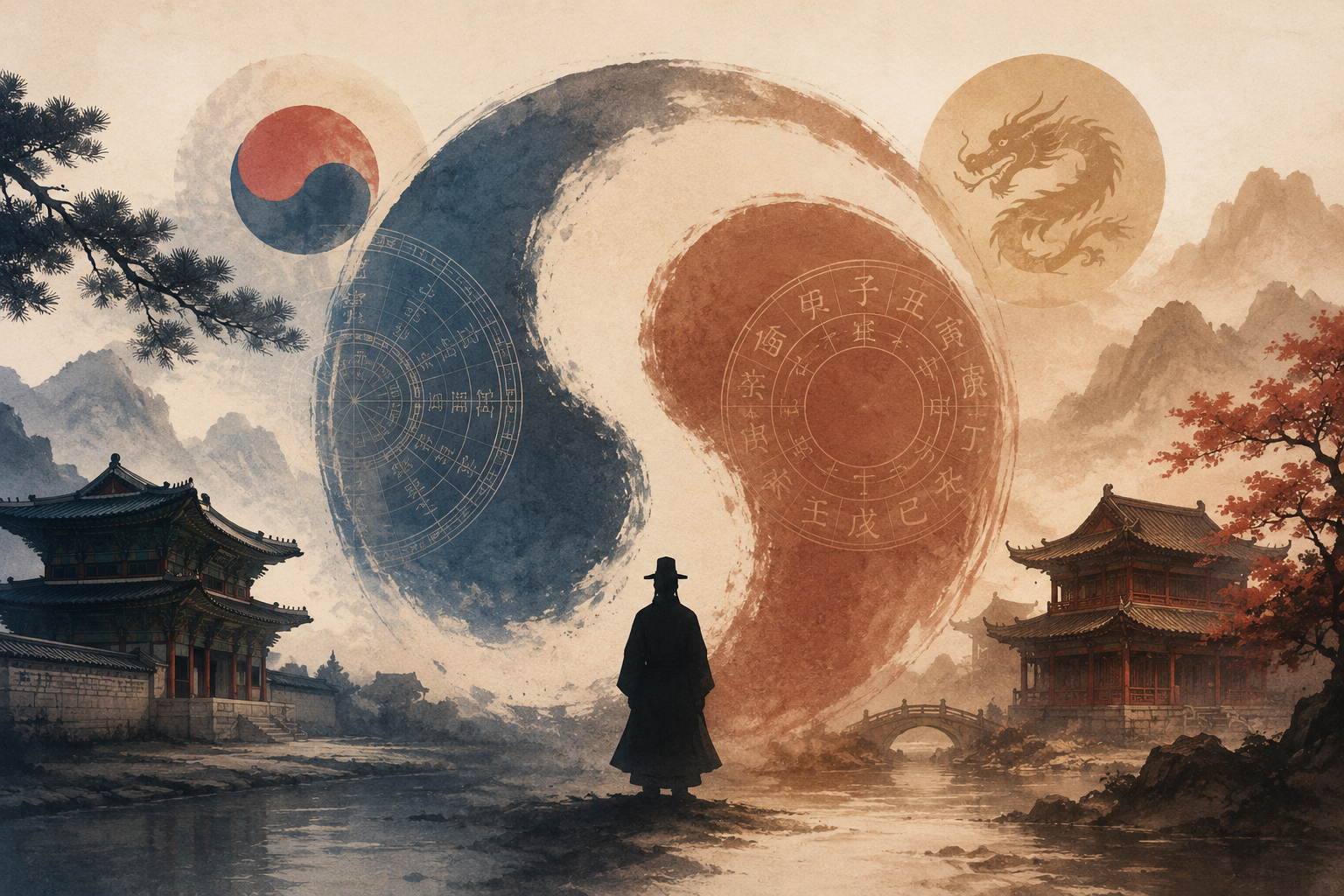
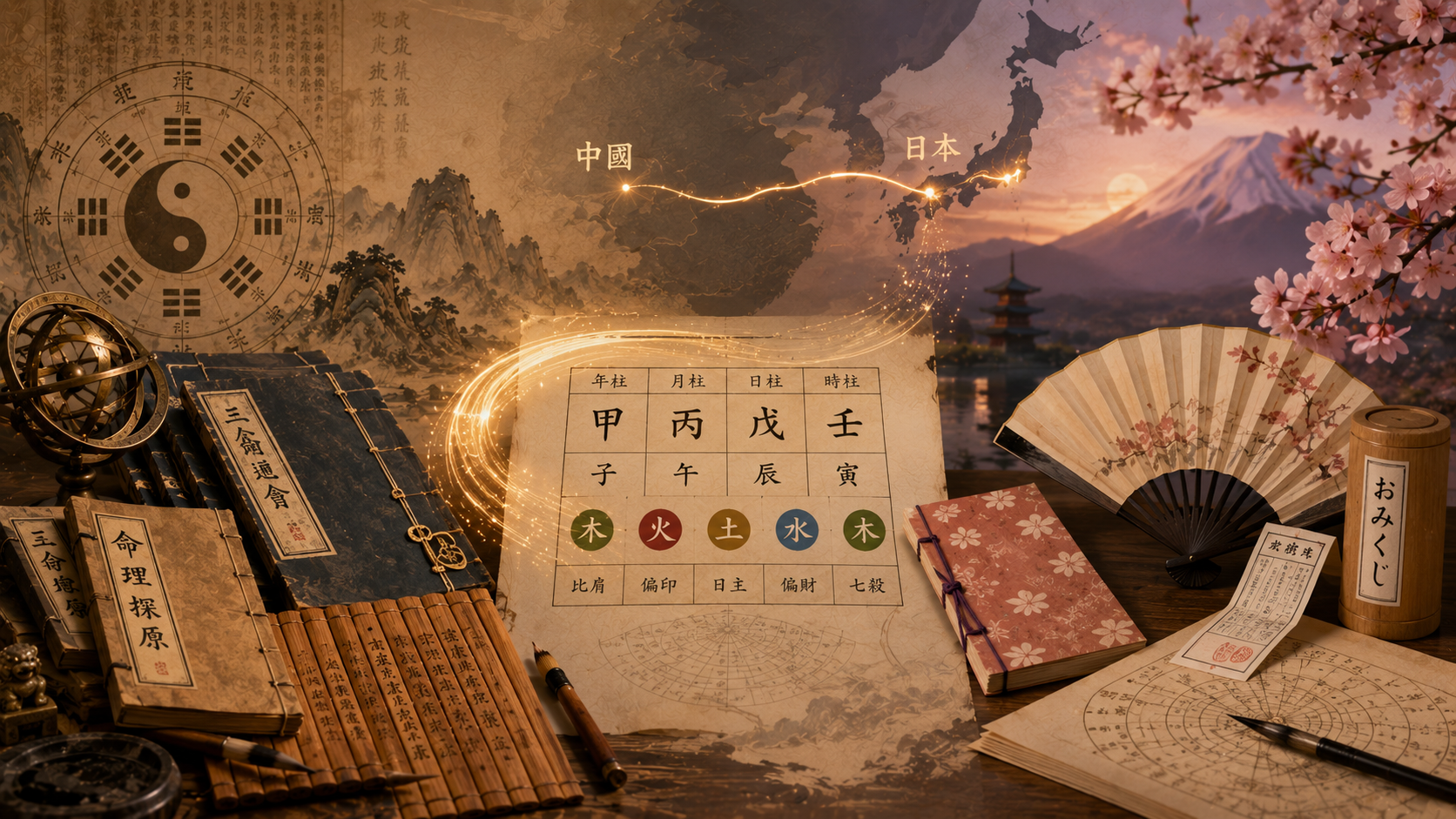
In our previous installment, we explored the diverse nature of East Asian destiny studies by examining the differences between Korean the Four Pillars and Chinese Zi Ping Mingli. This time, we delve deeper into Japanese Saju-Chumyeong, investigating its unique characteristics and how it diverges from Korean and Chinese divination systems. We will explore the cultural and philosophical background that has shaped Saju-Chumyeong in Japan.
In East Asian cultures, the study of destiny has developed in diverse ways, reflecting the unique histories and philosophies of each region. Following our previous discussion on the differences between Korean and Chinese approaches to Four Pillars theory, this article focuses on Japan’s ‘Saju-Chumyeong’ (四柱推命), highlighting its distinct characteristics and historical context. While Japanese Saju-Chumyeong is based on Four Pillars theory originally transmitted from China, it has undergone its own unique interpretations and evolutionary processes within Japan’s specific cultural milieu.
It is believed that Four Pillars theory was introduced to Japan during the Nara (奈良) and Heian (平安) periods, alongside various other Chinese cultural influences. Initially, it was studied primarily by aristocrats and Buddhist monks, often in conjunction with Yin-Yang and Five Elements philosophy. It was used to discern important national fortunes or misfortunes and to divine individual destinies. During the Edo (江戸) period, its popularity gradually spread to the general public. However, unlike in Korea or China, where it developed into a more academic discipline, in Japan, it tended to establish itself more as a practical form of fortune-telling.
Japan’s unique cultural foundation, influenced by its indigenous Shinto (神道) beliefs, Buddhism, and imported Confucian and Taoist philosophies from China, collectively shaped the interpretation and application of Saju-Chumyeong.
In Korea, terms like ‘Saju-Myeongri’ or ‘Ja Pyeong Myeongri’ (子平命理) are commonly used. In China, ‘Four Pillars theory’ or ‘the Eight Characters’ are the prevalent expressions. In contrast, Japan most frequently uses the term ‘Saju-Chumyeong’ (四柱推命). These differences are not merely semantic; they reflect distinct perspectives on how Four Pillars theory was adopted and developed in each region.
While Korean and Chinese Four Pillars theory often focuses on a deep analysis of individual fortune, misfortune, and the flow of destiny, Japanese Saju-Chumyeong tends to offer more practical, life-oriented advice. For instance, it is often utilized as a reference for making important decisions such as business ventures or marriage by understanding one’s fortune during specific periods, or as a tool to comprehend personal character and aptitude.
There are two primary reasons why Japanese Saju-Chumyeong has evolved differently from its Korean and Chinese counterparts. First is Japan’s relatively strong collectivist culture. With an emphasis on harmony and roles within the community rather than individual destiny, Saju-Chumyeong also shifted its focus from extreme individual fate predictions to finding harmonious paths in social life and interpersonal relationships.
Second is Japan’s distinctive cultural background, which highly values ‘Wa’ (和), meaning harmony. There is a strong tendency to avoid conflict and pursue harmony, leading to an interpretation of destiny that emphasizes positive advice rather than extreme negative predictions. This can be seen as a reinterpretation of Four Pillars theory, transforming it from a mere predictive tool into a source of wisdom for navigating life in a positive direction.
Today, Saju-Chumyeong continues to attract significant interest in Japan. It is widely accessible through magazines, TV programs, and online content, often consumed as a lighthearted form of divination for personality analysis, romantic prospects, or career fortunes. While there are professional Four Pillars theory researchers, the focus tends to be more on practical counseling techniques and fortune-telling methods rather than deep theoretical debates among schools, unlike in Korea or China.
This reflects Japanese society’s pragmatic attitude towards destiny studies: it is naturally accepted as a part of life but utilized as a reference rather than blindly believed.
It might be mistakenly thought that Japanese Saju-Chumyeong is less profound or more superficial than Korean or Chinese Four Pillars theory. However, this is not a matter of superiority or inferiority but rather a result of its evolution to suit the characteristics of its respective cultural context. Japanese Saju-Chumyeong aims to positively influence individual lives in its own way, excelling at delivering practical wisdom applicable to daily life rather than complex theories.
Furthermore, it is crucial to guard against the deterministic mindset that Saju-Chumyeong dictates everything. It is merely a tool for predicting fortunes and exploring life’s direction. One must not forget that individual effort and choice remain the most crucial factors in shaping one’s destiny.
In our next installment, we will explore the profound philosophical background of the ‘Yin-Yang philosophy,’ the foundation of East Asian destiny studies, examining how it formed and evolved.