Feng Shui and Four Pillars are two crucial pillars in East Asian culture for understanding human life and destiny. While seemingly distinct, these traditional philosophies—one exploring environmental influences, the other individual fate—are deeply interconnected and mutually impact our lives. This article delves into how they interact and shape our existence.
Feng Shui (風水) is a geographical philosophy that interprets the energy of the land to predict good and bad fortune and identify auspicious sites. Four Pillars (四柱) is a branch of Four Pillars theory that analyzes an individual’s destiny based on their birth year, month, day, and hour. Both of these traditional wisdoms share a common goal in East Asian culture: seeking harmony between human life, the environment, and destiny. Although they appear to address different subjects—environment and individual—they are fundamentally rooted in the same Yin-Yang and Five Elements (陰陽五行) philosophy. They are believed to complement each other and influence human fortune.
Beginners often confuse these two concepts or consider them separate. However, they are organically linked within the East Asian worldview. This article will explore the meaning and historical development of Feng Shui and Four Pillars, and examine how they mutually influence each other to provide profound insights into our lives.
Feng Shui originated in ancient China as a discipline derived from geographical observations used to determine the auspiciousness of living spaces and burial sites. The term itself, meaning ‘wind’ (風) and ‘water’ (水), reflects its practical purpose: to preserve vitality and seek prosperity by harmonizing with the natural environment. Early practices primarily emphasized the contours of mountains, the flow of water, and cardinal directions, deeply connected to the agrarian society’s reliance on natural harmony for survival. Beyond mere superstition, Feng Shui evolved into an environmental philosophy and architectural guideline based on a deep understanding and observation of nature.
The concept of ‘Jangpungdeuksu’ (藏風得水), meaning to shelter from wind and acquire water, describes the conditions for an ideal site where life energy gathers. This Feng Shui knowledge played a crucial role in selecting capital cities for dynasties and burial grounds for nobility. Over time, it spread to the common populace, becoming a practical wisdom for identifying favorable locations in daily life.
Four Pillars is a branch of Four Pillars theory that analyzes destiny by assigning two characters to each of the four pillars (四柱)—representing the year, month, day, and hour of birth—totaling eight characters (八字). Its origins can be traced to the `Myeongseo` (命書) of Li Xuzhong (이허중) during the Tang Dynasty. The current ‘Japyeongmyeongri’ (子平명리) system was established by Seo Japyeong during the Song Dynasty. Japyeongmyeongri analyzes the relationships between the Day Master, other Heavenly Stems, and Earthly Branches to understand an individual’s tendencies, talents, and the flow of their fortune.
Beyond simple fortune-telling, Four Pillars evolved into a tool for understanding an individual’s potential and life direction. Based on the belief that the cosmic energy at the moment of birth shapes one’s innate nature, it has predicted the joys and sorrows of life through the balance and imbalance of the Five Elements in the Eight Characters of the Four Pillars, offering wisdom for a better life. It primarily focuses on exploring individual intrinsic characteristics and the shifts in destiny that manifest over time.
Feng Shui and Four Pillars may appear to be separate disciplines, but within the broader framework of East Asian philosophy, they are complementary. While Four Pillars analyzes an individual’s ‘inner destiny’ (內命)—their inherent fate and temperament—Feng Shui examines ‘outer destiny’ (外命)—the geographical influences of the environment in which they live. If Four Pillars discerns the essence of a seed, Feng Shui assesses the quality of the soil where that seed will grow. Just as a good seed struggles to flourish in barren soil, and even fertile ground cannot yield much from a poor seed, individual destiny and environment are organically connected and interact with each other.
From this perspective, Feng Shui is believed to compensate for missing Five Elements in Four Pillars or mitigate negative energies indicated by Four Pillars. For instance, an individual whose Four Pillars lacks the Water element might choose to live near flowing water or incorporate water-symbolizing elements into their home to balance the energy. Conversely, it is also believed that even a favorable Four Pillars may not allow one to fully realize their potential if the surrounding environment is poor.
Both Feng Shui and Four Pillars are fundamentally based on the Yin-Yang and Five Elements (陰陽五行) philosophy. The Five Elements theory is a core principle of East Asian philosophy, positing that all things in the universe are composed of the two energies of Yin and Yang and five elements: Wood element, Fire element, Earth element, Metal element, and Water element. These elements interact through generating cycle and overcoming cycle cycles, constantly transforming. In Four Pillars, the Five Elements are assigned to the Heavenly Stems and Earthly Branches that constitute an individual’s Eight Characters to analyze their harmony and balance.
In Feng Shui, the Five Elements are assigned to the shapes of the land, directions, colors, and materials to determine auspiciousness. For example, a mountain shaped like a rising flame is considered to have strong Fire element energy, while the direction and speed of water flow are interpreted as manifestations of Water element energy. The principles of the Five Elements are also applied to home layouts, furniture placement, and color choices to create harmonious spaces. Thus, although these two disciplines deal with different subjects, they share a deep commonality in seeking to understand the interaction of all things in the universe through the same Five Elements theory.
The primary reason Feng Shui and Four Pillars developed as distinct concepts lies in their differing purposes and scopes of application. Four Pillars focuses exclusively on analyzing an individual’s innate destiny, characteristics, and life trajectory based on their precise birth time. It hones in on deeply personal aspects such as personality, talents, health, relationships, and career prospects. Therefore, Four Pillars serves as a tool for personal growth and self-understanding.
Conversely, Feng Shui analyzes the influence of a specific space—be it a home, building, burial site, or even an entire city’s geographical environment—on the people who reside there or are affected by it. The purpose of Feng Shui is to find ‘auspicious sites’ to enhance external fortunes for residents, including health, wealth, reputation, and progeny. It is an attempt to positively alter destiny by improving the environment, emphasizing the significant impact of surroundings independent of individual effort. This fundamental difference in purpose has guided the two disciplines along separate developmental paths.
Four Pillars takes ‘time’ as its core element of analysis. It captures the energy of a specific moment—the birth year, month, day, and hour—to interpret a person’s destiny. Its focus is on predicting how the flow of fortune changes as time progresses. Feng Shui, on the other hand, centers on ‘space’ as its core analytical element. It assesses the auspiciousness or inauspiciousness of a location by discerning the energy created by spatial factors such as mountains, water flow, terrain, and direction. This explores the fixed or continuous impact of spatial arrangement and structure on people.
Thus, Four Pillars deals with the dynamic changes of time, while Feng Shui addresses the static arrangement and flow of space, leading to differences in their analytical subjects and methodologies. However, in East Asian philosophy, time and space are understood as an inseparable continuum. Therefore, both disciplines ultimately illuminate the same universal principles from different perspectives.
Today, Feng Shui and Four Pillars are being reinterpreted as wise tools for enhancing the quality of modern life, moving beyond their past mystical connotations. Four Pillars is utilized for self-understanding and exploring personal potential. By identifying strengths and weaknesses, discerning areas for talent development, and anticipating opportunities, individuals can gain guidance for career choices and improving relationships. This can be understood in a similar vein to psychological self-analysis.
Feng Shui contributes to creating more pleasant and efficient living and working spaces. Applying Feng Shui principles to environmental design elements such as lighting, ventilation, furniture arrangement, and color selection can promote psychological stability and concentration, and positively influence health and wealth. This is not simply about adhering to superstition but pursuing aesthetic and functional benefits through harmony with nature, becoming a part of modern lifestyle. Feng Shui considerations are sometimes also incorporated into urban planning and architectural design.
Feng Shui and Four Pillars are no longer considered blind superstitions but are recognized as traditional wisdoms that help explore and understand various aspects of life. They prompt us to consider how to understand and accept our interactions with the environment and our evolving selves over time. Rather than fatalistically accepting destiny, they offer guidance on how to make better choices and cultivate a harmonious life based on our given environment and innate dispositions.
Especially in modern society, marked by high stress and uncertainty, Feng Shui and Four Pillars can provide individuals with psychological stability and a useful perspective for exploring the meaning of life. This can be seen not merely as predicting the future, but as a process of gaining insights necessary to live fully in the present and positively design the future.
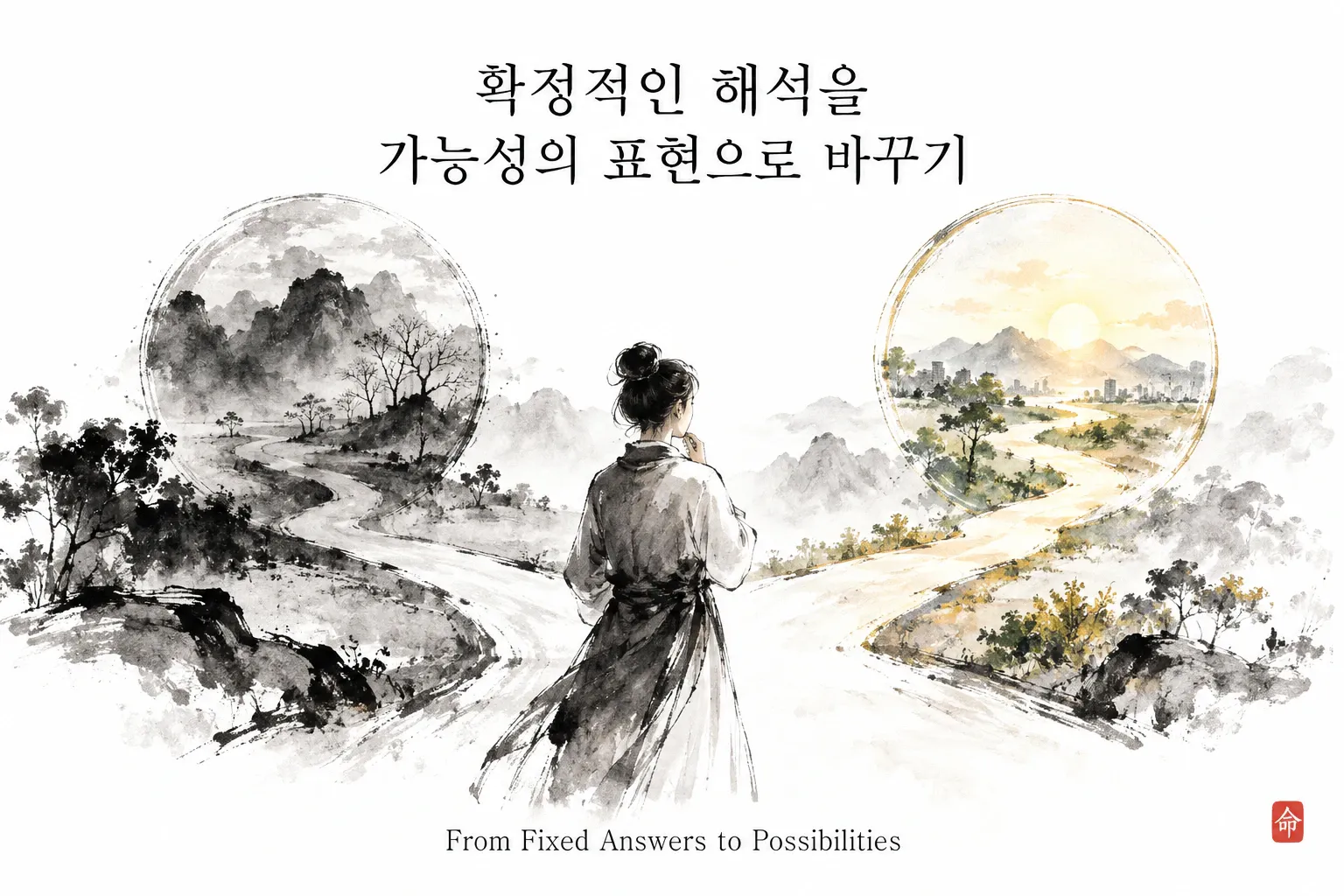
One of the biggest misconceptions about Feng Shui and Four Pillars is that they advocate a ‘deterministic view’ where human destiny is entirely predetermined. However, in East Asian philosophy, destiny is not fixed but understood as constantly changing through the interaction of innate temperament, environmental factors, and individual effort. Four Pillars merely indicates an individual’s inherent potential and tendencies; how that potential is realized and how those tendencies are overcome depends entirely on personal will and effort. Similarly, while Feng Shui emphasizes the positive influence of a good environment, it does not overlook the importance of the resident’s mindset and actions, even in the best of locations.
Therefore, information obtained from Four Pillars or Feng Shui should be regarded as advice: ‘Given these tendencies, prepare or strive accordingly.’ It’s like a weather forecast that indicates the possibility of rain, but whether to carry an umbrella is a personal choice. It is crucial to gain the wisdom to actively shape one’s life rather than passively accept destiny.
Neither blindly trusting Feng Shui and Four Pillars to make all decisions nor indiscriminately dismissing them is advisable. The key is to understand and utilize this traditional wisdom with a balanced perspective. It is certainly meaningful to use Four Pillars to understand one’s disposition and work on supplementing deficiencies, and to apply Feng Shui to create a positive surrounding environment. However, one must be careful not to harbor the illusion that all problems will be solved this way, nor to be swayed by distorted information for commercial purposes.
These wisdoms are cultural legacies deeply embedded in East Asian life for thousands of years. It is essential to understand their essence, reinterpret them from a modern perspective, and use them as guides for life without falling into blind faith. Only when utilized as tools for understanding oneself and one’s environment can Feng Shui and Four Pillars truly demonstrate their value.
Feng Shui and Four Pillars are unique East Asian wisdoms that seek to understand human life through the energies of the land and time, respectively. Both are founded on the shared philosophical basis of Yin-Yang and Five Elements, illuminating human destiny from multiple angles through the dual axes of individual inner self and external environment. Through them, we can not only predict the future but also gain wisdom to understand ourselves more deeply, interact harmoniously with our surroundings, and actively shape our lives.
In the next article, we will delve into I Ching (周易), another important pillar of East Asian philosophy, and how it interprets destiny differently from Four Pillars, examining their similarities and differences in depth.