This is the second article in our Saju Reading series. After establishing the overall process in Part 1, the next crucial step is to identify the Day Master (Ilgan), which serves as the fundamental starting point for any interpretation. This article explains why the Day Master is the essential reference point and how to locate and apply it within a Saju chart.
Why Focus on the Day Master First?
After setting up the sequence in Part 1, it’s time to establish a reference point. In the Four Pillars, all relationships derive meaning from a central reference.
This reference point is the Day Master (Ilgan). What supports you, what you create, and what controls you are all determined based on the Day Master.
Therefore, attempting to interpret the Five Elements (Ohaeng) or Ten Gods (Sipsin) without first considering the Day Master will lead to an incorrect understanding of relationships.
Day Master → Remaining Interpretation is the foundational structure.
Where is the Day Master Located in a Saju Chart?
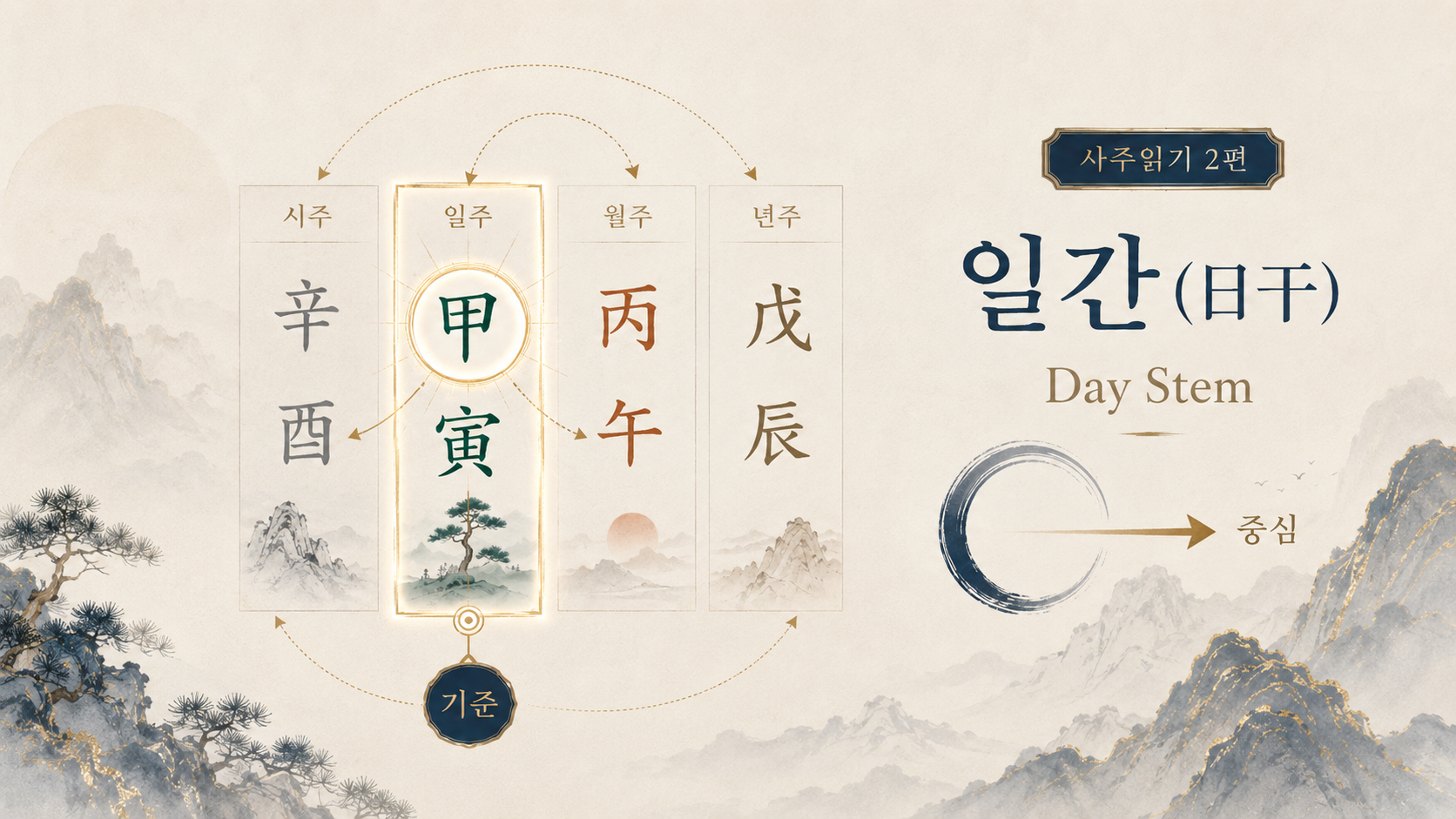
A Saju chart (Myeongsig) consists of four pillars: the Year Pillar (Yeonju), Month Pillar (Wolju), Day Pillar (Ilju), and Hour Pillar (Siju). Each pillar has a Heavenly Stem (Cheongan) at the top and an Earthly Branch (Jiji) at the bottom.
Among these, the Heavenly Stem of the Day Pillar (Ilju) is the Day Master (Ilgan). In essence, the character at the top of the Day Pillar is your reference point.
Even if the same character appears, its role varies depending on its position, so it’s vital to identify it based on its location.
At this stage, the goal is simply to accurately locate the Day Master, not to assign any meaning to it yet.
Why the Day Master is the Standard
The Four Pillars is a system of relationships. To understand these relationships, a central focus is needed.
The Day Master is the reference point established as ‘myself,’ and thus, the roles of all other characters are defined in relation to this center.
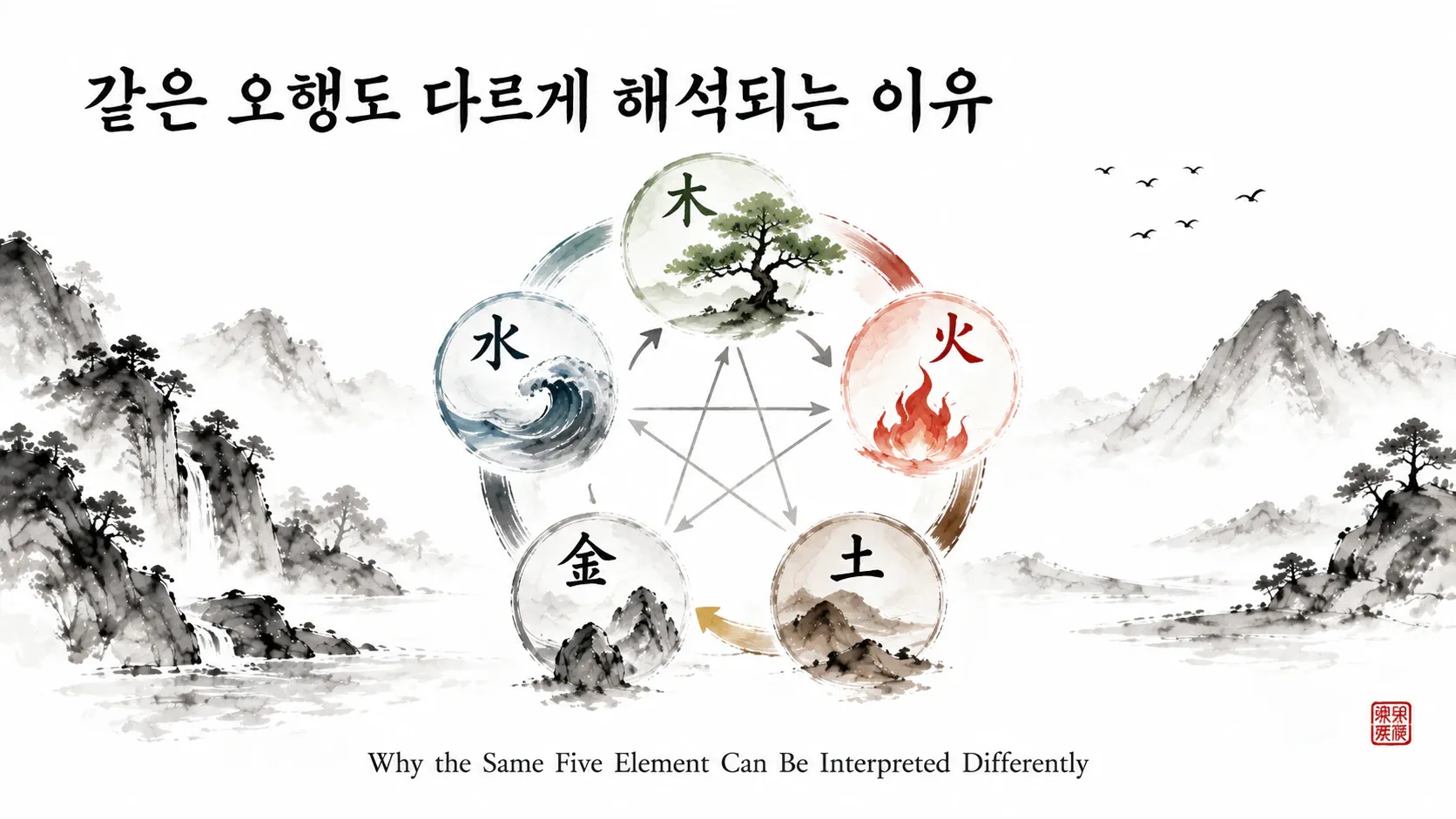
For instance, even the same Five Element can have entirely different meanings depending on whether it supports (saeng) or controls (geuk) the Day Master.
Therefore, without first identifying the Day Master, subsequent interpretations will lose their direction.
Purpose and Criteria for This Stage
The purpose of this stage is straightforward:
To accurately find the Day Master and establish it as the reference point.
| Check Item | Location | Purpose |
| Day Pillar (Ilju) | Third among the four pillars | Confirm the reference pillar |
| Day Master (Ilgan) | Heavenly Stem of the Day Pillar | Set the interpretation standard |
The judgment criteria are as follows:
- Have you accurately located the Day Master?
- Have you established it as the reference point before other elements?
- Have you avoided starting any interpretative analysis yet?
Practical Application
Open a Saju chart (Myeongsig).
For now, do not interpret, but follow these steps:
- Distinguish the Year Pillar (Yeonju), Month Pillar (Wolju), Day Pillar (Ilju), and Hour Pillar (Siju).
- Locate the Day Pillar.
- Identify the Heavenly Stem above the Day Pillar.
Mark this character. This is your Day Master.
Attempting to assign personality traits or meanings at this stage is a mistake.
Common Beginner Mistakes
- Starting by counting the number of Five Elements (Ohaeng).
- Judging characteristics based on Ten God (Sipsin) names first.
- Beginning interpretation without finding the Day Master.
These mistakes all stem from attempts to interpret without a clear reference point.
Any interpretation lacking a reference point will inevitably lead in the wrong direction.
Why the Month Branch (Wolji) is Next
Once the Day Master is established as the reference, the next step is to examine the environment.
That environment is the Month Branch (Wolji). Determining which season and energy the Day Master is situated in allows for a later assessment of its strength and weakness.
Therefore, the next step is the Month Branch.
Key Summary
The Day Master (Ilgan) is the starting point for Four Pillars interpretation.
Without first identifying the Day Master, all interpretations will lose their way.
━━━━━━━━━━━━━━━━━━
Saju Reading Progress Sequence
- Overall Sequence
- Day Master (Ilgan) — Current Stage
- Month Branch (Wolji)
- Five Elements (Ohaeng)
- Strength and Weakness (Gangyak)
- Ten Gods (Sipsin)
- Clashes, Harms, Punishments, and Combinations (Hapchung Hyeongpaehae)
- Great Luck (Daeun)
- Comprehensive Analysis
- Common Mistakes
- Priorities
- Record Keeping
━━━━━━━━━━━━━━━━━━
Current Stage: 2/12
Next Stage: Month Branch (Wolji) — Interpretation is possible only after confirming the environment in which the Day Master is placed.