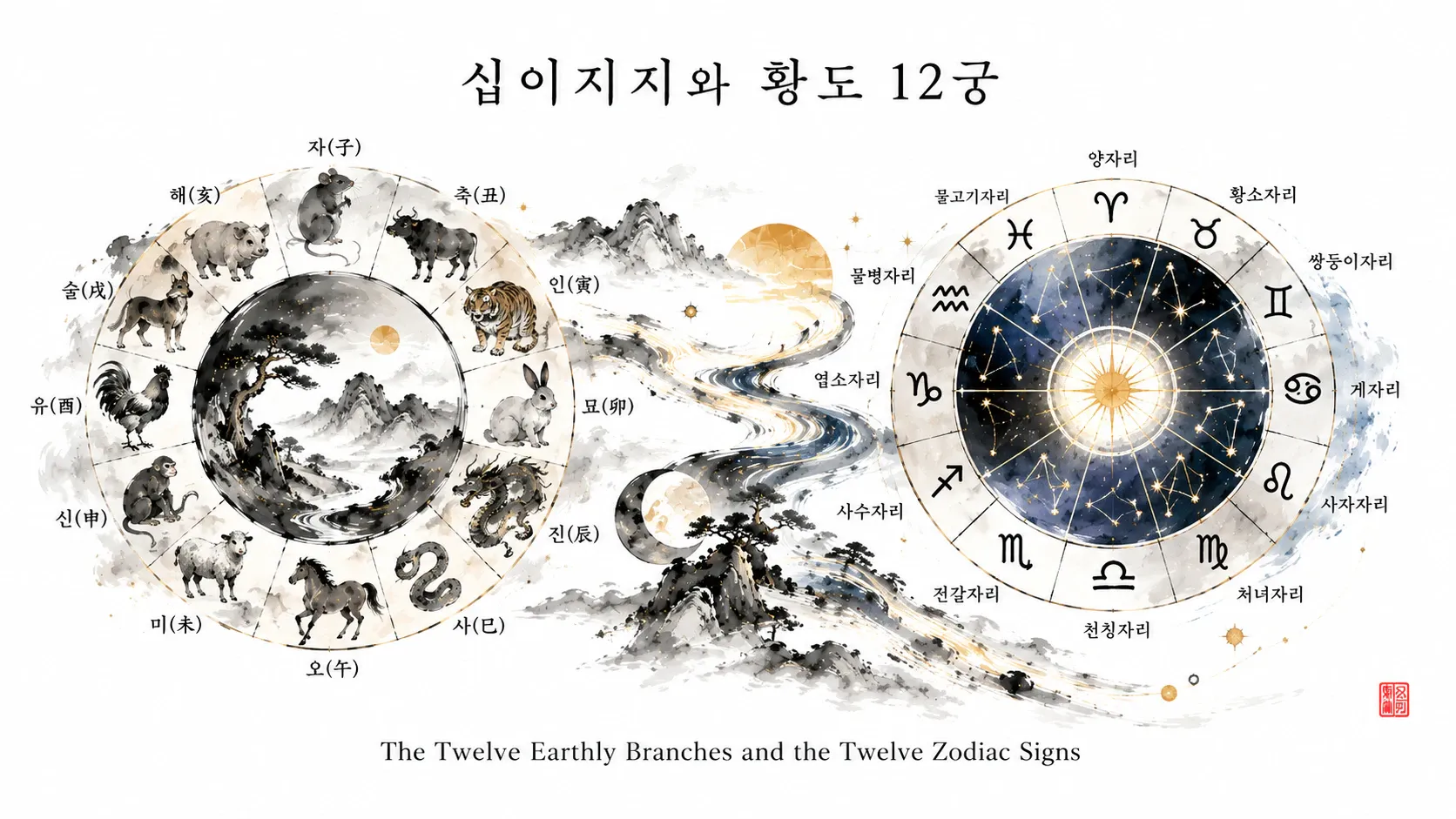
The Twelve Earthly Branches, which represent the flow of time and space in Eastern Four Pillars of Destiny, and the twelve zodiac signs (Twelve Zodiac Signs), which interpret individual fate in Western astrology, are significant symbolic systems developed in distinct cultural spheres. While both systems utilize the number 12 to map the order of the universe, their fundamental philosophies and interpretive methods differ significantly.
In the Eastern Four Pillars of Destiny and Western astrology, human fate and character are interpreted through distinct frameworks. At the heart of these systems are essential concepts for dividing time and symbolizing space: the Twelve Earthly Branches in the East, and the twelve zodiac signs in the West. Although both are composed of 12 units, their origins, applications, and underlying philosophies are notably different.
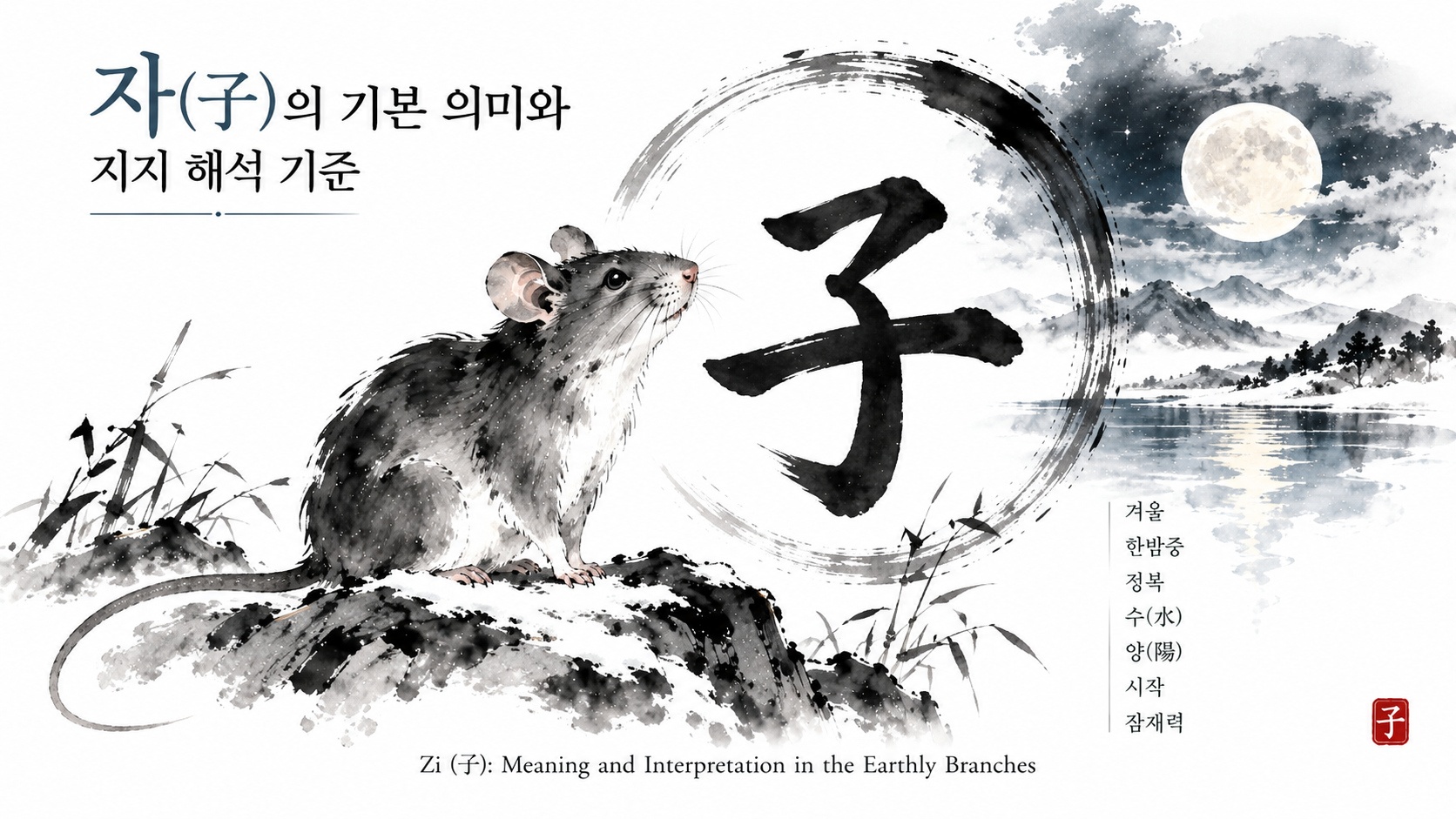
The Twelve Earthly Branches are far more than just 12 animal signs. They represent a complex symbolic system encompassing time (12 double-hours of a day, 12 months, and 12 years), directions, and the cycle of the growth and decay of the Five Elements. Just as Ja, the Rat Earthly Branch symbolizes midnight, the north, and the beginning of winter, and O, the Horse Earthly Branch symbolizes high noon, the south, and the peak of summer, each branch represents an energy flow specific to a time and space. This is a core tenet of Eastern philosophy, which seeks to project the natural cycles of the universe onto human life.
In the Four Pillars of Destiny, these branches combine with Heavenly Stems (Heavenly Stems) to form the sexagenary cycle, which is used to identify the patterns of shifting energy over time. Each branch possesses its own intrinsic Five Elements attributes and Yin-Yang qualities, which are essential for understanding the balance and harmony of the entire birth chart.
Four Pillars of Destiny is composed of four pillars—Year, Month, Day, and Hour—each consisting of a Heavenly Stem and an Earthly Branch. The branches act as the “roots” of these pillars. The Year Branch indicates ancestral and social background, the Month Branch (Month Branch) represents parents, siblings, seasonal environment, and career traits, the Day Branch (Day Branch) signifies the spouse and inner self, and the Hour Branch relates to children and the later stages of life. Each position holds significant meaning.
Furthermore, the complex relationships between the branches—such as Branch combination, Branch clash, Branch penalty, Branch break, and Branch harm—are used to predict changes and fortune. For instance, a clash between branches signifies change or conflict, while a combination signifies harmony and union. These interactions are used to read the various events and psychological states that may occur in an individual’s life.
Western astrology’s twelve zodiac signs is based on dividing the ecliptic—the apparent path of the sun as it travels across the sky—into 12 equal segments. Each sign is named after the constellation the sun occupies during that period, forming 12 symbolic zones ranging from Aries to Pisces. These signs each represent unique character traits, energy, and spheres of life.
The twelve zodiac signs is a core component of an individual’s natal chart. By determining which signs the planets occupied at the moment of birth, astrologers interpret an individual’s inherent character and potential. This concept traces back to ancient Babylonian civilization and developed through Greek and Roman traditions, becoming deeply rooted in Western culture.
The most widely recognized element of Western astrology is the ‘Sun Sign.’ It is believed that the zodiac sign where the sun was positioned at birth represents a person’s basic personality and ego. For example, if the sun was in Aries, the individual is interpreted as having the proactive and active traits characteristic of that sign.
However, in-depth analysis goes beyond the Sun Sign. It considers the positions of other celestial bodies—such as the Moon, Mercury, Venus, and Mars—within the 12 signs and their placement across the 12 ‘Houses,’ which represent different areas of life. Each sign is connected to specific domains like love, career, family, and health. By analyzing the combination of planetary positions and houses, astrologers gain a multidimensional view of a person’s complex fate and psychology.
While both systems divide the universe into 12 units to assign symbolic meaning, their core perspectives differ. The Twelve Earthly Branches are grounded in the Eastern theory of Yin-Yang and the Five Elements, focusing on the “cyclical nature of time” and “changes in energy.” It is an attempt to understand human life through the lens of how energy arises, matures, and fades within the flow of nature.
Conversely, the twelve zodiac signs focuses on “celestial positions” and their “symbolic influence.” The core analysis lies in how the Sun, Moon, and planets occupying specific zodiac zones affect an individual’s character and fate. If the Twelve Earthly Branches examine the “changes in energy” through the “flow of time,” the twelve zodiac signs examines the “influence” of “constellations located in space.”
Both systems assign animals or symbolic imagery to their 12 units, leading to perceived similarities. For example, the Dragon of the Twelve Earthly Branches and the Dragon constellation in the Western system both symbolize great power, while the Ox (associated with the Earthly Branch) and Taurus are often linked to endurance and abundance. Such superficial similarities often lead to attempts at one-to-one matching between animal signs and zodiac signs.
This can be a major source of misunderstanding. The animal signs in the Twelve Earthly Branches are merely symbols that encapsulate the branch’s Five Elements attributes and temporal significance; they are distinct from the mythic origins or planetary relationships of Western astrology. Connecting these systems without understanding their unique philosophies is a superficial approach.
Reading the Twelve Earthly Branches in the Four Pillars of Destiny involves more than just plugging in the characteristics of an animal sign. It is crucial to identify the inherent Five Elements (e.g., Ja, the Rat Earthly Branch is Water element, In, the Tiger Earthly Branch is Wood element) and the Yin-Yang properties of each branch. Interpretation further requires analyzing relationships with other Heavenly Stems (such as Stem combinations or Branch clashes) and connections between other branches (like Three-Harmony or Six-Harmony).
For instance, even for two people born in the Year of the Rat, the manifestation of energy will vary greatly depending on what branches appear in their Month, Day, and Hour positions. These interactions affect one’s personality, relationships, and career, and meaning must be derived from the overall harmony or imbalance within the birth chart.
In Western astrology, the interpretation of the twelve zodiac signs is not limited to the Sun Sign. While the Sun Sign represents the core ego, the Moon’s position reveals emotions and the unconscious, Mercury governs communication, Venus relates to love and values, and Mars indicates behavior patterns. The sign and house for every planet are vital components.
Furthermore, the aspects (the angles) that planets form with each other are critical interpretive elements. By combining these complex factors to analyze a natal chart, the twelve zodiac signs serves as a profound tool for self-understanding that goes beyond simple horoscope readings. The meaning of each sign is fixed, but the combinations of planets and houses open up infinite interpretive possibilities.
Neither the animal signs of the Twelve Earthly Branches nor the zodiac signs of the twelve zodiac signs define the entirety of a person. They serve as “starting points” and “basic classifications” for deeper study. Condensing an individual’s character or fate into a single animal or Sun sign is a superficial approach that should be avoided in both disciplines.
In the Four Pillars of Destiny, the Twelve Earthly Branches must be interpreted complexly within the context of Heavenly Stems, the Five Elements, and other branch relations. In Western astrology, the twelve zodiac signs must be analyzed through a multi-layered lens combining planets, houses, and aspects. It is vital to respect the complexity of each system and seek meaning within the broader context.
In this article, we compared the Twelve Earthly Branches and the twelve zodiac signs as fundamental Eastern and Western concepts of time and space, examining their roles, significance, and differences in interpretation. In the next article, we will delve deeper into the elements that best reveal an individual’s essence and core self: the ‘Day Master’ of the Four Pillars and the ‘Sun Sign’ of Western astrology. We will compare and analyze how these elements shape identity and influence life with concrete examples.