Overlooking specific conditions or combinations when analyzing the Four Pillars of Destiny can cause you to miss the bigger picture. This case study examines why it is vital to look beyond the obvious features to grasp the hidden meanings within a chart. By moving beyond a single interpretation, you can develop the ability to conduct a more comprehensive analysis.
In this hypothetical chart, while certain elements may appear strong or weak at first glance, critical underlying conditions were overlooked. For instance, a chart might appear to promise wealth because a strong Eating God star supports the flow toward money. However, if one fails to examine which Earthly Branches that star is rooted in or how it interacts with surrounding characters, one might fail to utilize that potential, leading to unexpected difficulties.
This chart contains complex interactions that cannot be judged solely by obvious strengths or weaknesses. Much like a lake that appears calm on the surface but hides powerful currents deep below, it is essential to understand the dynamic relationships beyond the surface of a chart. In this article, we explore how these often-overlooked conditions impact interpretation and how to identify them through a concrete example.
While the Four Pillars and Eight Characters consists of eight characters, they do not possess purely individual meanings. Each Heavenly Stems and Earthly Branches interacts to form a complex web of relationships. Specifically, the Earthly Branches act as roots for the Heavenly Stems and play a vital role in regulating the strength of specific Five Elements. Therefore, understanding the state of the Earthly Branches is essential to grasping the overall flow of the chart.
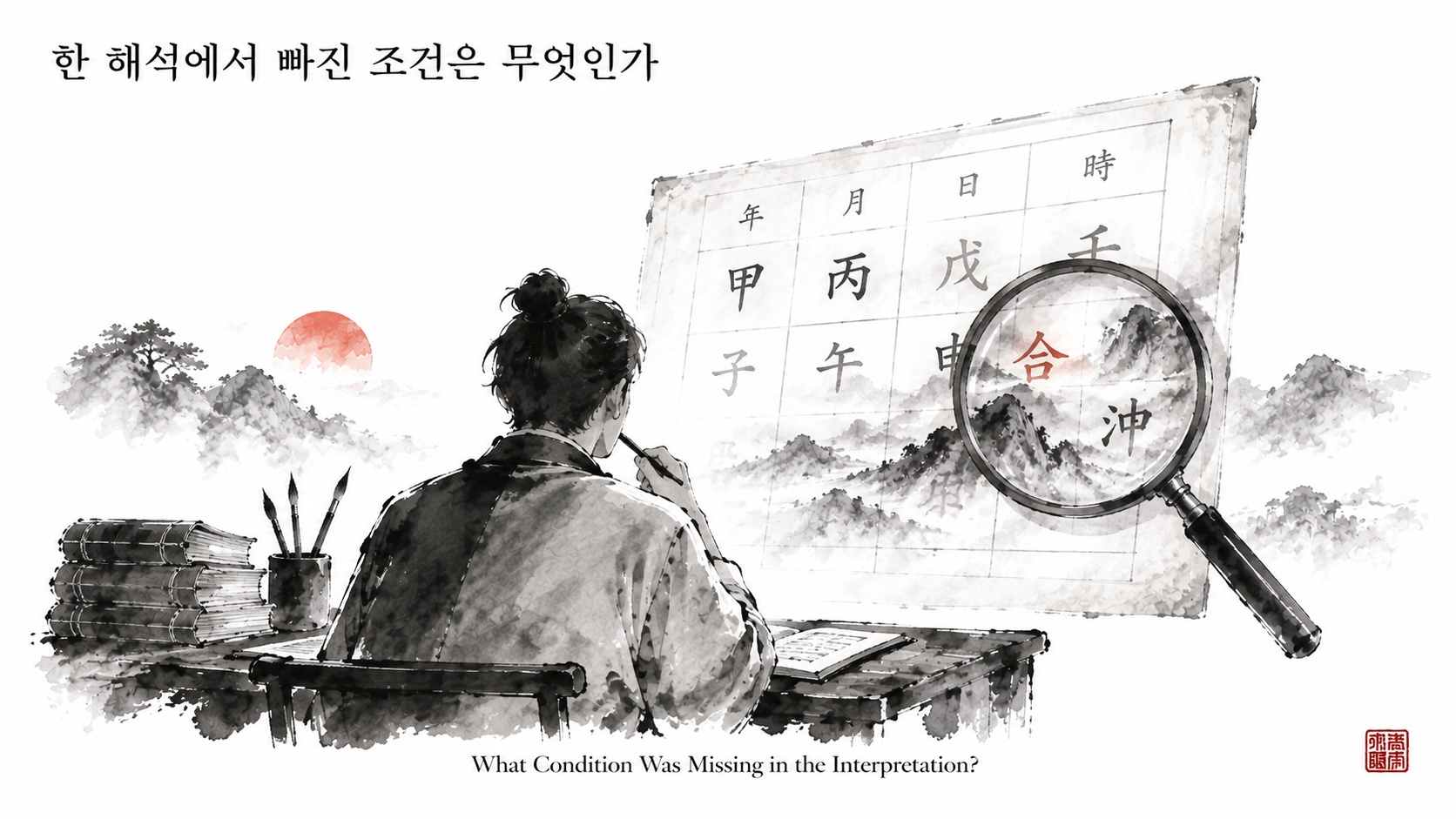
For example, even if the Day Master appears strong, it may struggle to manifest its power if its roots are weak or if it is destabilized by surrounding branch clashes (沖) or branch penalty. Conversely, even a seemingly weak Day Master can function positively through supportive characters or specific structural arrangements. In this hypothetical chart, hidden conditions such as branch combinations (合), clashes, and the status of character roots proved more critical than the visible strength of a specific element.
The key to this chart lies in reading the dynamic relationships between Earthly Branches and the resulting potential for change in the Heavenly Stems, rather than focusing on the strength of a single character. For instance, a specific branch combination occurring within the branches can shift the energy of the Heavenly Stems or strengthen or weaken certain elements. These changes exert a greater influence on the actual flow of life than the initial appearance of the chart suggests.
Furthermore, it is critical to accurately grasp the magnitude and direction of forces when one character is being subjected to control in the Five Elements or generation in the Five Elements by another. Instead of merely noting that one character controls another, one must examine the specific context: under what circumstances, with what intensity, and with what consequences does this occur? This analysis revealed why the flow of wealth or relationships in this chart manifested differently than expected.
Balance and compensation are vital concepts in interpreting a chart. Even if a chart is heavily skewed toward one element, it can yield positive outcomes if there are characters that compensate for the deficiency or if the structure alleviates that imbalance. Conversely, a chart with a relatively even distribution of elements may still lead to an unstable life if there are intense conflicts or destructive relationships.
This hypothetical chart analysis focused too heavily on the visible dominance of a specific element, neglecting the role of characters that could have provided balance or the ways in which characters harmonize or destabilize one another. For instance, having a strong Fire element is not inherently positive. If there are appropriate amounts of Earthly Branches or Metal element to drain or regulate that Fire element, its positive energy can be well-utilized. Re-examining the chart from the perspective of balance and compensation is crucial.
While exploring life’s direction through the Four Pillars is beneficial, relying solely on specific conditions or interpretations to make definitive judgments is risky. A chart is like a map showing an individual’s potential and possibilities, but how one uses that map and which path one chooses depends entirely on personal will and effort.
In this case, because certain conditions were overlooked, the interpretation might have been far more restrictive or exaggerated than the actual potential. For example, if one concludes that wealth luck is positive, one might still face unexpected obstacles in the process of acquiring wealth or struggle to preserve it. Therefore, interpretations should always be taken as indicators of potential and possibilities, used as reference material to guide life in a positive direction.
The meaning of specific characters or combinations in a chart is not fixed; it shifts constantly within the overall structure and the flow of the ten-year luck cycle and annual luck cycle. Moreover, it interacts with external factors such as individual experience, environment, and choices. Thus, making definitive judgments about a person’s character, career, health, or future based solely on eight characters is a hasty conclusion.
The fact that conditions were overlooked in this case means there was room for further interpretation. If a specific interpretation is wrong, it may be because the complex context of life was not fully considered. For instance, even if a certain career is recommended, it will be difficult to succeed if it does not align with an individual’s aptitude or social environment. The Four Pillars is a tool for understanding life, not an absolute law that determines everything. Approach interpretation with an open mind, keeping various possibilities in mind.
Through this case, we have reaffirmed the importance of specific conditions in chart interpretation. Beyond obvious features, it is vital to deeply examine hidden elements such as the state of the Earthly Branches, the complex relationships between characters, and the balance and compensation of the elements. Such multi-faceted analysis provides more accurate and realistic insights.
In the next article, we will focus on the limitations and problems of interpreting a chart using only the Day Pillar (日柱). We will examine with concrete examples why the tendency to judge everything based on the Day Pillar alone is dangerous and why viewing the entire chart is essential. This will help further develop the depth of your interpretive skills.