
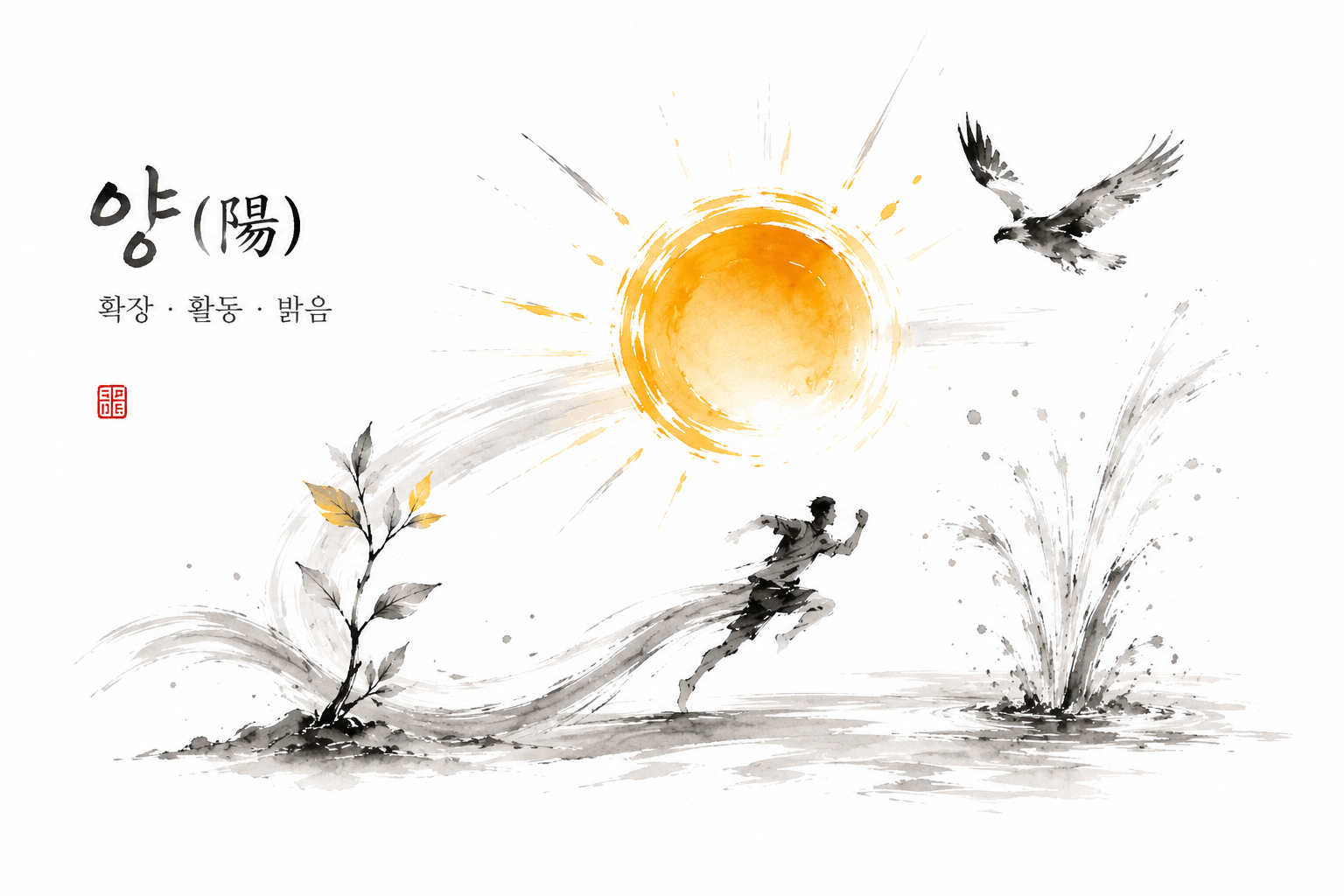
In the previous installment, we explored 'Yin', one of the fundamental characteristics of all things. Now, it's time to delve into the concept of 'Yang', its opposing yet complementary force. Along with Yin, Yang is one of the two fundamental energies that constitute everything in the universe, characterized by its active, bright, and outwardly expressive nature. Through this article, we will understand the essence of Yang and its significance in Four Pillars, fostering a balanced perspective on Yin and Yang.
Yang is an energy that stands in opposition to Yin while forming a mutually complementary relationship. If Yin is characterized by contraction and stillness, Yang possesses characteristics of expansion and dynamism. All qualities that are bright, hot, rising, outwardly expressed, active, and assertive can be classified as Yang. For example, day, sun, male, summer, fire, and sky are representative attributes of Yang. Yang serves as the driving force that fosters growth and development in all things.
We can easily find characteristics of Yang all around us in daily life. The morning sun illuminates the world, warms it, and initiates activity. The vibrant daytime is a Yang period when people work and move. The sprouting and upward growth of plants, the powerfully rising fountain, the intensely burning flame, and loud sounds and rapid movements all represent the energy of Yang. Thus, Yang symbolizes the vitality and vibrancy of all things.
In Four Pillars Four Pillars theory, Yang is primarily assigned to odd-numbered characters among those corresponding to Heavenly Stems, such as Byeong, the Yang Fire Heavenly Stem, Gyeong, the Yang Metal Heavenly Stem, Gap, the Yang Wood Heavenly Stem, Im, the Yang Water Heavenly Stem, and Mu, the Yang Earth Heavenly Stem. These characters represent outwardly expressed energy, active expression, and external activity. For example, while the wood energy of Yang Wood (甲) signifies a grand and majestic essence that extends upwards, Yin Wood (乙) manifests as flexible and delicate intertwined vines or grass. In this way, Yin and Yang impart differences in how the Five Elements manifest and take form, even though their underlying essence is the same.
Each of the Five Elements also contains Yin and Yang, further subdividing their characteristics. The application and nature of the same element differ depending on whether it is Yin or Yang.
Yang Wood (甲): Large tree, pillar, upward-surging vigor, strong drive.
Yang Fire (丙): Sun, hot fire, emanation, cheerfulness, passion.
Yang Earth (戊): Large mountain, vast land, stability, inclusiveness, profoundness.
Yang Metal (庚): Unrefined large rock, steel, hardness, loyalty, integrity.
Yang Water (壬): Large river, sea, flowing water, wisdom, inclusiveness, dynamism.
In this way, the Five Elements imbued with Yang energy express active and outgoing characteristics in different forms.
An imbalance occurs when Yang energy is excessively strong or weak. If Yang energy is too strong, it can manifest as excessive activity, aggression, impulsiveness, or burnout. Conversely, if Yang energy is too weak, it can lead to lethargy, passivity, indifference, or loss of motivation. In Four Pillars, the harmonious balance of Yin, Yang, and the Five Elements is considered paramount. Yang itself is neither inherently good nor bad; it becomes a positive energy only when it plays its role within an overall harmony.
Many beginners often misunderstand Yang as ‘good’ and Yin as ‘bad,’ a dichotomous error. However, this fundamentally misinterprets the essence of Yin and Yang. Yang possesses bright and active characteristics, while Yin has dark and static ones; neither is superior or inferior. All things in the world exist in harmony between Yin and Yang, and neither can be complete on its own. No matter how strong Yang energy is, it cannot exist without a Yin foundation, and Yin energy cannot change without the activity of Yang. When interpreting Four Pillars, instead of hastily concluding that a specific energy is unconditionally good or bad just because it’s abundant, one must understand it from the perspective of overall harmony and balance.
We have explored the concept of Yang and its meaning in Four Pillars. While Yin and Yang appear to be opposing forces, they actually require each other and are in a constant state of change and circulation. In the next installment, we will delve deeper into why Yin and Yang are never a matter of good or bad.


