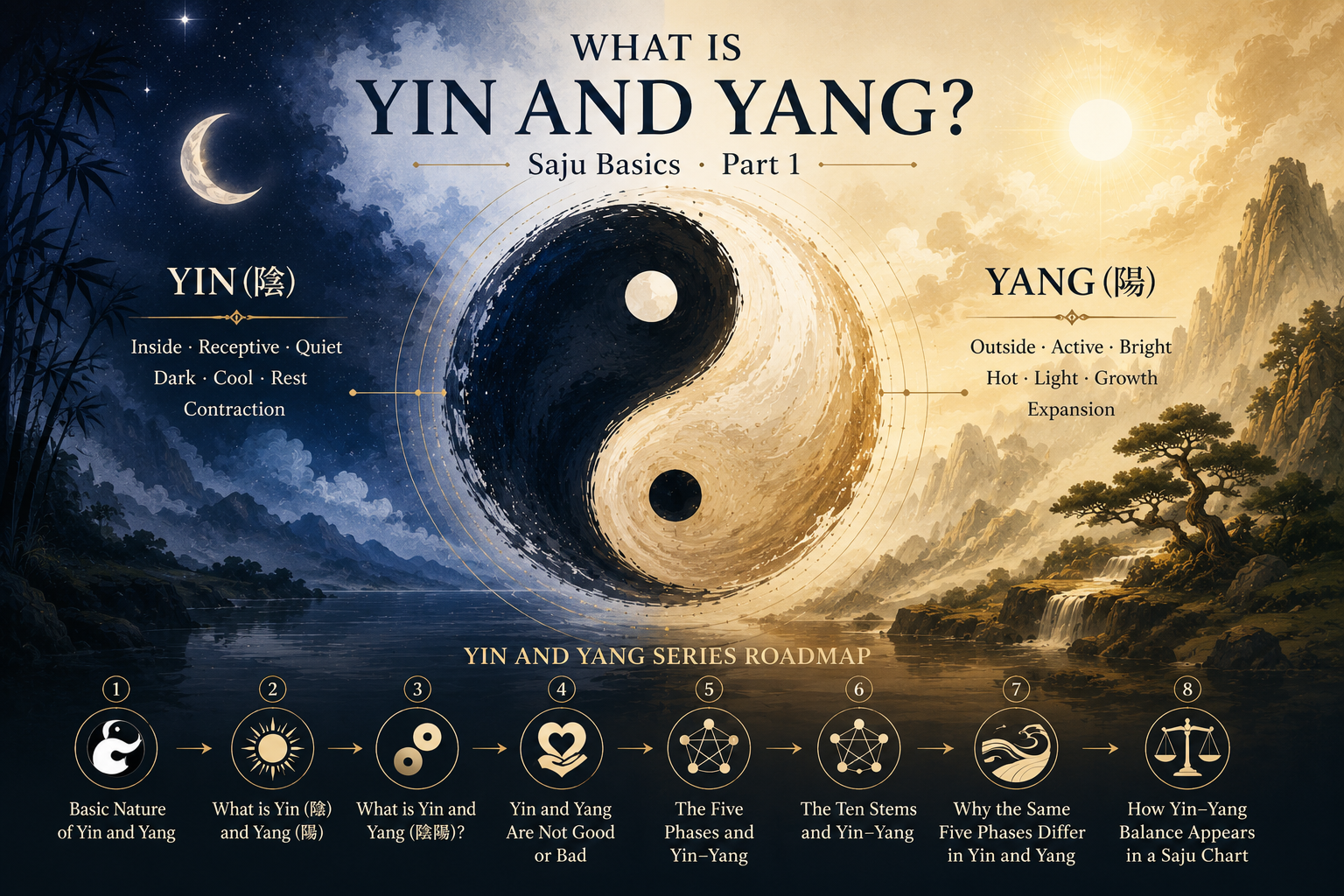
Yin and Yang, one of the most fundamental concepts in Saju, is not merely a dichotomy of good and bad. It's a core principle explaining how all things in the universe coexist in a state of complementary opposition, constantly changing and cycling. This article will explore what Yin and Yang represent and how to understand them from a basic perspective within the context of the Four Pillars.
Yin and Yang is a fundamental principle in Eastern philosophy that explains the creation and transformation of all things in the universe. It represents two opposing yet complementary forces, a relationship where neither can exist without the other. For instance, light helps us perceive darkness, and movement allows us to feel stillness; similarly, Yin and Yang reveal their existence through each other. They are not static but form a dynamic relationship of constant change and circulation.
The principles of Yin and Yang are easily observed in our daily lives. Common examples include day and night, sun and moon, heat and cold, male and female, and activity and rest. Day has a strong Yang polarity energy, while night possesses a strong Yin polarity energy; the sun symbolizes Yang, and the moon symbolizes Yin. Thus, Yin and Yang are not merely abstract concepts but are interwoven into all phenomena of our lives, constantly interacting and maintaining balance.
Saju studies are based on the principles of Yin and Yang and the Five Elements, interpreting the cosmic energies. The the Heavenly Stems and the Earthly Branches that make up the the Four Pillars each possess unique Yin and Yang attributes. For example, among the Heavenly Stems, Gap, the Yang Wood Heavenly Stem, Byeong, the Yang Fire Heavenly Stem, Mu, the Yang Earth Heavenly Stem, Gyeong, the Yang Metal Heavenly Stem, and Im, the Yang Water Heavenly Stem correspond to Yang polarity energy, while Eul, the Yin Wood Heavenly Stem, Jeong, the Yin Fire Heavenly Stem, Gi, the Yin Earth Heavenly Stem, Sin, the Yin Metal Heavenly Stem, and Gye, the Yin Water Heavenly Stem correspond to Yin polarity energy. Similarly, among the Earthly Branches, Ja, the Rat Earthly Branch, In, the Tiger Earthly Branch, Jin, the Dragon Earthly Branch, O, the Horse Earthly Branch, Sin, the Monkey Earthly Branch, and Sul, the Dog Earthly Branch belong to Yang polarity, while Chuk, the Ox Earthly Branch, Myo, the Rabbit Earthly Branch, Sa, the Snake Earthly Branch, Mi, the Goat Earthly Branch, Yu, the Rooster Earthly Branch, and Hae, the Pig Earthly Branch belong to Yin polarity. By understanding an individual’s Yin and Yang distribution through their the Four Pillars, we take the first step towards comprehending the characteristics and balance of their inherent energy.
Yin and Yang combine with the Five Elements (Wood, Fire, Earth, Metal, Water) to represent more refined energies. Each of the Five Elements is further divided into Yin and Yang, forming the 10 the Heavenly Stems. For example, even within the ‘Wood’ energy, Gapmok (甲木) represents a large, sturdy tree with Yang polarity energy, while Eulmok (乙木) symbolizes soft grass or vines with Yin polarity energy. This distinction of Yin and Yang, even within the same Five Element, adds subtle but crucial differences to their characteristics and modes of operation, deepening the interpretation of the Four Pillars.
Yin and Yang are not about good or bad, but about balance. If the Yin and Yang energies in the Four Pillars are appropriately harmonized, one can expect a stable and smooth flow. Conversely, if one side’s energy is excessively strong or weak, creating an imbalance, it can lead to specific tendencies or difficulties in various aspects of life. Understanding this state of Yin and Yang balance through the Four Pillars and striving to adjust any imbalance is important.
Many beginners often misunderstand Yin and Yang, thinking ‘Yang is good and Yin is bad.’ However, this misinterprets the true nature of Yin and Yang. Yang represents active and outward energy, while Yin represents receptive and inward energy; there is no relationship of superiority or inferiority between them. Just as day loses its meaning without night, Yin and Yang are mutually complementary beings that become complete only when both are present. Without either, the world cannot exist, and a balanced state is considered ideal.
So far, we have explored the basic concepts of Yin and Yang and their importance in Saju. In the next part, we will delve deeper into the energy of ‘Yin polarity’ among Yin and Yang, examining the various meanings and characteristics of Yin in detail.