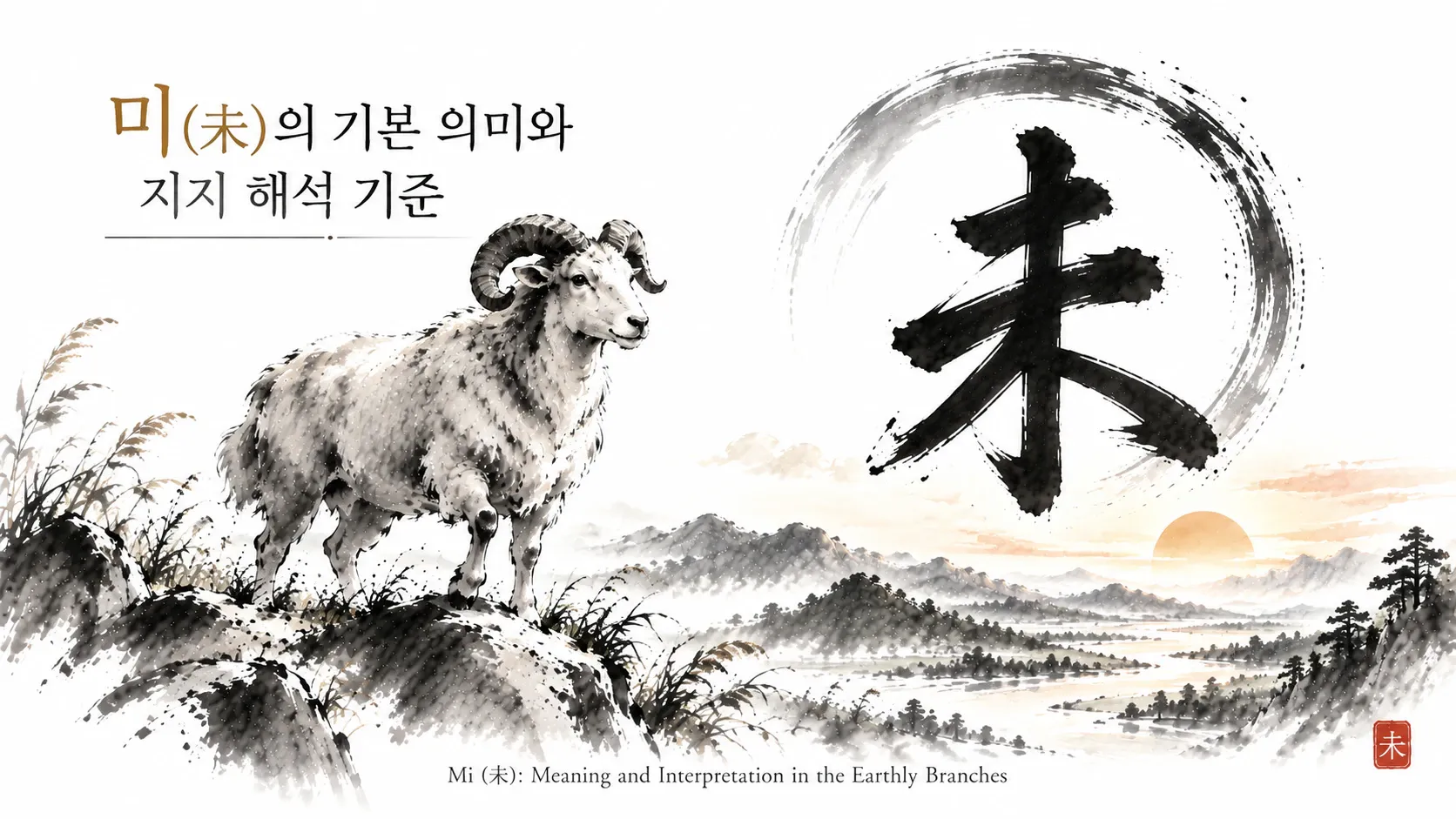
Mi, Goat पार्थिव शाखा को पार्थिव शाखाएँ के क्रम में आठवें अक्षर के रूप में जाना जाता है, जो बारह पशुओं में 'बकरी' का प्रतिनिधित्व करता है। यह वह संक्रमण बिंदु है जहाँ ग्रीष्म ऋतु की ऊर्जा अपने चरम पर पहुँचकर अगली ऋतु में प्रवेश करने की तैयारी करती है। केवल पशु प्रतीक तक सीमित न रहकर, यह अक्षर मौसमी बदलाव और प्राकृतिक व्यवस्था के सिद्धांतों को समाहित करता है, जो चार स्तंभ के विश्लेषण में अत्यंत महत्वपूर्ण है। यह लेख Mi, Goat पार्थिव शाखा के मूल अर्थ और इसे व्यापक चार स्तंभ ढांचे के भीतर समझने के तरीकों पर प्रकाश डालता है।
Fundamental Meaning and Etymology of Mi
Mi is the eighth character in the sequence of पार्थिव शाखाएँ, corresponding to the Goat among the twelve animals. In चार स्तंभ analysis, however, it is essential to focus on the character’s inherent energy and symbolism rather than just its animal association.
The character ‘未’ depicts the image of tree branches growing lushly but not yet bearing fruit. It signifies a middle stage of growth and maturation—implying ‘not yet’ or ‘incomplete’—and symbolizes future potential and possibility. This aligns with its role as a transitional marker at the end of summer, preparing to shift into autumn.
Coordinates: Season, Time, and Direction
Seasonally, Mi represents the last month of summer, or the sixth lunar month. It is a period when the intense heat of summer reaches its zenith while simultaneously preparing for autumn. It marks the state just before things reach full maturity and harvest, signaling an impending change.
In terms of time, it represents the period from 1:30 PM to 3:30 PM. It is a time when the peak heat of the day lingers but gradually begins to transition toward the evening, symbolizing high activity shifting toward stability.
Directionally, it points to the south-southwest. This is a slight deviation from the true south of O, Horse पार्थिव शाखा, indicating the point where the energy of summer begins to shift westward. These coordinates clarify the transitional nature of Mi.
Properties: Elements and Yin-Yang
Mi corresponds to the पृथ्वी तत्व element element and, in terms of यिन प्रवृत्ति-Yin, represents the यिन प्रवृत्ति energy of यिन प्रवृत्ति पृथ्वी तत्व. As a strong पृथ्वी तत्व element at the end of summer, it possesses the quality of ‘dry पृथ्वी तत्व.’ It holds the essence of पृथ्वी तत्व element, which nurtures and gathers, while simultaneously retaining the residual heat of summer.
As यिन प्रवृत्ति पृथ्वी तत्व, Mi is flexible and accommodating but often conceals an inner stubbornness and persistence. While its inner heat can sometimes lead to impatience or impulsiveness, it fundamentally seeks stability and harmony. These characteristics manifest differently depending on the placement of the character within the चार स्तंभ.
The Hidden Energy: Stems within Mi
The hidden stems (Zhi-Jang-Gan) are crucial for understanding the essence of an Earthly Branch. Mi contains the hidden stems Jeong, Yin Fire स्वर्गीय तना, Eul, Yin Wood स्वर्गीय तना, and Gi, Yin Earth स्वर्गीय तना.
Jeong, Yin Fire स्वर्गीय तना represents the intense heat of summer अग्नि तत्व, Eul, Yin Wood स्वर्गीय तना signifies the flexible energy of लकड़ी तत्व, and Gi, Yin Earth स्वर्गीय तना is the primary energy of यिन प्रवृत्ति पृथ्वी तत्व. Positioned at the end of summer, Mi is a complex character that holds residual अग्नि तत्व (Jeong) while simultaneously fostering the vitality of लकड़ी तत्व and the gathering nature of पृथ्वी तत्व.
This configuration shows that Mi is not purely पृथ्वी तत्व element but a fusion of अग्नि तत्व and लकड़ी तत्व. When interpreting Mi in a चार स्तंभ, one must consider the शाखाओं का संयोजन and relative strength of these three energies.
Interpretation by Position in the Four Pillars
The influence and expression of Mi vary based on its position in the चार स्तंभ.
- Year Branch: Relates to ancestors or childhood environments. It suggests a foundation established by ancestors or growing up under a protective environment. It may also indicate a conservative or stability-oriented upbringing.
- Month Branch: The Month Branch represents social life, career, and parents. Here, Mi suggests a pursuit of professional stability, driven by persistence and patience. It may reflect traditional values shared with parents. While it may feel restrictive in early social life, one’s capacity tends to bloom with time.
- Day Branch: The Day Branch represents the spouse, personal character, and inner self. Individuals with Mi here are generally gentle, accommodating, and favor stable relationships. They are often dedicated and responsible partners, though they can possess a strong internal stubbornness and a tendency to hold their ground.
- Time Branch: The Time Branch reflects later life, children, and personal potential. It suggests a pursuit of stability in one’s later years and emphasizes harmonious, traditional values in family relations. It often implies that one’s talents are refined over time, leading to fulfillment in the later stages of life.
Transformations through Interactions
पार्थिव शाखाएँ interact with others, causing shifts in energy. Mi’s characteristics change through combinations and conflicts.
- शाखाओं का संयोजन: In the Hae-Myo-Mi लकड़ी तत्व शाखाओं का संयोजन, when Hae, Pig पार्थिव शाखा, Myo, Rabbit पार्थिव शाखा, and Mi gather, they form a powerful लकड़ी तत्व energy. Though Mi is inherently पृथ्वी तत्व, this शाखाओं का संयोजन transforms it into a driver of growth and vitality.
- छह संयोजन: In the O, Horse पार्थिव शाखा-Mi अग्नि तत्व शाखाओं का संयोजन, when O, Horse पार्थिव शाखा meets Mi, they combine into अग्नि तत्व energy. The पृथ्वी तत्व quality of Mi weakens as it merges with the intense अग्नि तत्व, potentially heightening one’s active and passionate nature.
- Conflicts (Chung): In the Chuk-Mi conflict, Chuk, Ox पार्थिव शाखा and Mi clash. Because Chuk, Ox पार्थिव शाखा is wet पृथ्वी तत्व and Mi is dry पृथ्वी तत्व, their interaction can cause instability, leading to movement, change, or interpersonal conflict.
- शाखाओं का दंड संबंध: The Chuk-Sul-Mi शाखाओं का दंड संबंध occurs when Chuk, Ox पार्थिव शाखा, Sul, Dog पार्थिव शाखा, and Mi gather. This interaction can trigger friction, rumors, or legal troubles due to the complex and unpredictable energy mix.
- शाखाओं का टूटन संबंध: The Jin-Mi शाखाओं का टूटन संबंध involves Jin, Dragon पार्थिव शाखा and Mi. This signifies a potential for discord or disruption, introducing cracks into the stability of पृथ्वी तत्व.
- शाखाओं का हानि संबंध: The Ja-Mi शाखाओं का हानि संबंध involves Ja, Rat पार्थिव शाखा and Mi. This implies a relationship where one energy hinders or interferes with the other, potentially restricting Mi’s natural flow.
Common Misconceptions for Beginners
A common mistake for beginners is focusing solely on the animal association of the ‘Goat.’ While Mi shares traits like gentleness or persistence, चार स्तंभ requires a synthesis of season, time, elements, and hidden stems.
It is also a mistake to assume that because Mi is यिन प्रवृत्ति पृथ्वी तत्व, it is inherently passive. It harbors the intense heat of summer and the hidden potential of अग्नि तत्व and लकड़ी तत्व, granting it inner stubbornness and strong momentum. Because its energy shifts significantly with combinations or conflicts, one should avoid defining personality based on single-faceted information.
Summary of Interpretation Criteria
Mi is यिन प्रवृत्ति पृथ्वी तत्व, marking the end of summer and a transitional point.
- It represents the middle stage of maturation and future potential.
- Through the hidden stems Jeong, Yin Fire स्वर्गीय तना, Eul, Yin Wood स्वर्गीय तना, and Gi, Yin Earth स्वर्गीय तना, it carries a complex mix of अग्नि तत्व, लकड़ी तत्व, and पृथ्वी तत्व energies.
- Its influence manifests differently based on its position in the चार स्तंभ.
- It requires a view of the overall harmony, as its energy changes through interactions with other branches.
- Interpretation should be multifaceted rather than relying on the animal sign or element alone.
| Category | Key Meaning of Mi | Considerations for Interpretation |
|---|---|---|
| Season/Time/Direction | End of Summer, 1:30–3:30 PM, South-Southwest | Maturity, Transition, Activity |
| Elements/यिन प्रवृत्ति-Yang | यिन प्रवृत्ति पृथ्वी तत्व, Dry पृथ्वी तत्व | Stubbornness within flexibility, Tolerance, Inner heat |
| Hidden Stems | Jeong, Yin Fire स्वर्गीय तना, Eul, Yin Wood स्वर्गीय तना, Gi, Yin Earth स्वर्गीय तना | Composite energy of अग्नि तत्व, लकड़ी तत्व, and पृथ्वी तत्व |
| Interactions | Hae-Myo-Mi लकड़ी तत्व शाखाओं का संयोजन, O, Horse पार्थिव शाखा-Mi अग्नि तत्व शाखाओं का संयोजन, Chuk-Mi conflict, etc. | Energy changes depending on neighboring branches |
| Position in Chart | Year, Month, Day, Time | Varies in scope—ancestry, society, spouse, later life |
Connection to the Next Branch: Sin, Monkey पार्थिव शाखा
We have examined Mi, the character that matures in the heat of summer while preparing for autumn. If Mi marks the transition, the next branch, Sin, Monkey पार्थिव शाखा, signals the true beginning of autumn. Sin, Monkey पार्थिव शाखा represents the energy of धातु तत्व and acts as the gateway to the season of gathering and harvest. In the next article, we will explore the characteristics of Sin, Monkey पार्थिव शाखा and the criteria for its interpretation in the चार स्तंभ.