This is the third installment in our Four Pillars reading series. After establishing the overall process in Part 1 and understanding the Day Master as the core of interpretation in Part 2, it's now time to explore the Month Branch and its associated season – key elements in understanding the environmental context of one's the Four Pillars of Destiny. This article will clarify the significance of the Month Branch, explain how to locate it in a chart, and guide you through the process of determining the season.
Why the Month Branch and Season are Crucial
This 'Four Pillars Reading' series aims to help you master the sequence and principles of interpretation. After covering the overall framework in Part 1 and the Day Master – the focal point of analysis – in Part 2, our next step is to understand the environment of the Day Master: the Month Branch and its associated season. The Month Branch is one of the most influential characters in the Eight Characters, serving as a critical factor that shapes the overall energy and trajectory of one's the Four Pillars of Destiny.
Objective of This Step: Understanding the the Four Pillars of Destiny Environment
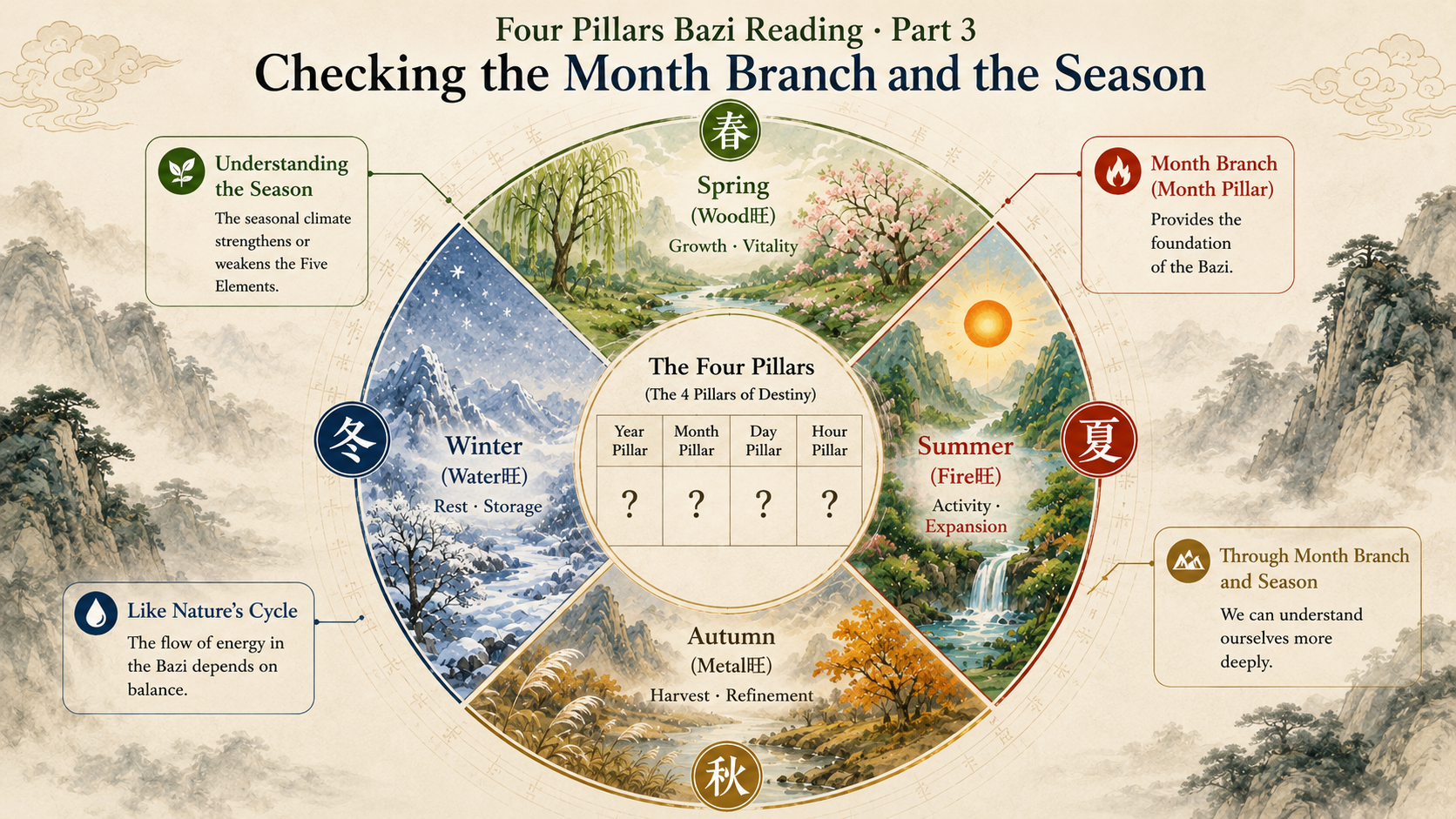
The primary goal of this stage is to gain a clear understanding of the environmental context in which the Day Master, the central figure of the chart, was born. The Month Branch is more than just an individual character; it signifies the seasonal backdrop that profoundly influences the entire energy of the the Four Pillars of Destiny. By recognizing this, you can begin to form a comprehensive picture of the energies that define a particular Four Pillars chart.

Why Prioritize Identifying the Month Branch and Season?
While the Four Pillars of Destiny interpretation centers on the Day Master, its inherent strength and characteristics are heavily shaped by the Month Branch. Consider, for instance, a 'Wood' Day Master: a tree born in spring will have vastly different growth conditions and essential needs compared to one born in winter. The Month Branch provides crucial insights into the fundamental energy flow and the overall strength and weakness of the the Four Pillars of Destiny. Failing to identify this first can lead to significant misinterpretations of individual Five Elements or Ten Gods. It's akin to trying to grow a plant without understanding its necessary soil and climate.
Locating the Month Branch in a Four Pillars Chart
A the Four Pillars of Destiny chart is composed of four pillars: the Year Pillar, the Month Pillar, the Day Pillar, and the Hour Pillar. Within this structure, the Month Branch (Wolji) is specifically the the Earthly Branches of the the Month Pillar. Just as we identified the Day Master as the Heavenly Stem of the Day Pillar in Part 2, the Month Branch is found by locating the character positioned as the Earthly Branch of the Month Pillar. This single character encapsulates the seasonal attributes of the entire the Four Pillars of Destiny.
Procedure for Determining the Season from the Month Branch
Step 1: Locate the Month Branch: Identify the character corresponding to the Earthly Branch of the Month Pillar in the chart (e.g., 寅 (In), 卯 (Myo), 辰 (Jin), etc.).
Step 2: Connect to the Season: Each Earthly Branch triad corresponds to a specific season:
寅卯辰 (In-Myo-Jin) → Spring (Strong Wood energy)
巳午未 (Sa-O-Mi) → Summer (Strong Fire energy)
申酉戌 (Sin-Yu-Sul) → Autumn (Strong Metal energy)
亥子丑 (Hae-Ja-Chuk) → Winter (Strong Water energy)
Step 3: Understand the Seasonal Energy: Grasp which of the Five Elements the identified season represents. For example, In-wol (寅月) marks the beginning of spring, a period where Wood energy becomes strong.
A Common Pitfall for Beginners: The Importance of Solar Term Start Dates
Many beginners mistakenly equate the Month Branch with the Gregorian or lunar birth month. However, in the Four Pillars of Destiny, the Month Branch is determined by the Solar Terms (Jeolgi), which are 24 seasonal divisions in the lunisolar calendar. For instance, even if the Gregorian calendar shows February, if it falls before Ipchun (Start of Spring), the Month Branch remains 'Chuk-wol' (representing the previous year's energy). It transitions to 'In-wol' only after Ipchun. Therefore, it is crucial to use a Manseoryeok (traditional almanac) or a the Four Pillars of Destiny app to verify the precise Solar Term start date to accurately establish the Month Branch. Neglecting this detail can fundamentally skew the entire seasonal context of the the Four Pillars of Destiny.
Connecting to the Next Steps
We have now identified the Day Master, its environmental context through the Month Branch, and the associated seasonal energy. This process is vital for comprehending the broader framework of the entire the Four Pillars of Destiny. In the next installment, we will delve into how to determine the distribution and strength of the Five Elements (Ohaeng) within a the Four Pillars of Destiny chart, using the Month Branch and season as our foundation. Understanding which elements are strong or weak will enable us to assess what energies the Day Master requires, and which might be excessive or deficient.
This concludes the third session of our Four Pillars Reading series, focusing on identifying the Month Branch and season. The Month Branch is a crucial element that reveals the environmental and seasonal backdrop of the the Four Pillars of Destiny. In the upcoming installment, we will explore methods for discerning the distribution and strength of the Five Elements within the the Four Pillars of Destiny based on this Month Branch.