Four Pillars theory and Western astrology explore an individual's destined tendencies through distinct lenses. At the heart of both systems are foundational tools that capture and analyze the moment of birth: the 'Four Pillars' in Four Pillars theory and the 'Natal Chart' in Western astrology. This article examines what these core concepts are, how they are structured, and how they are interpreted.
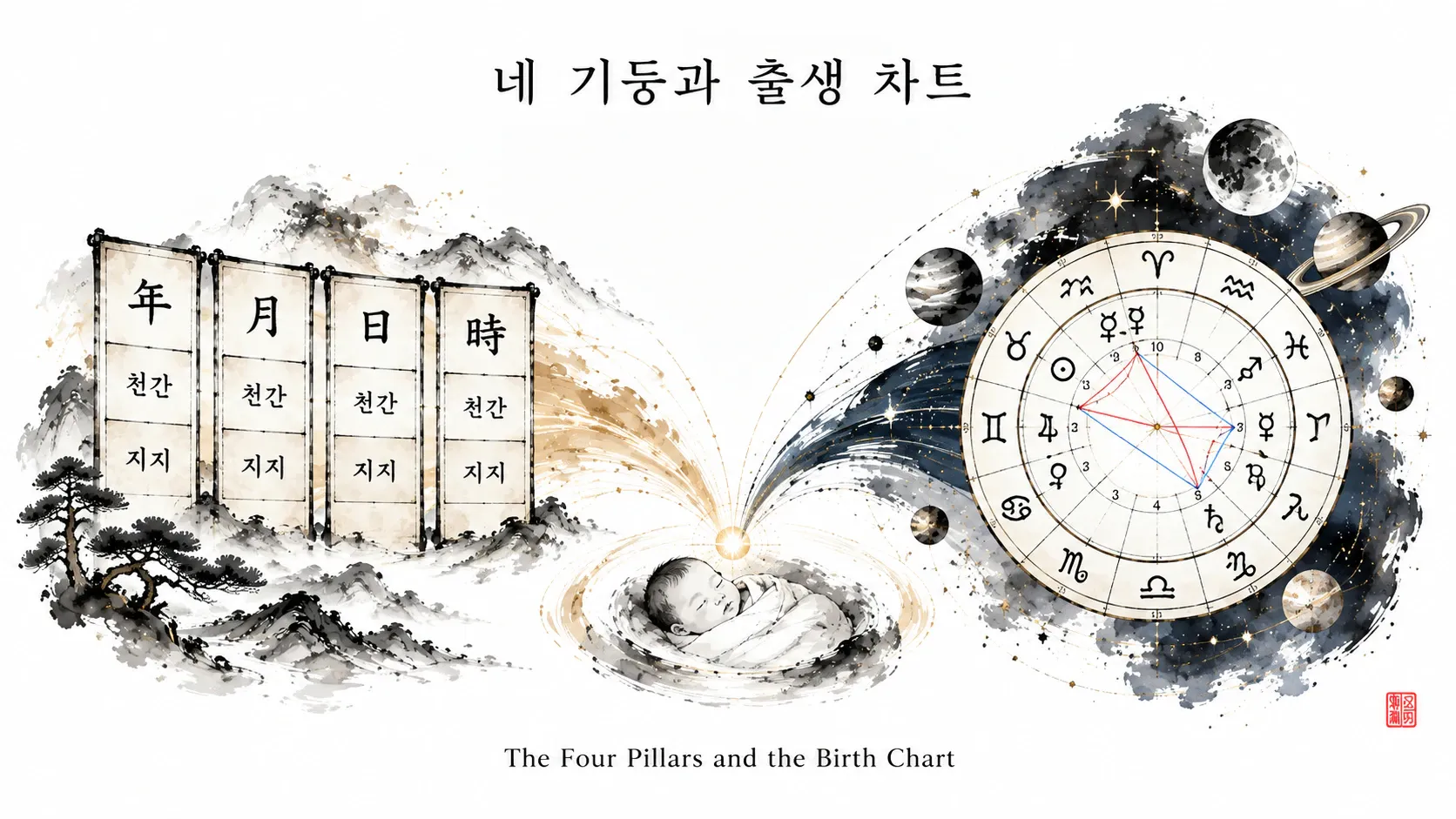
Four Pillars theory and Western astrology are both attempts to analyze the energy of the time and space into which an individual is born, seeking to understand their potential, temperament, and life’s trajectory. In Four Pillars theory, the year, month, day, and time of birth form the ‘Four Pillars,’ with the combination of Heavenly Stems and Earthly Branches identifying an individual’s unique energy composition. Conversely, Western astrology utilizes a ‘Natal Chart,’ a visual map showing the positions of planets in the sky at the exact moment and location of birth. These two tools serve as the starting point and most critical source of information for all interpretations within their respective systems.
In Four Pillars theory, the ‘Four Pillars’ refer to the year, month, day, and time of an individual’s birth. Each pillar consists of two characters—one from the Heavenly Stems and one from the Earthly Branches—forming a total of eight characters known as the ‘Eight Characters’. These eight characters act as a unique energy code granted at birth; by examining the energy of the Five Elements represented by each character and their relationships, one can discern an individual’s characteristics and the flow of their life. Each pillar carries clear symbolic meaning: the year pillar represents ancestors or the state, the month pillar signifies parents or society, the day pillar represents the self and spouse, and the time pillar relates to children or one’s later years.
Western astrology’s ‘Natal Chart’ is a circular map based on an individual’s precise time and place of birth, plotting the positions of the Sun, Moon, and planets within 12 zodiac signs and 12 houses. Each planet represents a specific energy or function, signs indicate how that energy is expressed, and houses denote the areas of life where that energy acts. This chart contains all the information necessary to understand various aspects of life, such as personality, talents, relationships, career, and wealth, while the angles between planets, known as aspects, reveal how these energies interact.
In Four Pillars theory, the Four Pillars constitute the most fundamental information forming an individual’s ‘fate.’ The distribution and interaction of the Five Elements contained within these eight characters hint at one’s innate temperament, potential, and the basic environment and connections one might encounter. Much like the genetic information in a seed, the Four Pillars provide critical clues for predicting how one might grow under different conditions. Therefore, reading the Four Pillars theory is a process of understanding an individual’s essential energy composition through these combinations to seek a direction for life.
In Western astrology, the Natal Chart is often called a ‘message from the universe,’ playing a decisive role in understanding one’s identity. Elements within the chart—including planets, signs, houses, and aspects—comprehensively display an individual’s psychological traits, talents, strengths, weaknesses, and major life themes. Beyond mere personality descriptions, it provides deep insight into the types of experiences one might have, areas where one may excel, and the nature of one’s relationships. The Natal Chart is both a powerful tool for self-understanding and a personalized map guiding one’s life journey.
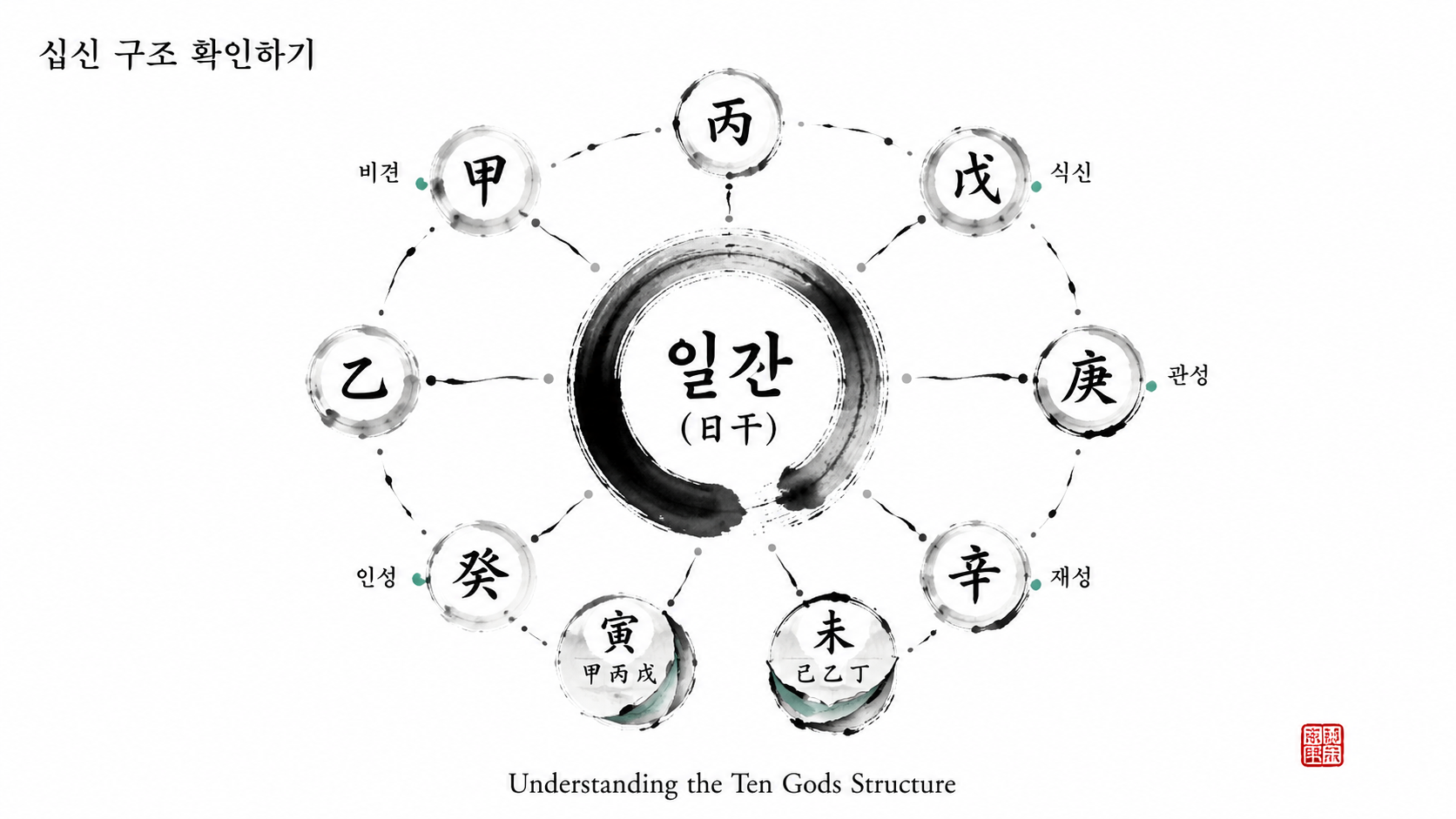
Interpreting the Four Pillars of Four Pillars theory goes beyond knowing the meaning of individual characters; it emphasizes the relationships and balance between them. The core focus lies in the generating cycle and overcoming cycle relationships among the Five Elements (Wood, Fire, Earth, Metal, Water), as well as the overall harmony and balance of the Four Pillars theory. For instance, practitioners analyze phenomena that arise when a specific element is too strong, too weak, or missing. Furthermore, by centering the analysis on the Day Master and observing how other characters interact with it, while considering the flow of energy relative to the ten-year luck cycle and the annual luck cycle, one can judge an individual’s fortune. It is a complex process that reads dynamic changes over time rather than static states.
Interpretation of a Western astrology Natal Chart occurs on multiple levels. Fundamentally, one identifies which sign each planet occupies and which house it belongs to. For example, having Mars in Aries within the first house suggests a very strong manifestation of individual drive and initiative. Analysts then examine aspects (angles between planets) to identify the harmony or conflict of these energies. If the Sun and Moon form a harmonious angle, it suggests inner and outer balance, whereas tense angles might indicate internal conflict. These elements are linked organically to understand complex psychology and life patterns.
Many mistakenly assume that the Four Pillars of Four Pillars theory and Western astrology’s Natal Chart are the same concept with different names. However, aside from both being based on the time of birth, the two systems differ significantly in their philosophical backgrounds, components, and interpretive methods. Four Pillars theory interprets the flow of energy through the combination of Heavenly Stems and Earthly Branches based on Eastern Yin-Yang and Five Elements philosophy, while Western astrology analyzes psychological traits and life areas through the astronomical positions of planets based on ancient Greco-Roman cosmology and mythology. Thus, it is more important to view them as independent tools for understanding the individual from different perspectives.
There is also a common misconception that Four Pillars or Natal Charts fix one’s fate, rendering it unchangeable. However, both systems interpret fate not as ‘predetermined,’ but as an ‘innate tendency’ or ‘potential energy composition.’ The Four Pillars of Four Pillars theory are like the type of seed an individual possesses; they suggest that different fruits can be borne depending on the environment in which they are nurtured. Similarly, a Natal Chart is merely a map showing one’s talents and challenges; how one walks that path depends entirely on individual choice and effort. These tools act as guides for exploring life’s direction and aiding self-understanding, not as shackles that dictate or restrict fate.
We have explored the respective roles of the Four Pillars of Four Pillars theory and Western astrology’s Natal Chart. While both are essential tools for understanding an individual’s essence, it is clear that they differ in composition and interpretation. But what perspectives do these systems have on the fundamental energy that constitutes the world? In the next article, we will compare the Five Elements of Four Pillars theory with the ‘Four Elements’ of Western astrology to delve deeper into how Eastern and Western worldviews and natural philosophy are reflected in the interpretation of an individual’s fate.