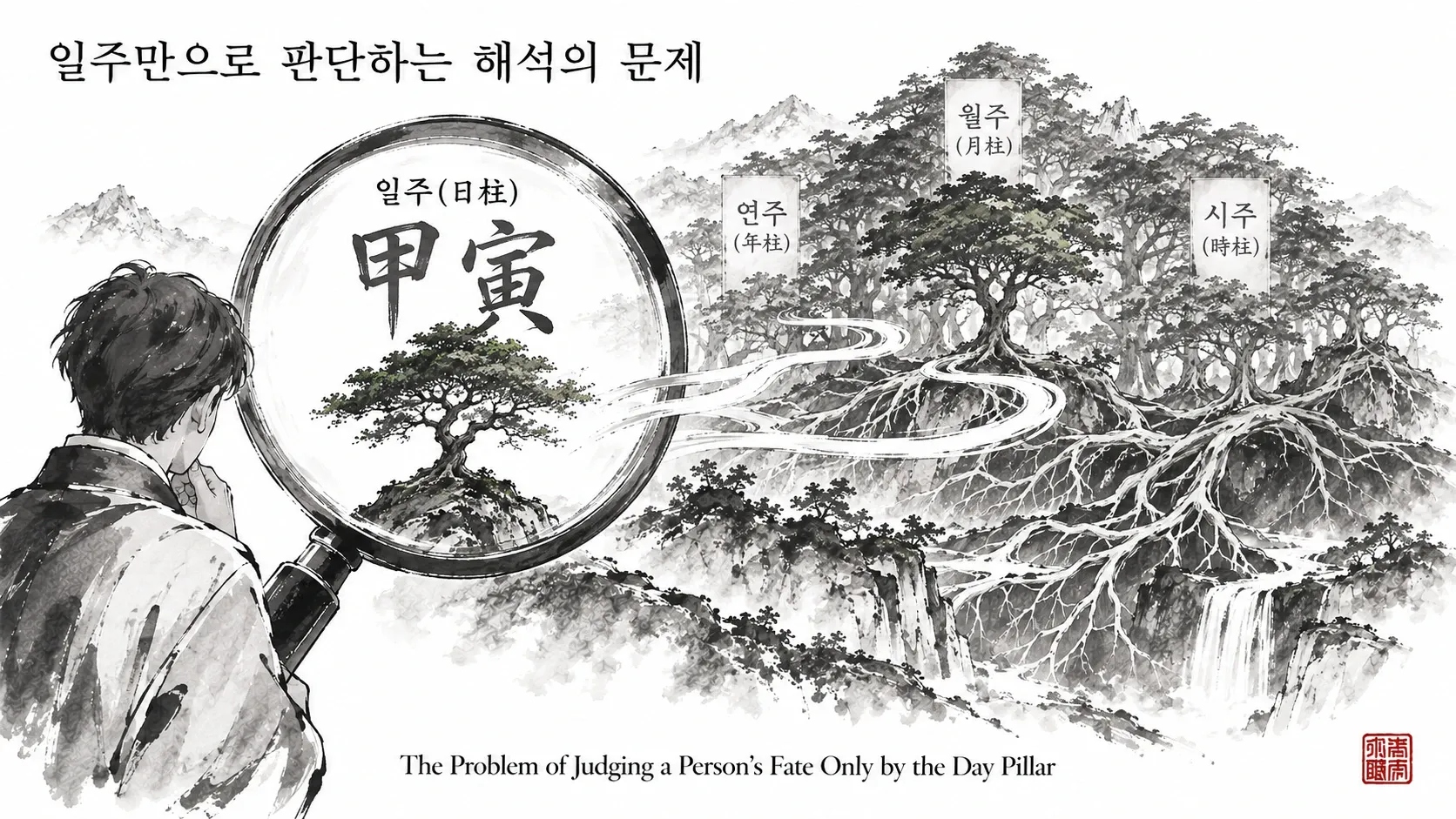
One of the most common starting points for those new to Four Pillars is to focus solely on the Day Pillar. However, because the Eight Characters represent a complex system where all eight components interact organically, relying on just one pillar can lead to significant misunderstandings. In this article, we will examine the limitations and risks of judging a complete Four Pillars profile based exclusively on the Day Pillar through a hypothetical case study.
Analyzing Four Pillars, is the Day Pillar enough? The Eight Characters consist of the Four Pillars representing the year, month, day, and hour of birth, along with eight characters formed by Heavenly Stems and Earthly Branches. Among these, the Day Pillar is considered the most vital character symbolizing the ‘self,’ leading many to attempt to gauge their personality or destiny based on it alone. While the Day Pillar is a core component of Four Pillars interpretation, it cannot represent the entirety of one’s Four Pillars.
Although the Day Pillar reveals essential individual traits, the remaining three pillars—Year Pillar, Month Pillar, and Hour Pillar—exert a profound influence on it and determine the balance and flow of the entire Four Pillars. Much like how a tree’s growth depends on soil, sunlight, and its surrounding environment even if its roots are strong, judging an entire Four Pillars by the Day Pillar alone is like assuming the state of an entire tree by looking only at its roots.
Hypothetical case: The hidden side of a seemingly strong Day Pillar. Let us consider a hypothetical profile. Suppose someone has a Day Pillar of Gapsin (甲寅). This configuration, where the Heavenly Stem Gapsin sits atop the Earthly Branch In, is known as Ganyeojidong, a state characterized by exceptionally strong energy. Because Gap represents a large tree and In signifies a vast forest, it is easy to assume that such an individual possesses strong leadership, drive, stubbornness, and independence.
Indeed, many beginners in Four Pillars or those with limited information often jump to conclusions about a person’s character based solely on this. They might say, “Since you have a Gapsin Day Pillar, you must be very forceful and opinionated!” However, this interpretation ignores the complex interactions created by the other seven characters. Will the subject of this profile truly lead such a strong and independent life?
Summary of core structure: Why we must look at the whole. The Eight Characters must be read comprehensively through the relationships of the Five Elements (Wood, Fire, Earth, Metal, Water) and the Ten Deities. Even if a Day Pillar holds strong energy, if the Month or Hour Pillars contain elements that exert control or drain energy from it, the initially strong nature of the Day Pillar can be significantly weakened or transformed.
For example, even with a strong Wood energy in the Gapsin Day Pillar, if the Month Pillar contains strong Metal energy, the Metal can control the Wood. Likewise, if the Hour Pillar has strong Fire energy, the Wood will exhaust its energy to generate the Fire, leading to internal fatigue despite a strong outward appearance. This is why understanding the structure of the entire Four Pillars is essential.
How should we interpret this combination? Consider again our hypothetical Gapsin Day Pillar profile. What if the Month Pillar is Gyeongsin and the Hour Pillar is Byeong-o? While Gapsin represents strong Wood, the Gyeongsin Month Pillar represents powerful Metal that strongly controls the Wood. This is akin to a large tree being constantly whittled away by a sharp axe. It suggests that the inherent drive or independence of the Day Pillar may be constantly restricted or thwarted by the external environment or social life.
Furthermore, the Byeong-o Hour Pillar contains strong Fire energy. Since Wood generates Fire, the Gapsin Day Pillar must continuously expend its energy to fuel this Fire. This indicates that while the individual may use their strength for others or pursue goals with passion, their own energy may be rapidly depleted. They may appear strong on the outside, but are actually likely to experience exhaustion or frustration due to external constraints and internal consumption.
Balance and complement: A perspective for harmonious interpretation. When interpreting Eight Characters, it is crucial to look beyond a mere list of meanings and understand the overall balance and harmony. In the previous case, we saw that despite the strong Wood energy of the Gapsin Day Pillar, its strength is difficult to fully manifest due to the control control of Metal and the energy drainage by Fire.
In such cases, one must identify which Five Elements or Ten Deities are needed to balance the entire Four Pillars. For instance, Water energy might be required to mitigate the strong control of Metal and regulate the drainage of Fire. Water plays a role in draining the energy of Metal, generating Wood, and moderating Fire. Thus, Four Pillars analysis is not just about measuring strength, but about deeply analyzing how each element interacts to form a point of balance.
Practical cautions: The danger of definitive interpretations. Many who study Four Pillars have a tendency to define a person’s personality, career, health, or even future fate based on one specific pillar or character. However, this is a very dangerous approach. The Eight Characters are like a map showing an individual’s innate temperament, but that map does not dictate the entirety of their life.
Our lives are constantly changing and evolving due to countless variables beyond the Eight Characters, including environment, education, personal effort, and relationships. Four Pillars interpretation should be a tool that helps us understand the direction of our lives, identify our strengths and weaknesses, and make better choices. Concluding that someone “will definitely be like this” simply because of their Day Pillar is a fallacy that restricts human free will and infinite potential.
Why we should avoid jumping to conclusions: The complexity of human life. Human life is a complex, multi-layered phenomenon that cannot be explained by a single factor, and the same applies to the Eight Characters. While each of the eight characters has an independent meaning, they constantly influence one another to create endless possibilities. Making a specific conclusion based on only one pillar is like judging the atmosphere of an entire orchestra performance by listening to only one instrument.
True Four Pillars interpretation is the process of understanding the meaning of each character and reading the overall flow of life and individual potential by comprehensively considering how they harmonize, conflict, or which elements are lacking or excessive. Always remember that definitive interpretations hinder this deep understanding and can lead to misguided judgments.
Next story: Reading the same Four Pillars from different perspectives. In this article, we explored why judging Four Pillars based solely on the Day Pillar is problematic and why we must look at the entire Eight Characters through a hypothetical case. In our next article, we will revisit this profile to see how many different stories can emerge depending on the analytical perspective, and explore how to add depth to such interpretations. We hope you will continue to cultivate a broad perspective on understanding Four Pillars.