In this twelfth installment of our Four Pillars series, we explore how the ten Heavenly Stems interact. While each stem possesses its own unique characteristics, 'Heavenly Stem Combination' (Cheongan-hap) refers to the phenomenon where stems meet and form new energies, much like two people entering into a relationship. Understanding these dynamics provides a vital key to interpreting the Four Pillars chart with greater depth.
Heavenly Stem Combination (Cheongan-hap) refers to the specific relationships formed when the ten Heavenly Stems interact within a Four Pillars chart. This goes beyond simple proximity; it describes a dynamic process where stems influence one another, potentially transforming into new energies or altering their original properties. Much like how water and fire can weaken each other or combine to form steam, Heavenly Stem combinations represent a vital shift in energy. In an Four Pillars chart, these combinations are interpreted as significant factors influencing an individual’s personality, relationships, and destiny.
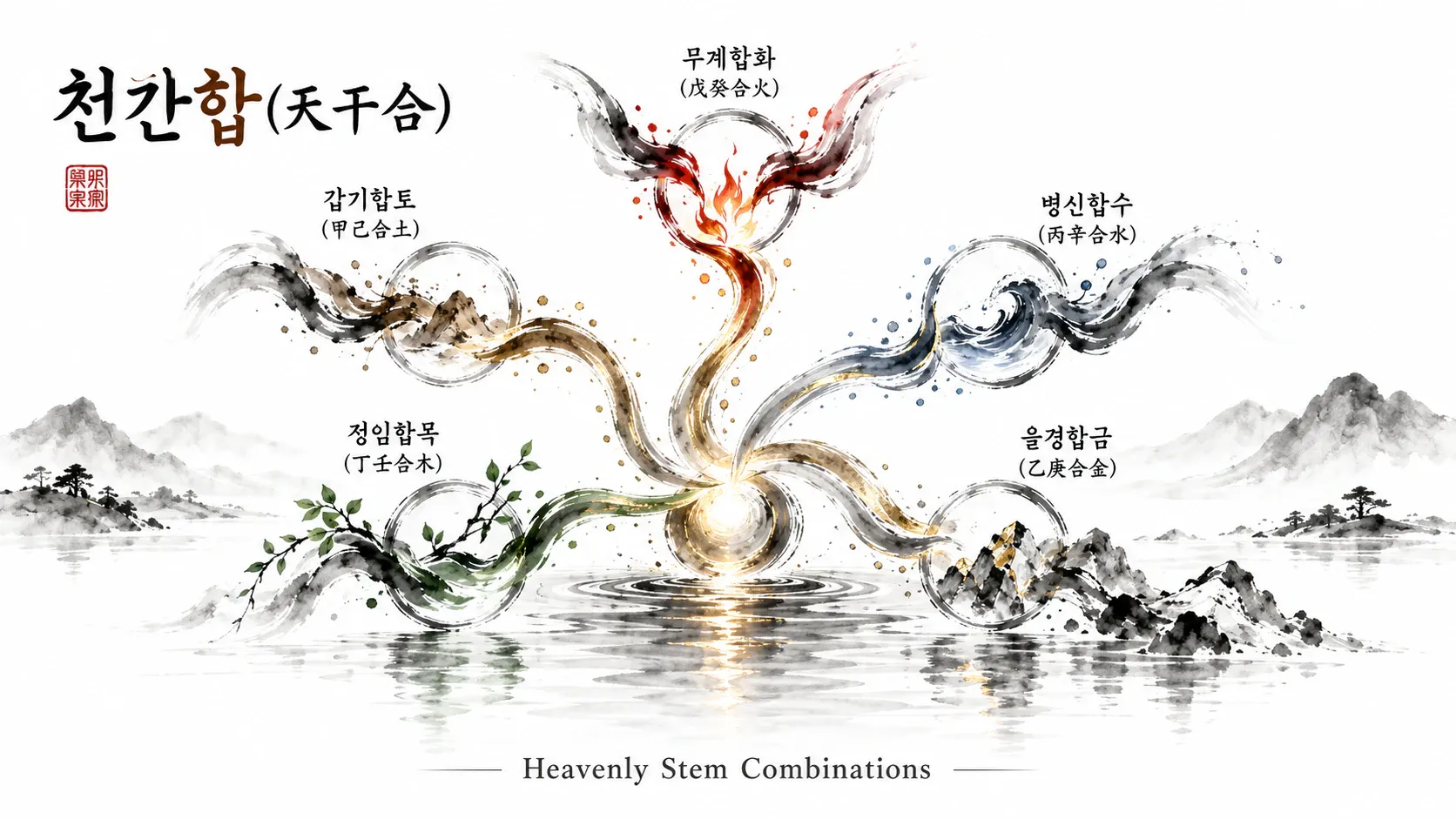
There are five primary combinations, each with its own name and significance. For instance, when Gap meets Gi (the Yin Earth Heavenly Stem), it is known as ‘Gap-Gi Combination,’ which is believed to transform into the energy of the Earth element. This should not be viewed merely as a pairing of characters, but as a process where the inherent energies of each stem unite according to the principles of Yin-Yang and the Five Elements to create a new force. These interactions play a core role in grasping the flow of energy within the entire Four Pillars chart.
Heavenly Stem combinations are based on the principles of the generating cycle (generating cycle) and overcoming cycle (overcoming cycle) of the Five Elements. Each stem holds unique Yin-Yang and Five-Element properties, which compensate for or transform one another upon contact. For example, Gap is Yang Wood, and Gi is Yin Earth. When they meet, they form the Gap-Gi combination, shifting into the energy of the Earth element. This can be interpreted as the Wood and Earth element uniting to strengthen the properties of the Earth element. Crucially, one must consider the harmony of Yin-Yang between the combining stems, not just the change in elements.
Furthermore, these combinations are influenced by the seasons. Each stem represents the energy of a specific season, and the intensity or outcome of a combination can vary depending on that seasonal context. If someone born in summer forms a combination involving Wood energy, it might indicate a complex situation where the Wood energy is either heightened or diminished by the summer heat. Therefore, interpreting these combinations requires a comprehensive analysis that considers the seasonal energy of the stems as well as their relationship with other stems and branches within the chart.
There are five distinct combinations: ‘Gap-Gi (Earth),’ ‘Eul-Gyeong (Metal),’ ‘Byeong-Sin (Water),’ ‘Jeong-Im (Wood),’ and ‘Mu-Gye (Fire).’ Each leads to a transformation into a specific Five Element, representing a new energy distinct from the stems’ original natures. For example, the ‘Eul-Gyeong Combination’ occurs when Eul (Yin Wood) meets Gyeong (the Yang Metal Heavenly Stem) to transform into the energy of the Metal. This can be seen as a process where the flexible nature of Wood transforms into the rigid character of Metal.
Such transformations carry profound weight within an Four Pillars chart. If the Day Master (the stem of the birth day) requires a specific elemental energy and gains it through a combination, it is often viewed as an auspicious event. Conversely, if the combination weakens the Day Master or creates unfavorable energy, it may be interpreted as inauspicious. Identifying the resulting element and its impact on the overall balance of the Four Pillars chart is essential.
The interpretation of a Heavenly Stem combination changes based on its position within the chart. A combination between the Year Stem and the Month Stem may indicate changes related to one’s ancestors, parents, or social environment. Conversely, a combination between the Day Master and the Hour Stem may relate to one’s spouse, children, or destiny in later life. Determining the position is crucial for understanding which area of an individual’s life is being influenced.
Furthermore, the strength of the stems involved and their relationships with other chart elements determine the outcome. If one of the two stems possesses immense strength, the result of the combination will likely be skewed in its favor. If both are weak, the effect may be negligible or easily disrupted by other factors. Analysts must always weigh the combined influence of the stems against the harmony of the entire chart.
A common misconception among beginners is that once a combination occurs, the original properties of the stems vanish entirely, leaving only the new element. In reality, the original properties are not completely erased; rather, they are transformed or augmented by the new energy. For example, in a Gap-Gi combination, the original Wood nature of Gap and the Earth element nature of Gi do not disappear; instead, they function as a complex energy where the Earth element is enhanced or blended with the Wood properties.
Another mistake is to label these combinations as inherently ‘good’ or ‘bad.’ Their impact depends on the overall composition and balance of the Four Pillars chart. A combination that bolsters the Day Master is generally positive, while one that strengthens an element that counters or weakens the Day Master may be negative. Judgments must always be made within the context of the entire chart, considering the Day Master’s needs and the balance of all elements.
1. Identify the type: Determine which of the five combinations is occurring, as each transforms into a unique element.
2. Note the position: Check if it occurs in the Year, Month, Day, or Hour columns to understand the impacted life area.
3. Assess the strength: Evaluate how much power the participating stems wield within the chart.
4. Analyze the Day Master connection: Determine how the newly transformed energy affects the Day Master, the focal point of the Four Pillars.
5. Check broader interactions: Observe if the combination is affected by other stems or branches through Branch clashes or Branch penalty (Branch penalties), as these can complicate or alter the outcome.
We have now covered the basic principles and interpretation methods of Heavenly Stem combinations. They are vital keys to understanding the intricate web of relationships within an Four Pillars chart. By grasping how these unique energies interact and transform, one can read a chart with far greater nuance and see the flow of energy as a coherent picture.
Our next article will address the final topic in our Heavenly Stems series: ‘Heavenly Stem-Earthly Branch Combination’ (Cheonganji-hap). While today’s lesson focused on stem-to-stem interactions, this upcoming session explores the more complex and fascinating mergers between the Heavenly Stems and the Earthly Branches. This will provide a deeper look at how the different dimensions of a chart harmonize or conflict, directly influencing an individual’s destiny. It is the final gate to mastering the Heavenly Stems before we venture into the world of the Earthly Branches.