As the tenth Heavenly Stem, Gye represents a stage of culmination and preparation for a new beginning. While it may appear soft and flexible on the surface, it conceals profound wisdom and the power to embrace transformation. Grasping the essence of Gye is a vital key to understanding the flow of one's entire Four Pillars of Destiny.
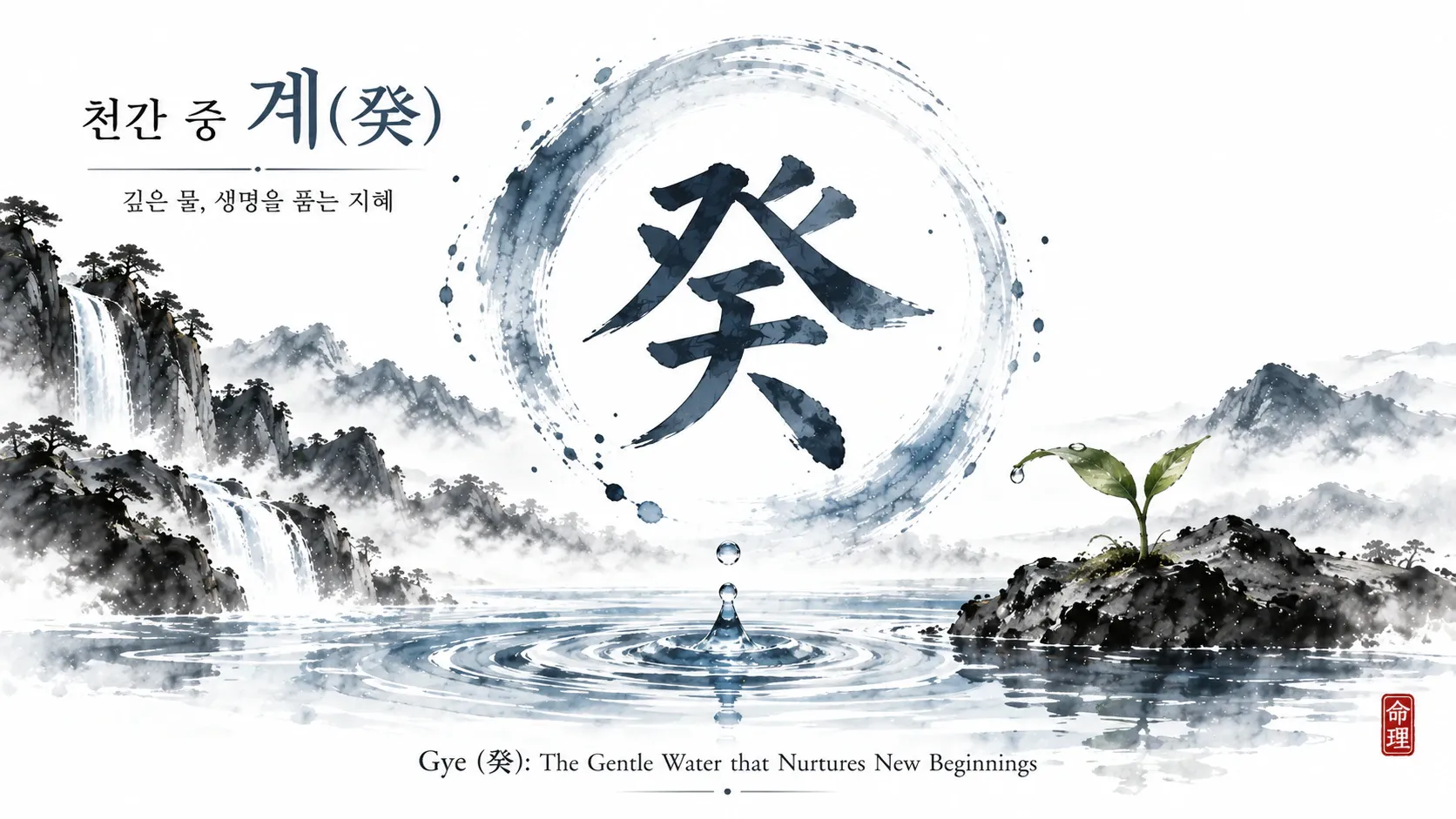
Gye is the tenth Heavenly Stem, marking the stage where all energies conclude and prepare for a fresh start. The character ‘癸’ is traditionally associated with the imagery of a sprout breaking through the earth. This reflects a complex duality: it signifies life force lying dormant within a seed, ready to emerge at the appropriate time, representing both an end and a new beginning. Though it may appear gentle, flexible, or sometimes passive, it holds concentrated potential for growth and change.
This significance of Gye extends beyond mere finality. Instead, it symbolizes a strong will and hidden potential to foster new life when everything appears to be fading. Thus, Gye serves as a crucial clue for exploring the essence and possibilities hidden beneath surface-level phenomena.
Gye possesses Yin energy and corresponds to the Water in the Five Elements. Water represents wisdom, flow, inclusivity, and depth, characterized by a cool and flexible nature. As the Yin Water, Gye internalizes and softly expresses these qualities. Like the deep ocean or a tranquil lake, it may appear calm on the surface, but it contains immeasurable depth, wisdom, and an all-encompassing capacity.
Additionally, Gye embodies the energy of ‘coolness’ and ‘condensation.’ This marks a period when all things reach their deepest state of rest and consolidation, preparing for the next phase. While this nature can sometimes project a sense of melancholy or stagnation, it should be understood as a process of conserving energy and preparing for a new change. The coolness of Gye does not extinguish life but acts as a necessary purification and preparation for the next cycle of life.
If one were to liken Gye to nature, think of cool, deep-night dew, early morning mist, or water from the deep sea. These elements are not overtly visible but are essential for sustaining life, possessing the property of moistening and permeating everything. The energy of Gye moves from top to bottom or converges inward. Much like rain falling or water flowing, it naturally trends downward, soaking and absorbing everything in its path. Furthermore, this inward-tending energy encourages profound reflection and contemplation.
Gye also carries the essence of ‘flow’ and ‘transformation.’ Although it may appear serene, water is constantly in motion and changing shape; similarly, Gye possesses the ability to adapt continuously. This flexibility becomes a strength for finding a path and adapting to new environments even in unpredictable circumstances. Rather than overt strength, Gye symbolizes the resilience and adaptability hidden within softness.
In a Four Pillars, the interpretation of Gye depends on its placement. For instance, if Gye is located in the Day Master, the individual may typically be wise, inclusive, and highly adaptable to change. However, this personality is further refined based on how Gye combines with other Heavenly Stems or Earthly Branches within the Four Pillars. If Gye is accompanied by strong elements (such as Earth or Metal), its qualities may be either accentuated or controlled.
Furthermore, if Gye is positioned in the Month Branch, the energy of that specific month combines with the qualities of Gye to define individual traits and the characteristics of that period. For those born in winter (Hae, Ja, or Chuk), Gye may act as a more natural energy. Its role within the Four Pillars—whether it functions as a useful element (Yong-sin) or supportive element supportive element, or as an unfavorable element unfavorable element—significantly alters its influence and interpretation. Therefore, it is important to consider the overall harmony of the Four Pillars alongside the position of Gye.
Gye exhibits various changes when interacting with other Heavenly Stems. For example, meeting Gap creates a ‘Gye-Gap combination,’ strengthening the Water-Wood energy, which can symbolize the beginning of new life or wise growth. Conversely, meeting Gyeong leads to a ‘Gye-Gyeong clash,’ where Water and Metal energies collide, indicating change or conflict. These interactions of combination and clash are significant factors that can alter, strengthen, or weaken the original nature of Gye.
Its nature also shifts in relation to Earthly Branches. In branches of Water like Hae or Ja, the Water energy of Gye intensifies, potentially enhancing deep wisdom or emotional sensitivity. Conversely, in branches of Fire like O or Sa, the Water energy of Gye is suppressed, causing its qualities to weaken or manifest in different forms. Consequently, the interpretation of Gye must be comprehensive, considering its relationship with surrounding characters.
A common mistake beginners make when interpreting Gye is dismissing it as merely a ‘weak and passive energy.’ While Gye is the Yin Water and thus possesses soft and flexible traits, this is distinct from weakness. Instead, it holds a profound power to embrace all things and drive transformation. Just as water can penetrate rock, there is toughness hidden within its softness.
Another misunderstanding is interpreting Gye solely as ‘the end’ or ‘extinction.’ While Gye certainly symbolizes a conclusion, it is simultaneously a preparatory stage for a new beginning. Just as a seed may appear to rot in the soil while actually gestating new life, Gye is an essential process for the next phase, not a dead end. Therefore, it is vital not to overlook the positive potential and the possibilities for change inherent in Gye.
Gye (癸) Interpretation Checklist
Yin/Yang & Five Elements: Gye is the Yin Water, symbolizing wisdom, inclusivity, change, condensation, and depth.
Nature Imagery: Think of deep water, dew, and mist—essential but unobtrusive elements that sustain life.
Direction of Energy: It possesses a nature of flowing downward or gathering inward, implying flow and potential for change.
Placement in the Four Pillars: Check its position, such as the Day Master or Month Branch, and its combination with other characters.
Combinations and Clashes: Understand the effects of combination and clash when meeting other stems or branches.
Positive Potential: Do not overlook the inner strength and wisdom geared toward growth and transformation, rather than labeling it as weak.
We have now explored up to the tenth Heavenly Stem, Gye. While each stem holds unique properties, they do not exist in isolation within the Four Pillars, but constantly interact with other stems and branches to expand their significance. In our next article, we will examine the ‘Heavenly Stem Combination’ that occurs when these stems meet. The Heavenly Stem Combination is a complex and fascinating phenomenon where characters merge to change their properties and generate new energy, providing a pathway to deeper interpretation of the Four Pillars of Destiny.